Fourstroke
vsSupercaliber
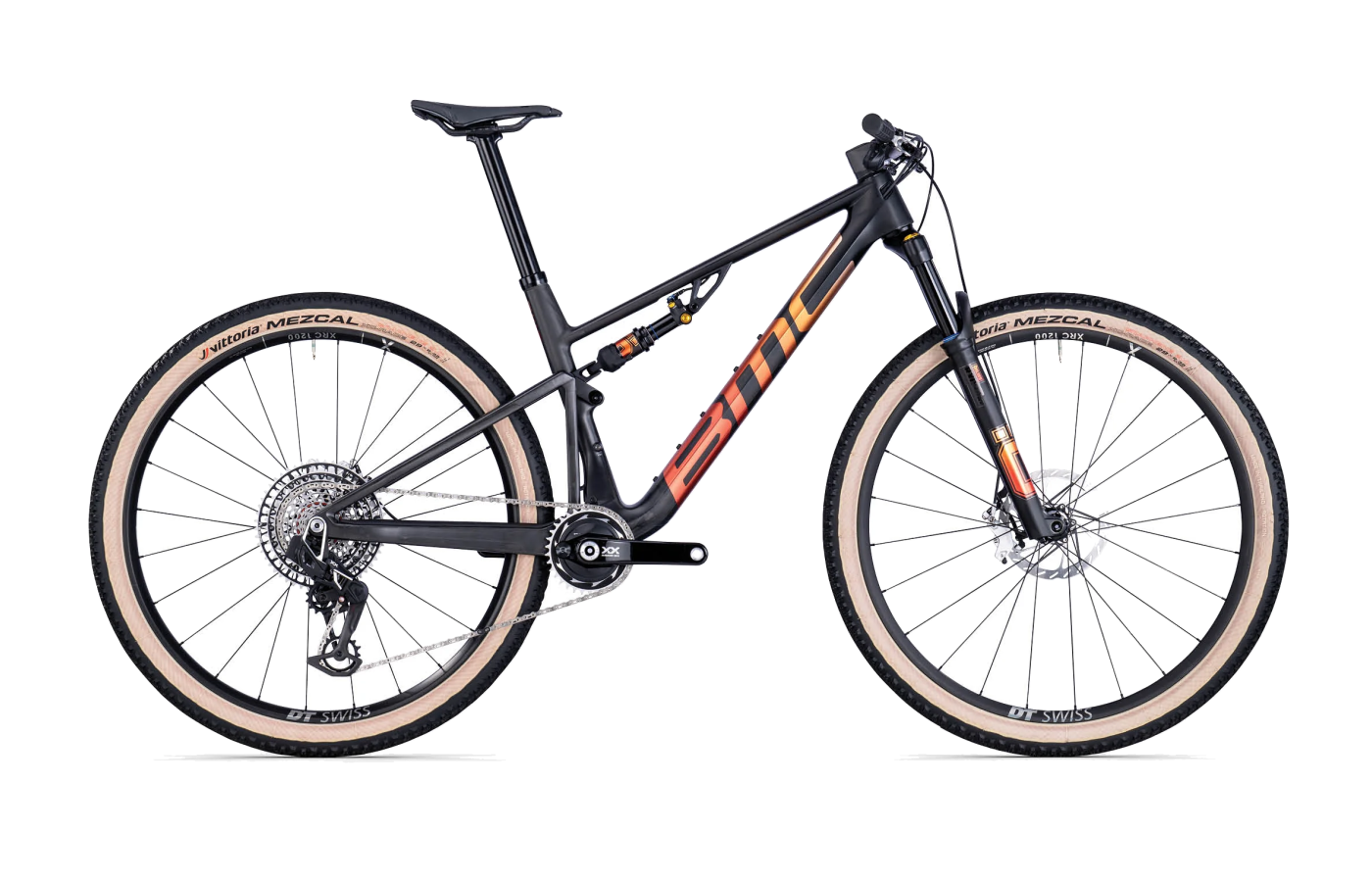
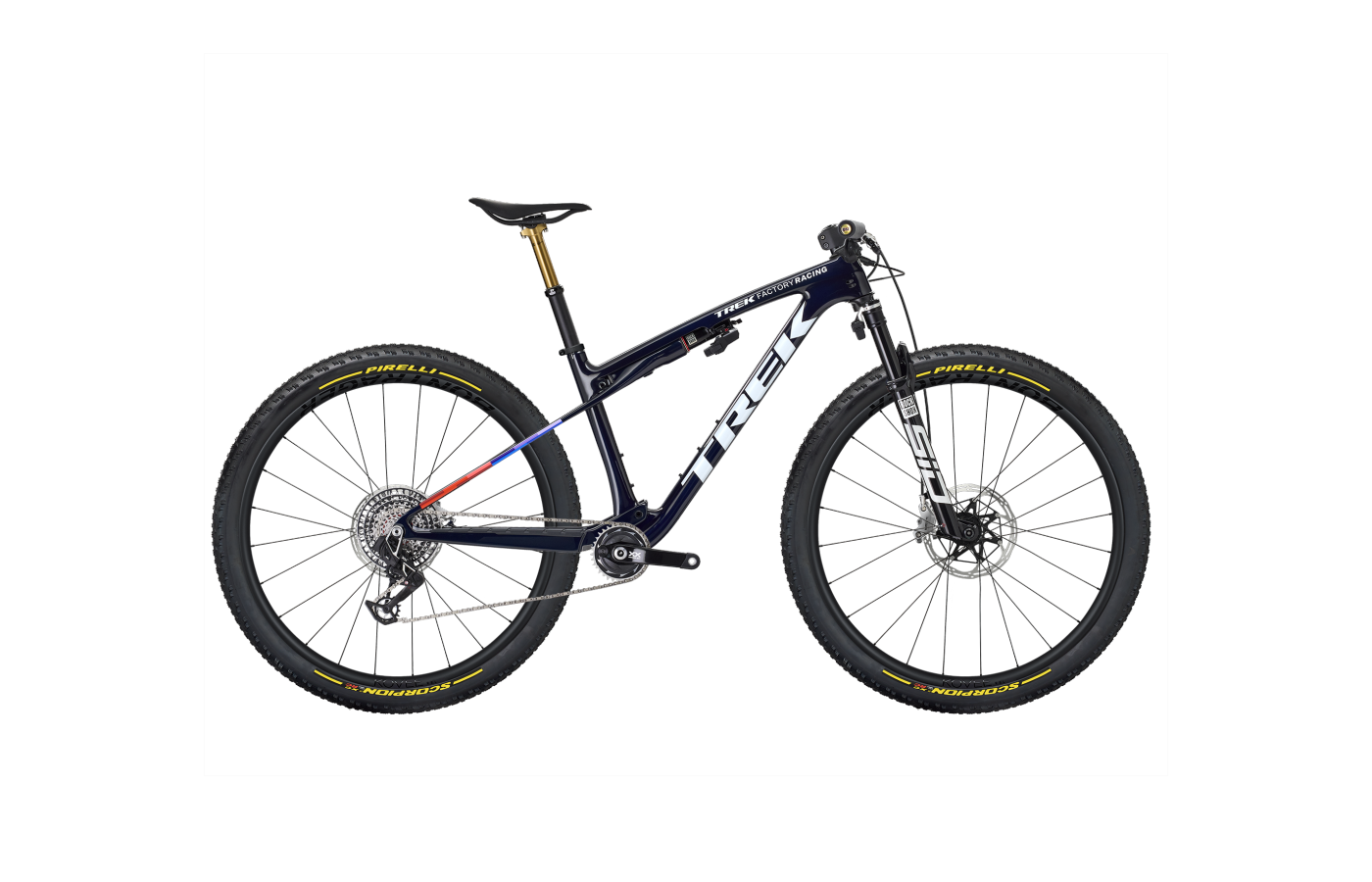
Two XC race bikes, two suspension philosophies.
The Fourstroke bridges race-to-trail with a full dual-link and 100 mm of travel. The Supercaliber chases hardtail efficiency with 80 mm through its structural IsoStrut.
Fourstroke
- More travel front and rear at 100/100 mm — noticeably more compliance than the Trek's 110/80 on chunky terrain.
- Dual-link suspension stays active under power — rear wheel grabs traction on loose climbs where firmer platforms skip.
- Slacker head angle at 66.5° with 115 mm trail — composed on steep descents a pure-XC bike would protest.
- Thin lineup — only two US builds, and a $8,800 gap between them.
- Low 53 mm BB drop means frequent pedal strikes on rocky, technical climbs.
Supercaliber
- Ruthless pedaling efficiency — the IsoStrut's high anti-squat gives the "near-instantaneous response" of a hardtail.
- Dropper post standard on every build, even the $4,799 SL 9.6 — eliminates a near-mandatory upgrade.
- Wide price ladder — 8 builds from $4,799 to $14,999 means a sensible entry point at every budget.
- Only 80 mm rear travel — bottoms out harshly on huck-to-flats and chunky trails.
- IsoStrut needs ~10 hours of break-in to shake its "stubborn" initial feel.
Editor’s analysis
This isn't a travel-number debate — it's a question of how much suspension you actually want noticing between you and the start line.
On paper these sit in the same World Cup XC bracket. Both have won Olympic gold — the Fourstroke under Tom Pidcock in 2021, the Supercaliber under Jolanda Neff in the same Games. Both run 29ers, carbon frames, and one-piece cockpits. But spend ten minutes on the geometry charts and the two philosophies split hard.
The BMC Fourstroke is the dual-link interpretation of an XC bike. 100 mm front and rear through BMC's APS linkage, a slack 66.5° head tube, 431 mm chainstays, and a low bottom bracket — it's built to stay seated and pedal through chop where other XC bikes force you out of the saddle. Reviewers describe it as "wickedly efficient" but still supple enough to glide small bumps. The trade-off is that the 100 mm RockShox SID SL fork on lower builds is frequently "outridden by the frame" on rougher descents — the chassis writes checks the fork can't always cash.
The Trek Supercaliber is the structural shortcut. Instead of a linkage, the IsoStrut lets the rear shock act as a load-bearing member of the frame, giving 80 mm of travel with near-hardtail rigidity. Anti-squat is high enough that the lockout is "superfluous" on most terrain. The Gen 2 slackened the head tube to 67.5°, raised the BB 7 mm to fix pedal strikes, and added a dropper across the entire range. The honest limit: at 80 mm, drops and huck-to-flats can bottom out with a "metallic" sensation — you feel the ceiling.
Put another way: the Fourstroke is what you buy if your race course has rock gardens and you care about staying loose through them. The Supercaliber is what you buy if your race course is Puke Hill and you want the pedaling response of a hardtail without paying for it with your back.
Where the builds differ.
Comparing our editor's-pick builds side-by-side. Winners highlighted row-by-row — lower price and weight, and the better-spec component, each mark a point.
Build variants & pricing
Two very different lineups. BMC offers just two US builds — a $4,699 entry and a $13,499 flagship, nothing between. Trek spreads eight builds across $4,799 to $14,999.
We compare flagships here because BMC's US catalog skips the mid-tier entirely — no GX, no X0, no XT Di2 option on the Fourstroke. If you want a $6–9k Fourstroke build, you don't have one; the Supercaliber gives you four choices in that window. Prices are current US MSRP.
How they fit, how they steer.
Size M on the Fourstroke matches ML on the Supercaliber for a 5'8" rider — similar reach (457 vs 450 mm) and near-identical stack (592 vs 590 mm). The Fourstroke is 1° slacker up front, with a dramatically steeper 75.6° seat tube that puts you 4.6° further forward over the pedals.
Which size should I buy?
Size recommendations based on stack, reach, and effective top tube. Trek's five-size range (S/M/ML/L/XL) gives a finer fit step for riders between traditional sizes.
→These are starting points. Flexibility, riding style, and preferred position all shift the answer — if you’re between sizes, a professional fit beats a chart.
What the magazines said.
Published reviews from trusted cycling outlets. Click through for the full write-up.
Which one should you buy?
If your rides have rocks and roots and you want to pedal through them, get the Fourstroke. If they're fast and flowy and you'd take a hardtail if it didn't hurt so much, get the Supercaliber.
Fourstroke
If your courses and local trails include rock gardens, rooty chutes, and fast but broken descents, the Fourstroke's 100 mm dual-link gives you room to stay seated and stay fast. It climbs like a race bike and descends like a light trail bike — the frame arguably outperforms its category.
Supercaliber
If you ride flat-to-rolling XC, short tracks, or dirt crits and value pedaling response above all else, the IsoStrut delivers what feels closest to a hardtail with a safety net. The lockout often goes unused — the platform is that firm.
Questions buyers actually ask.
Short answers to the things we get emailed about most often.
01Which climbs more efficiently?
The Trek Supercaliber, by a small margin. Its IsoStrut was kinematically tuned for high anti-squat (Trek raised the main pivot 10 mm in Gen 2), so it feels "near-hardtail" under power — reviewers describe standing sprints as "ridiculous urgency."
The BMC Fourstroke is no slouch — its APS linkage is called "wickedly efficient" and its steep 75.6° seat tube puts you hard over the pedals — but its 100 mm rear end does move more under power than the Trek's 80 mm. If your climbs are smooth, Trek wins; if they're technical and you need rear-wheel tracking, the BMC's more active suspension holds traction better.
02Which descends better?
The BMC Fourstroke, meaningfully. It has a slacker head angle (66.5° vs 67.5°), more travel (100 mm vs 80 mm rear), and a lower bottom bracket — all of which add up to a bike that reviewers say "descends like a trail bike."
The Supercaliber Gen 2 is far more capable downhill than Gen 1 — the longer wheelbase and slacker head angle have killed the old "nervous" feel — but 80 mm of rear travel has a hard ceiling. On drops and rough compressions, it can bottom out with a "metallic" sensation. The Fourstroke keeps going where the Supercaliber reminds you it's an XC race bike.
03How does 80 mm of rear travel compare to 100 mm in the real world?
On smooth-to-rolling XC courses, the 20 mm difference is barely noticeable — both bikes take the edge off chatter and stay composed. The gap opens up on chunky terrain. Trek's own reviewers note the Supercaliber is a "sharply focused race tool" that "reminds you it's an XC racer" when you run out of travel.
The Fourstroke's extra 20 mm, plus its dual-link progression, gives it much more bottom-out resistance and a suppler mid-stroke. For a 60-minute XCO lap on a World Cup-style course with rock gardens, the BMC will leave you less beaten up.
04What's the deal with BMC's Autodrop seatpost?
The Autodrop is exclusive to the Fourstroke 01 series and is genuinely clever — it drops without needing the rider's body weight, saving energy on race starts. Reviewers call it "a revelation" and "brilliant."
The catches are real: it only has two positions (fully up or fully down — no infinite adjustment), the air tank needs regular topping off with a high-pressure pump (up to 14 bar / 200 psi), and the proprietary oval seat tube locks you out of aftermarket droppers. Trek sidesteps the whole debate by including a standard infinitely-adjustable dropper on every Supercaliber build.
05Does the IsoStrut really need a break-in period?
Yes, and it's documented. Multiple reviewers (Flow Mountain Bike, Guy Kesteven) reported the IsoStrut felt "stubborn" or "harsh" out of the box, requiring roughly 10 hours of ride time — or a factory top-up of lubrication oil — to reach its intended sensitivity. At least one test bike arrived under-lubed from the factory.
Once bedded in, it's described as "supple" and "fluid" over small bumps. If your new Supercaliber feels dead the first ride, that's expected — keep riding it, or talk to a shop about adding damper oil.
06Can either bike work as a light trail bike?
The Fourstroke can, loosely. Its slack geometry, 100 mm travel, and low center of gravity make it surprisingly capable on trails outside its XC brief — reviewers describe the frame as "outperforming" its fork on descents. If you want more, BMC sells the closely related Fourstroke LT (120/120 mm) on the same chassis.
The Supercaliber is not a trail bike. Trek is explicit about this — it's a "sharply focused race tool." 80 mm of rear travel plus a 32 mm-stanchion SID fork (on most builds) means anything chunky eats into travel fast. For that use case, Trek points you at the 120/120 mm Top Fuel.
07How do the flagship builds compare on spec?
Both flagships run SRAM XX SL Eagle Transmission and carbon one-piece cockpits. Key differences:
BMC R 01 ONE ($13,499, 11.0 kg): Öhlins RXC34 fork and TXC2 shock — boutique Swedish suspension that's rare at this tier. DT Swiss XRC 1200 carbon wheels (30 mm internal). DT Swiss remote lockout.
Trek SLR 9.9 XX Flight Attendant ($14,999, 10.3 kg): RockShox SID SL Ultimate with Flight Attendant — automated electronic suspension adjustment that reads terrain and firms up for climbs on its own. Bontrager Kovee RSL carbon wheels.
The Trek is $1,500 more but lighter and includes auto-adjusting suspension. The BMC is heavier but gets arguably more refined manual damping from Öhlins.
08Why such a huge price gap between the two BMC builds?
BMC's US catalog for the Fourstroke runs just two builds: the 01 THREE at $4,699 (Shimano SLX, RockShox SID SL, alloy DT Swiss X 1900 wheels) and the R 01 ONE at $13,499 (XX SL, Öhlins, DT Swiss XRC 1200 carbon). Nothing in the $6–9k window.
If you want that mid-tier — XT Di2, GX Eagle AXS, X0 T-Type, carbon-wheel builds in the $6–9k range — Trek has four Supercaliber options there (the SL 9.7 GX, SLR 9.8 X0 AXS, SLR 9.8 XT Di2, SLR 9.8 X0 Flight Attendant). On pure build-lineup breadth, the Supercaliber is the more accessible platform.
Similar bikes
If your priorities don’t map cleanly onto either of these, one of these adjacent bikes probably fits better.
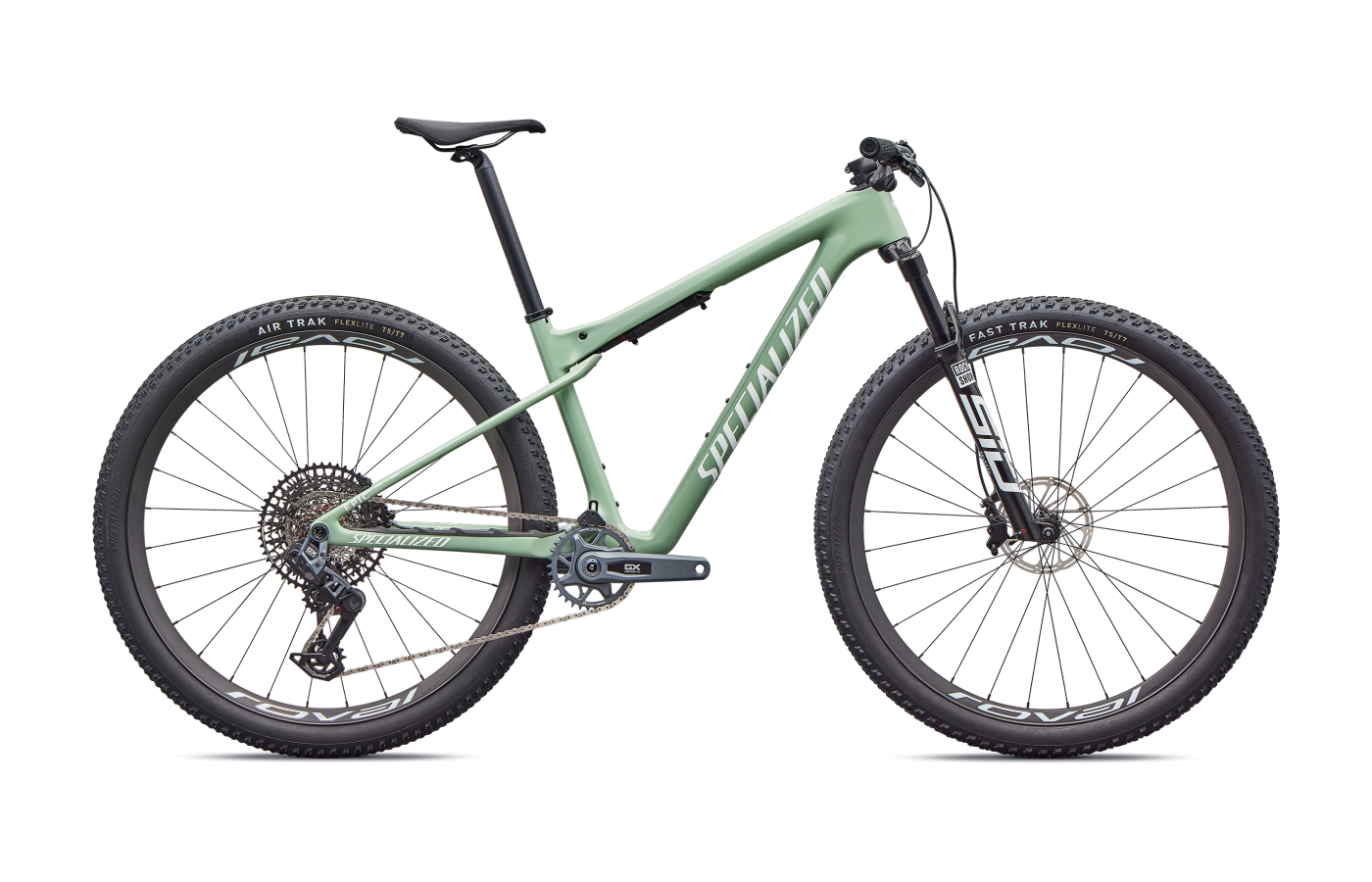
Epic World Cup
The Supercaliber's direct rival — another integrated-shock 75 mm XC bike with no lockout needed, relying on air-spring tuning instead of structural shock placement. If you want the hardtail-efficiency brief with Specialized's fit and ecosystem, start here.
Compare →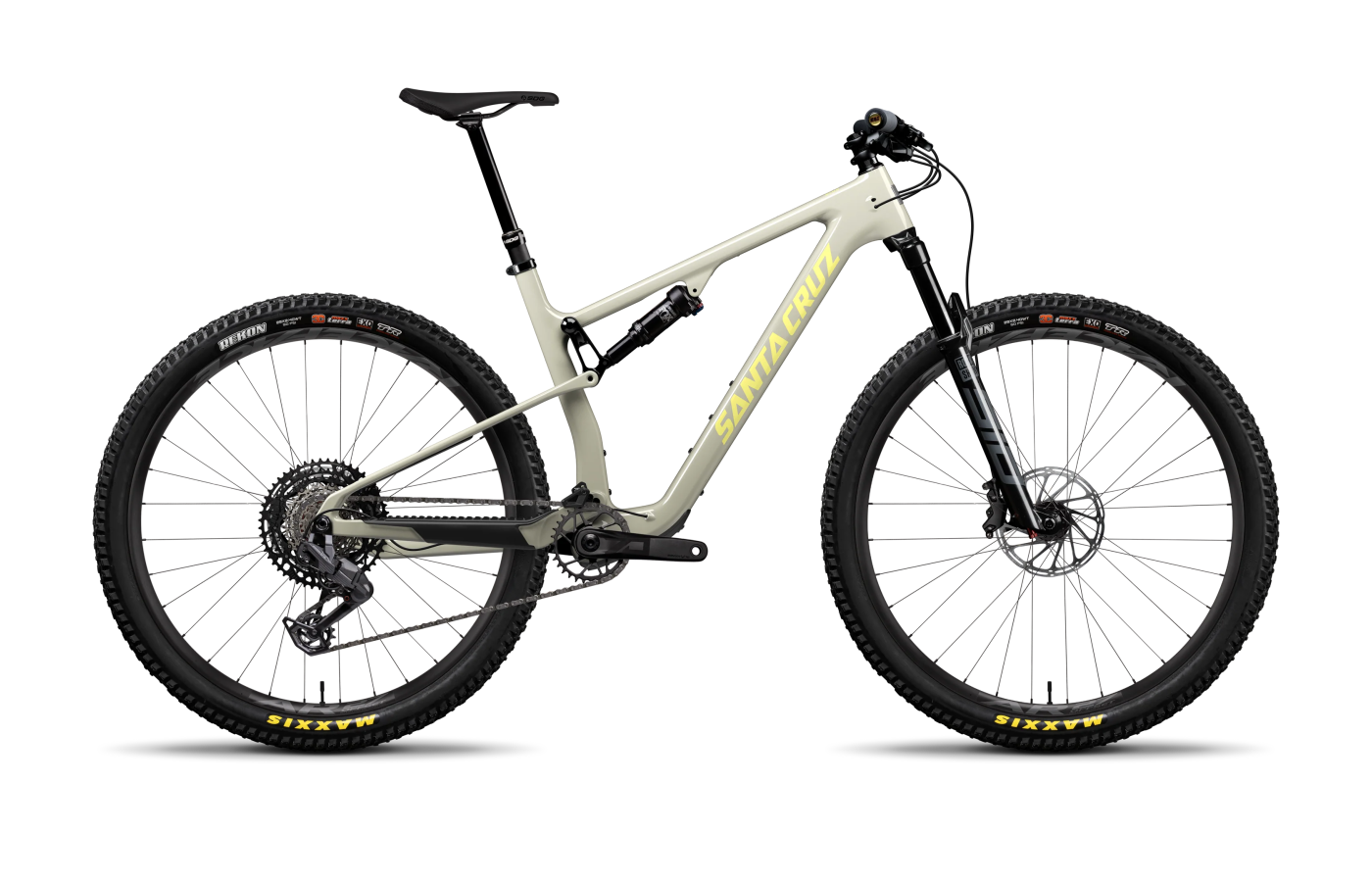
Blur
Santa Cruz's VPP take on XC — similar dual-link character to the Fourstroke with traction-first climbing and a 115 mm rear end. Lifetime bearings and a more forgiving geometry make it the pick if you like BMC's philosophy but want less aggressive race-bike posture.
Compare →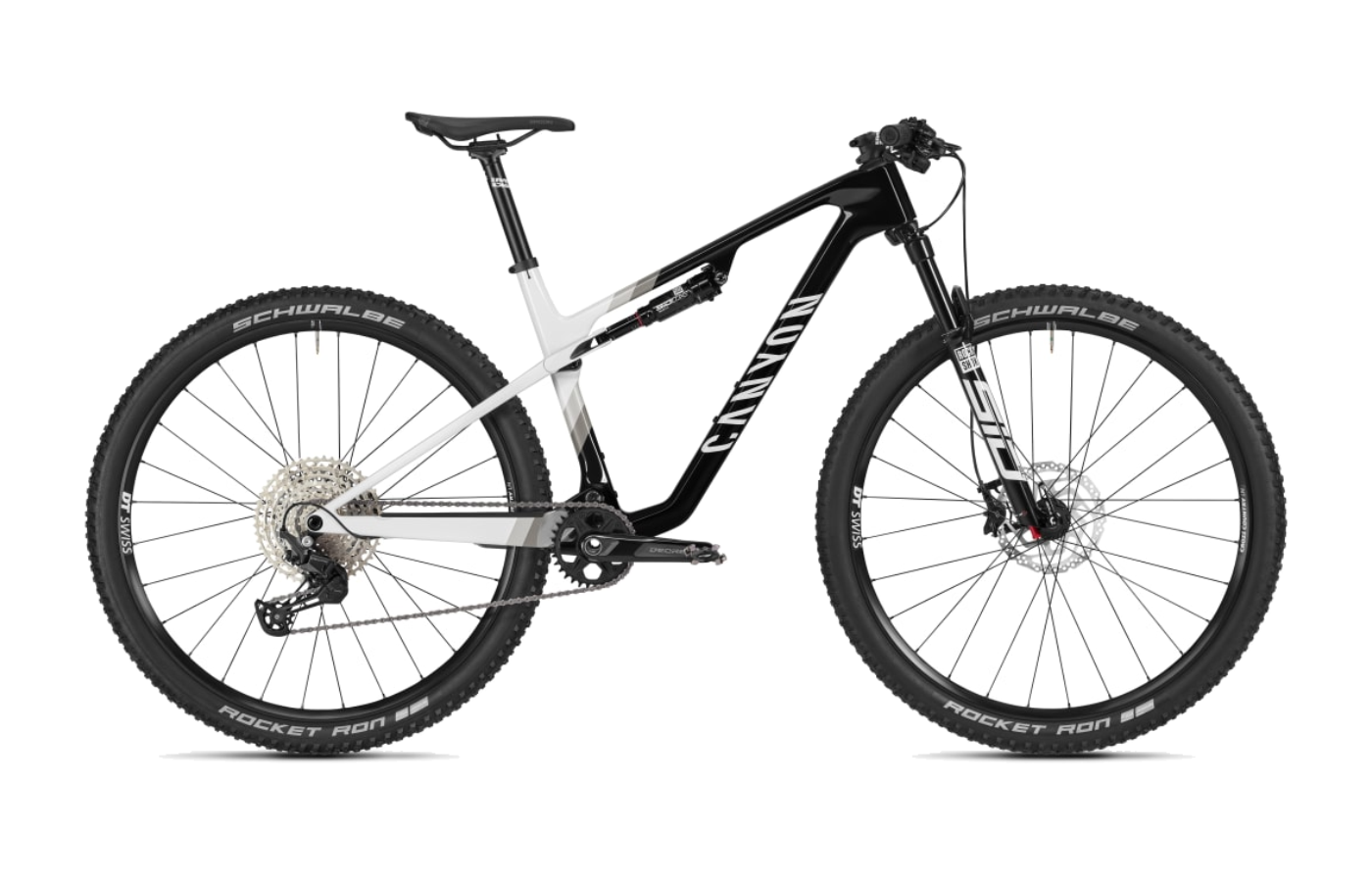
Lux World Cup
Canyon's direct-to-consumer answer to both — a pure 100 mm race bike that often undercuts the BMC and Trek by thousands on spec-for-spec builds. The catch is no local dealer and no demos; best if you know your fit.
Compare →