Cutthroat
vsWarbird
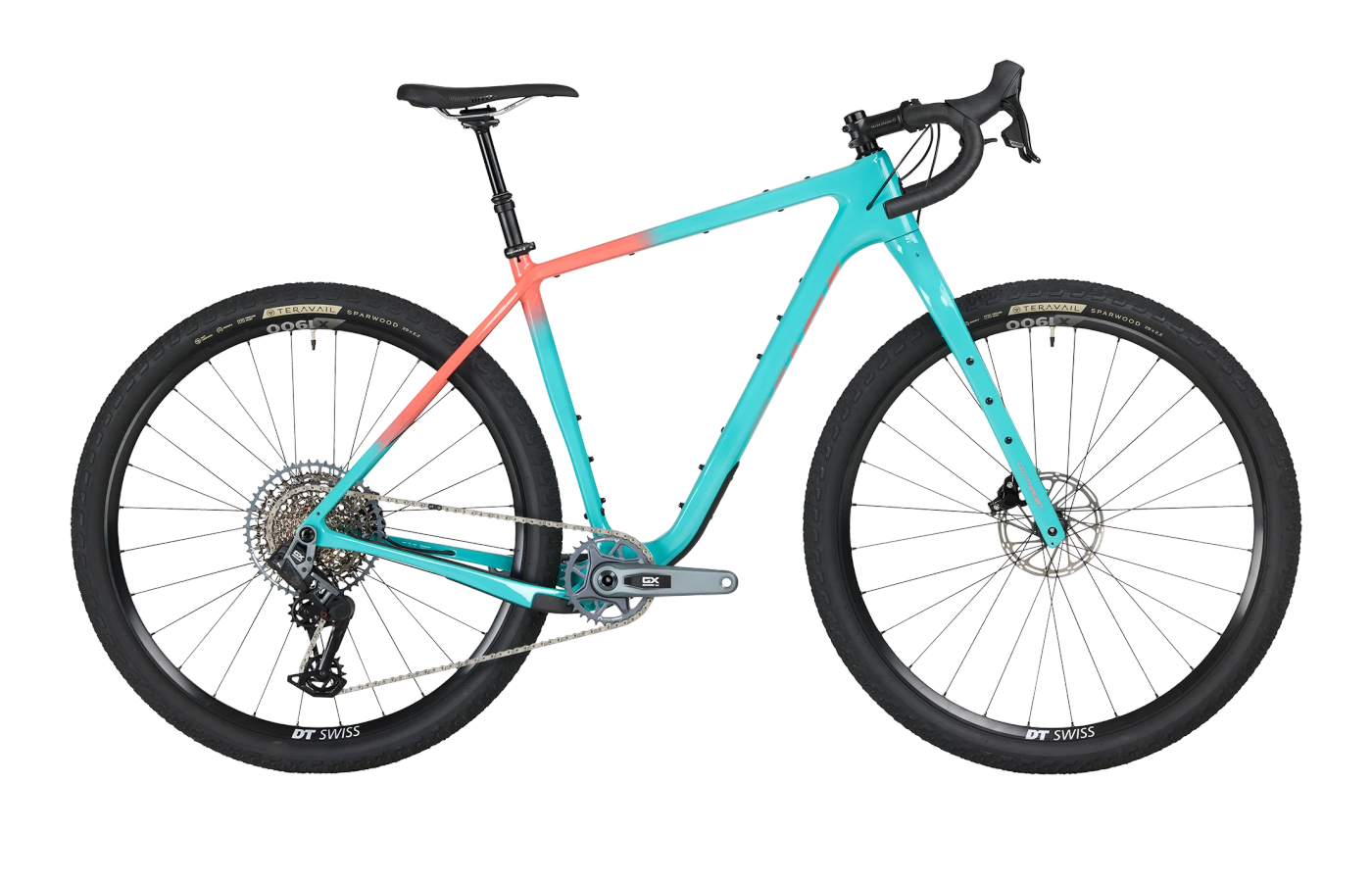
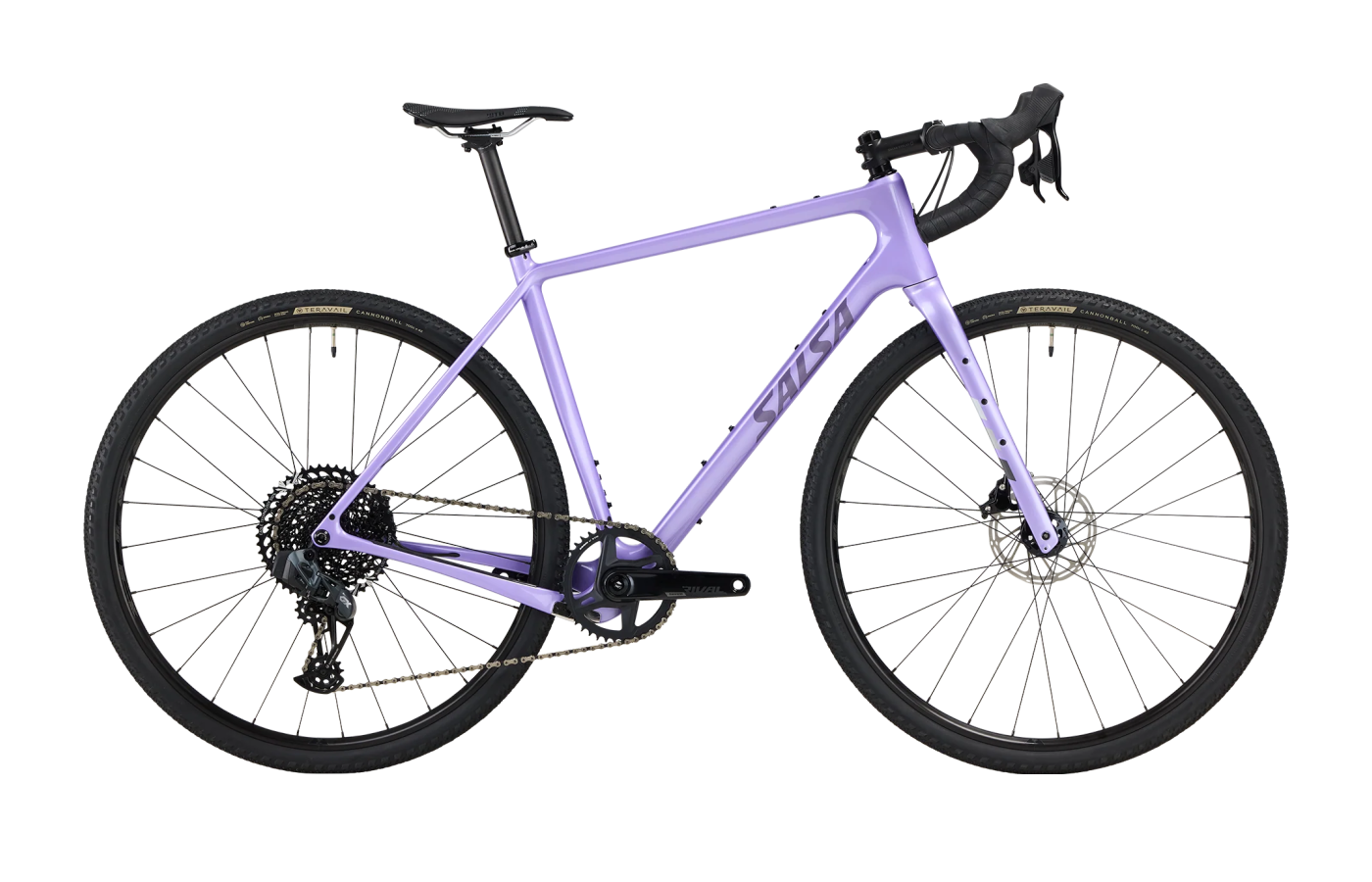
Two Salsas, two definitions of gravel.
The Cutthroat is a drop-bar 29er built for the Tour Divide. The Warbird is the original American gravel racer, built to hold a paceline on crushed limestone.
Cutthroat
- Massive tire clearance — 29 x 2.4" officially, some reviewers fit 2.8" in the fork. A category-of-one for drop-bar rigs.
- Suspension-corrected fork — swap in a 100 mm 29er fork without breaking the geometry. Real upgrade path into aggressive terrain.
- Purpose-built bikepacking frame — 20+ mounts, bolt-on direct-mount frame bag, three-pack mounts on each fork leg.
- Long wheelbase and slack front end make tight, low-speed corners a chore.
- Upright stack and slower steering cost you speed on smooth tarmac — the Warbird feels quicker everywhere the surface is clean.
Warbird
- Race-tuned geometry — 70.75-degree head angle, 430 mm chainstays, the gravel equivalent of a pure race posture.
- Light and lively — the top build comes in at 19 lb 1 oz (56 cm), notably quicker-accelerating than the Cutthroat on rolling terrain.
- Dual-wheel compatibility — runs 700c x 45 mm or 650b x 2.1" tires, so you can tune it for fast gravel or plusher mixed-surface days.
- 45 mm tire ceiling — not the bike for chunky singletrack or anything the Cutthroat is designed around.
- Stock component specs draw consistent criticism at the higher price points — most reviewers recommend buying the frameset and building it up.
Editor’s analysis
Same brand, same VRS seatstays, same Cowchipper/Cowbell cockpits — and almost nothing else in common once the road tilts up or the surface gets rough.
The Salsa Cutthroat was designed around one event: the Tour Divide, 2,745 miles from Banff to the Mexican border. Its starting points are a 69-degree head tube angle, 445 mm chainstays, a 1,090 mm wheelbase at 56 cm, and clearance for 29 x 2.4" tires. Reviewers keep reaching for the same phrase — "drop-bar cross-country MTB" — and they're not wrong. It's suspension-corrected for a 100 mm fork, the carbon fork claims 32% more compliance than the previous generation, and the geometry rewards you for riding over obstacles instead of around them.
The Salsa Warbird was designed around a different event: Unbound Gravel, Kanza, American-style fast gravel on long, straight, chunky roads. It runs a 70.75-degree head tube, 430 mm chainstays, a 1,038 mm wheelbase at 56 cm, and tops out at 45 mm tires. Same Class 5 VRS story in the rear triangle — tall, thin, outwardly bowed seatstays flexing vertically — but the rest of the bike is tuned for speed and line-holding on repeatable gravel, not for surviving week-long expeditions.
The spec sheets tell the same story. The Cutthroat's top build runs a Road Boost drivetrain — Force AXS levers driving an X0 Eagle Transmission with a 34T chainring and mountain-bike cassette — a proper crawler gear for grinding up a loaded fire-road pitch at 40 rpm. The Warbird tops out with Force AXS Wide, a 43/30T road double: tighter jumps, higher top-end, the gearing of a bike whose rider expects to be spinning 90+ rpm in a pack. One bike assumes you're carrying dry bags and four bottles; the other assumes you're racing on an empty frame.
Put plainly: the Cutthroat is the bike you buy if your longest ride this year will be on a route map, not a closed course. The Warbird is the bike you buy if your gravel calendar has start times.
Where the builds differ.
Comparing our editor's-pick builds side-by-side. Winners highlighted row-by-row — lower price and weight, and the better-spec component, each mark a point.
Build variants & pricing
Warbird range is deeper and starts cheaper ($2,799 GRX 600 1x). Cutthroat starts at $3,499 and tops out higher — $7,999 for the Force XO Transmission flagship.
Both platforms use SRAM's road-levers-plus-mountain-drivetrain combo at the higher builds, but the Cutthroat leans harder into the MTB side (X0 Eagle Transmission, 29x2.2" Teravail Sparwoods stock) while the Warbird keeps a road DNA (Force AXS Wide 43/30T option, 700c x 42 mm Cannonballs). Tier-match your pick accordingly.
How they fit, how they steer.
Both at 56 cm. The Cutthroat sits 34.7 mm taller in stack (619.5 vs 584.9) with 4 mm more reach — a meaningfully more upright, more MTB-like front end. Head tube 1.75 degrees slacker, chainstays 15 mm longer, wheelbase 52 mm longer.
Which size should I buy?
Sizing suggestions based on stack, reach, and effective top tube. Both bikes offer five to seven sizes; confirm standover if you're near a size break — the Cutthroat runs noticeably taller.
→These are starting points. Flexibility, riding style, and preferred position all shift the answer — if you’re between sizes, a professional fit beats a chart.
What the magazines said.
Published reviews from trusted cycling outlets. Click through for the full write-up.
Which one should you buy?
If your rides are measured in days and the route includes singletrack, get the Cutthroat. If your rides are measured in hours and start with a mass roll-out, get the Warbird.
Cutthroat
If the Tour Divide, the Baja Divide, or a week of remote Cascades singletrack is on your calendar, this is the bike. The massive tire clearance, suspension-corrected fork, and 20-plus mounts are tools you'll actually use. Accept the slower steering and you get a platform nothing else in the drop-bar world really matches.
Warbird
If your year has start times and your rides are measured by watts held for three hours, the Warbird is the sharper tool. Lighter, lower, quicker to respond — a classic American gravel-race geometry refined across four generations. Stay on gravel and road, avoid the chunky stuff, and it'll keep you in the front group.
Questions buyers actually ask.
Short answers to the things we get emailed about most often.
01What's the tire clearance difference?
Cutthroat: 29 x 2.4" officially — roughly 61 mm of measured clearance. A handful of reviewers report fitting 2.8" tires in the fork.
Warbird: 700c x 45 mm, or 650b x 2.1" on the smaller-wheel setup. Roughly 45 mm of measured clearance.
That 15–20 mm gap is the single biggest difference between these bikes. It's the line between "gravel bike" and "drop-bar XC bike."
02Which is faster on smooth gravel and road?
The Warbird, not close. Its top build comes in at 19 lb 1 oz (56 cm) vs the Cutthroat's 23 lb 13 oz — roughly 4.5 lb between comparable Rival-tier builds. The head tube is 1.75 degrees steeper, the reach is longer-and-lower, and the tires roll faster. Reviewers consistently call the Warbird "lively and quick" on tarmac; the Cutthroat is described as "prefers taking things easy when you accelerate."
If more than half your riding is on maintained roads, the Warbird is the right bike.
03Which handles technical terrain better?
The Cutthroat, by a wide margin. The slack 69-degree head angle, long 445 mm chainstays, 29 x 2.2" stock tires, and suspension-corrected fork give it real singletrack capability. Bikepacking.com's reviewer reported popping over eight-to-twelve-inch logs "as well as any rigid XC racer."
The Warbird has gotten more capable in v4 — slacker geometry, more stable at speed — but its 45 mm tire ceiling puts a hard limit on what it'll absorb. Reviewers describe it as a gravel bike that dabbles in singletrack, not a bike that's at home there.
04What's the deal with "Road Boost"?
Road Boost is Salsa's name for running mountain-bike hub spacing (110x15 mm front, 148x12 mm rear) on a drop-bar bike. It lets the Cutthroat share wheels and drivetrain parts with a 29er hardtail — including direct-mount MTB derailleurs and full-size MTB cassettes (like the 10-52T paired with a 34T chainring on the top build).
The Warbird uses standard road boost (100x12 front / 142x12 rear) and road-style drivetrains, so its wheel options and drivetrains don't cross over with mountain bikes.
05Can I take the Warbird bikepacking?
Yes — it has rack mounts, fender mounts, three bottle mounts on larger sizes, toptube and downtube accessory mounts, and triple fork mounts. Reviewers like Bikepacking.com have taken the 650b build on multi-day trips and found it comfortable.
But the Cutthroat is purpose-built for it. The direct-mount frame bag alone — bolts straight to the frame without straps — is a feature the Warbird can't match. If bikepacking is the primary use case, the Cutthroat is the answer. If it's an occasional use case, the Warbird is enough.
06Which has better value on the complete bikes?
Neither is the value pick of the gravel segment, and reviewers flag both for component compromises at their price points. On the Warbird specifically, Cycling Weekly and BikeRadar independently called out "stingy" spec choices — alloy steerers, lower-spec hubs, mid-tier brakes on bikes over $3,000. Cycling Weekly's explicit advice was "buy the frameset for $2,199 and build it how you like."
The Cutthroat runs into the same issue at the mid-range: narrower rims, house-brand parts. Carbon wheels and better contact points don't show up until the Force-tier builds.
07What about the press-fit bottom bracket?
Both bikes use a BB92 press-fit bottom bracket, and yes, several reviewers flag it as a durability concern — Road.cc, Bicycling, and GearJunkie all noted the general reputation for creaking and harder serviceability.
In practice, Bikepacking.com's reviewer logged 1,400+ miles on the Cutthroat V1 and additional testing on the V2 with no issues. Salsa defends the choice for tire clearance and chainstay length gains. A real concern worth knowing about, but rarely a dealbreaker.
08Is the Cutthroat's upright fit really that much more relaxed?
At size 56, the Cutthroat has 34.7 mm more stack than the Warbird (619.5 vs 584.9 mm) with nearly identical reach. That's the difference between a classic endurance-gravel posture and an almost-MTB upright position.
If you have back or neck issues, or you just prefer seeing the road over your stem instead of down your arms, the Cutthroat is the clear winner. If you want to tuck into a paceline, the Warbird fits the job description.
Similar bikes
If your priorities don’t map cleanly onto either of these, one of these adjacent bikes probably fits better.

Fargo
Still in-house at Salsa, the Fargo trades carbon for steel and adds even more upright geometry — the touring-chair cousin to the Cutthroat. Heavier, cheaper, and indestructible.
Compare →Grizl
Canyon's answer to the Warbird category — a direct-to-consumer carbon gravel race bike at meaningfully lower prices, with more tire clearance. The trade: no dealer network, no demo, and you need to know your fit.
Compare →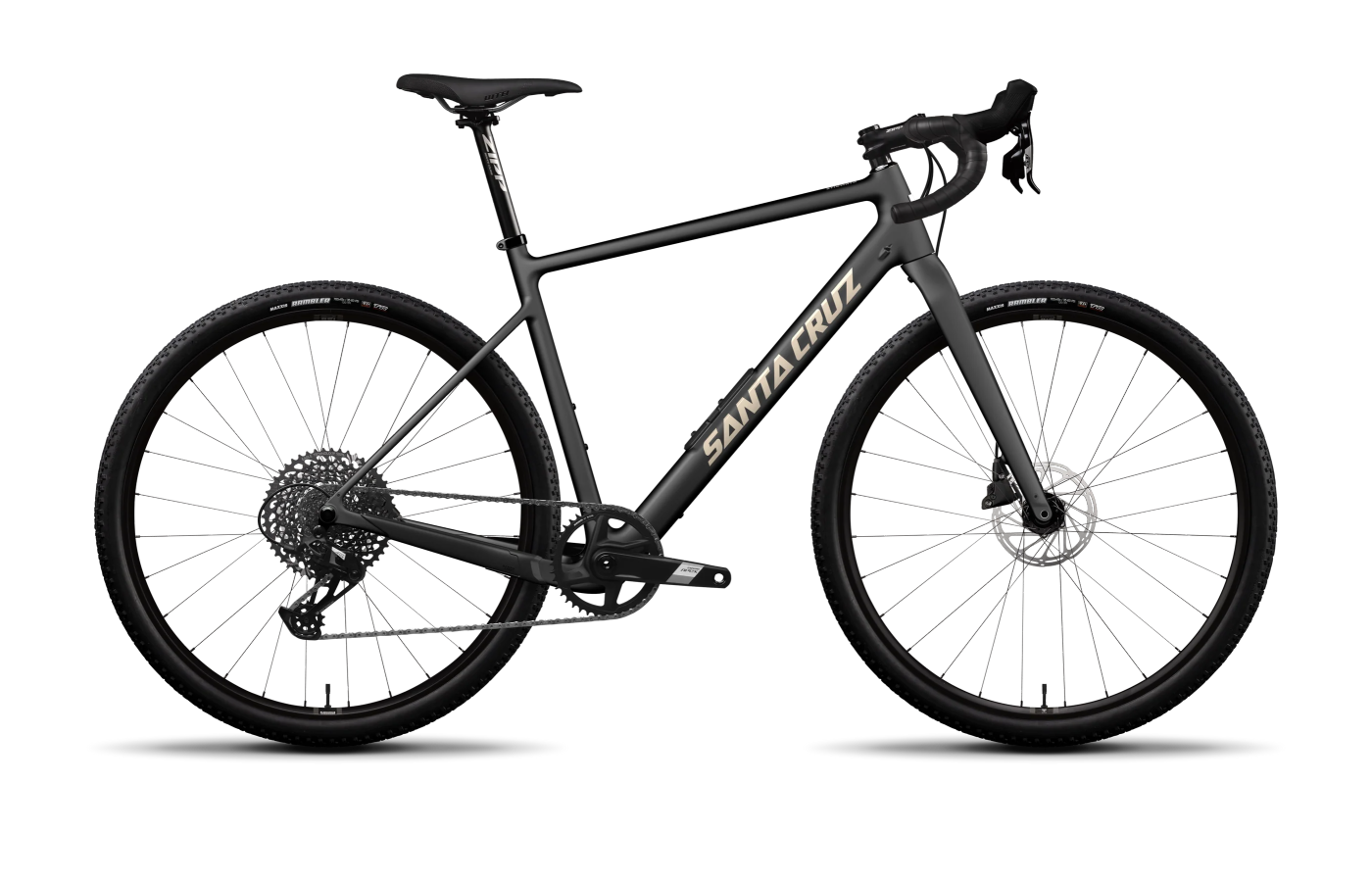
Stigmata
Santa Cruz's race-gravel platform with an MTB-influenced front end — more capable than the Warbird when the route gets technical, while staying within the light, racy gravel bracket.
Compare →