Slayer
vsEnduro
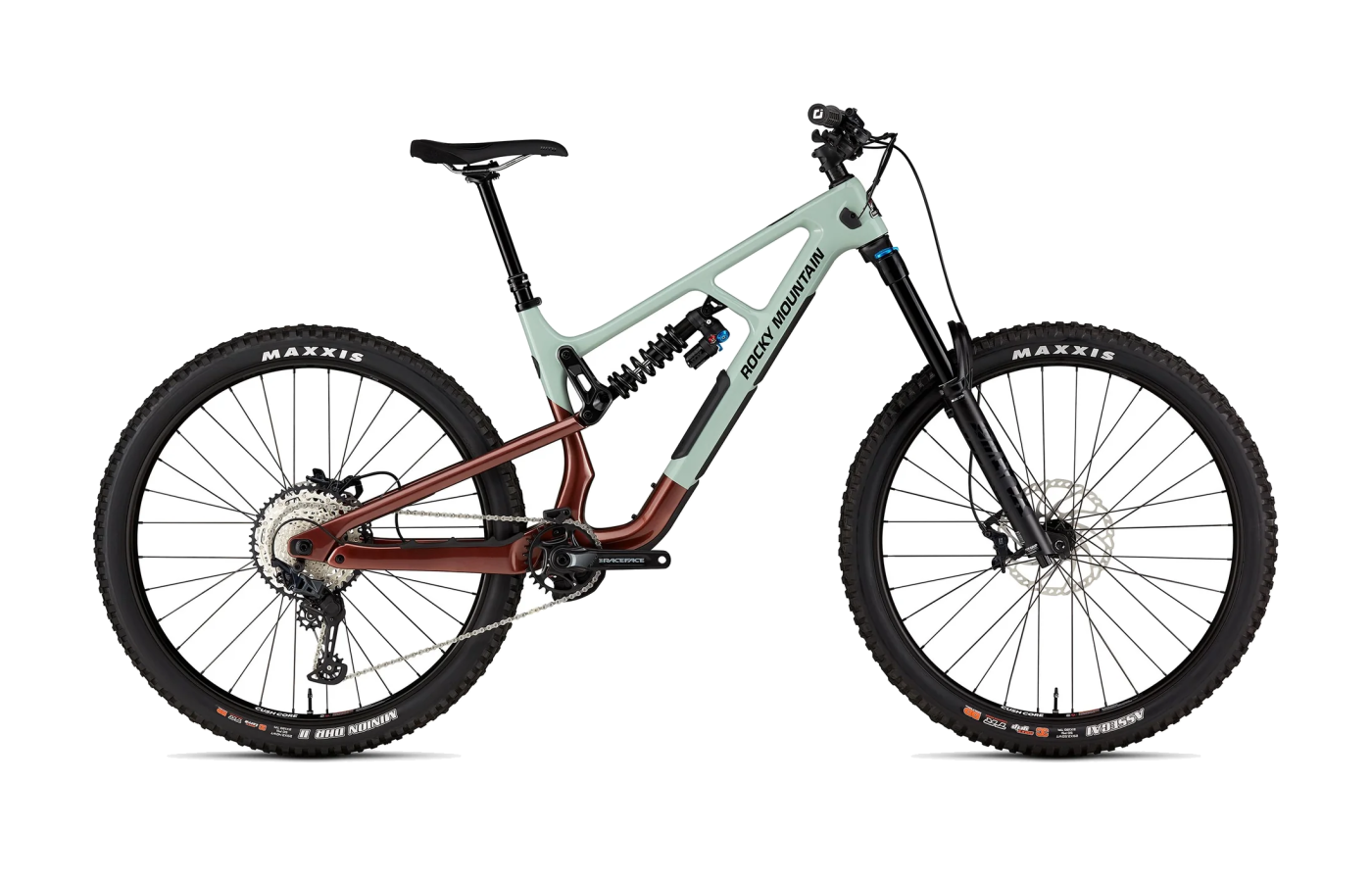
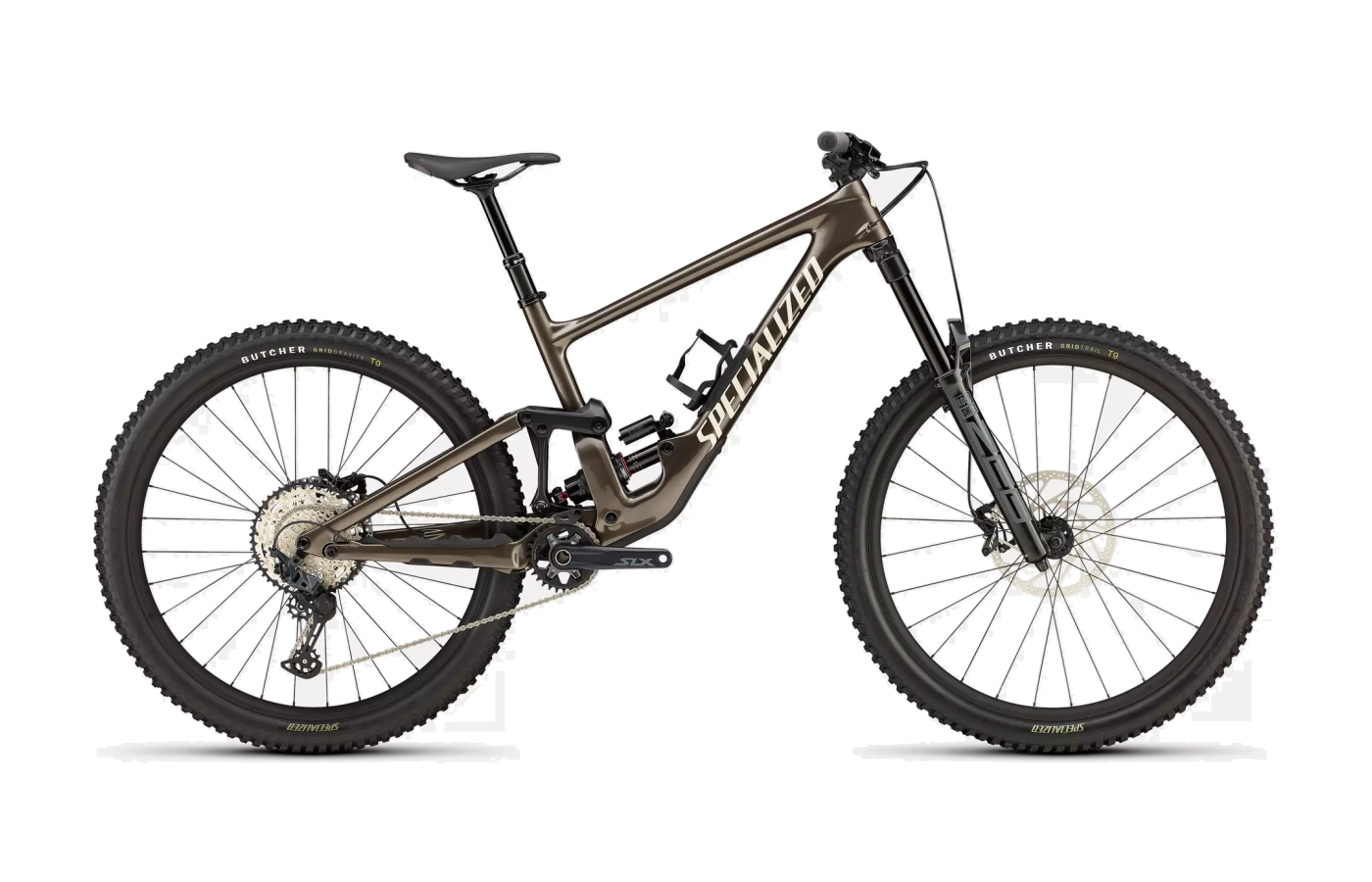
Freeride bruiser meets mini-DH racer.
The Slayer is 180 mm of coil-sprung monster truck built for the bike park. The Enduro is a carbon-only racing tool that shrinks a Demo DH bike into something you can still pedal uphill.
Slayer
- More travel — 180 mm front and rear vs. the Enduro's 170 mm, with a coil shock stock on every build.
- Adjustable geometry — RIDE-4 flip chip plus a 10 mm chainstay adjustment (440/450 mm) tunes the bike from plow to playful.
- Alloy option starting at $4,599 — the only way into this platform under five grand, and a dual-crown Park edition exists.
- Stock coil tune runs soft — reviewers repeatedly note a lack of mid-stroke support until you swap springs or dampers.
- Frequently called noisy — cable rattle and the Penalty Box lid come up in nearly every long-term review.
Enduro
- Momentum-carrying kinematics — the Demo-derived rearward axle path makes it "just not slow down" through square-edged hits.
- Climbs well for 170 mm — 40% more anti-squat than the prior generation and a 76° seat tube angle make it pedal like a shorter-travel bike.
- SWAT box storage and a threaded bottom bracket — practical wins that Specialized gets right across the range.
- Carbon-only from $4,999 up — no alloy option, no sub-$5k entry point.
- 2020–2021 frames had a documented headset-cracking issue; Specialized warrantied them, but it's worth checking on used bikes.
Editor’s analysis
Both bikes send bigger than they should — but one absorbs the trail, and the other erases it.
On the surface, the Rocky Mountain Slayer and the Specialized Enduro sit in the same gravity-biased 170-plus bracket. Both are long, slack, carbon-optional-only (in the Enduro's case), and built to be the biggest bike in the rider's garage. But the philosophies diverge the moment you touch them. The Slayer runs 180 mm front and rear, a coil shock as standard, and a 62.5° head tube angle that's essentially DH-bike territory. The Enduro runs 170 mm, an air shock, and a 64.3° head tube — still slack, but held back from going full downhill.
The Slayer leans into plushness. Reviewers across the board describe it as "gooey," "bottomless," and a "monster truck" on steep, chunky fall-line terrain. The RIDE-4 flip chip and 10 mm chainstay adjustment give it range, and a dual-crown-compatible Park edition exists for lift-fed days. The trade-off is honest: the stock coil tune is often called "soft" and "dead" on rollers — on mellower trails the Slayer feels "sluggish and floppy" until speed picks up.
The Specialized Enduro plays a different game. Its Demo-derived kinematics push the rear axle rearward through the initial stroke, carrying momentum through square-edged hits in a way reviewers call "cheating." Anti-squat is up 40% over the previous generation, which is why a 170 mm bike climbs "surprisingly well." It's stiffer, more precise, and more playful than the Slayer — but that also means mellower trails can feel "boring," and the pre-2022 headset-cracking issue is worth knowing about if you're shopping used.
Put simply: the Slayer is the bike you buy when the climb is just the cost of admission to a Whistler-style descent. The Specialized Enduro is the bike you buy when you want to race the way down — and still self-shuttle to the top.
Where the builds differ.
Comparing our editor's-pick builds side-by-side. Winners highlighted row-by-row — lower price and weight, and the better-spec component, each mark a point.
Build variants & pricing
Both platforms overlap in the $5–8k bracket. The Slayer scales both lower (alloy from $4,599) and higher (Carbon 90 at $10,299); the Enduro is carbon-only with just two builds.
Prices are current US MSRP. The Enduro's lineup is unusually narrow — just Comp and Pro — so the tier-matched editor's picks here land at different price points ($6,299 vs. $4,999). The Slayer Carbon 50 also exists in a GX Eagle variant at the same price if you prefer SRAM.
How they fit, how they steer.
The fit algorithm picks a size lg Slayer and an S2 Enduro for the same rider — their sizing conventions diverge. The Slayer is 1.8° slacker (62.5° vs 64.3°), 37 mm longer in reach, and 64 mm longer in wheelbase. The Enduro is the more compact, steeper-steering bike; the Slayer is the plow.
Which size should I buy?
Size recommendations based on stack, reach, and effective top tube. Note the Enduro uses Specialized's S-sizing (S2–S5) where reach is decoupled from seat tube — pick by reach, not by rider height.
→These are starting points. Flexibility, riding style, and preferred position all shift the answer — if you’re between sizes, a professional fit beats a chart.
What the magazines said.
Published reviews from trusted cycling outlets. Click through for the full write-up.
Which one should you buy?
If your season revolves around bike park laps and fall-line steeps, get the Slayer. If you race enduro and want a 170 mm bike that still climbs, get the Enduro.
Slayer
If you live for chairlift days, huck-to-flat landings, and 50-foot gap jumps, this is the bike. The 180 mm of travel and 62.5° head angle turn rock gardens into "cakewalks" — at the cost of being sluggish on flatter trails and often wanting a firmer shock tune out of the box.
Enduro
If you want a 170 mm carbon race weapon that climbs like a shorter-travel bike and carries speed through chunder like a downhill rig, this is it. It rewards aggressive riding and steep trails — and can feel "boring" on mellower flow where its ground-hugging nature works against you.
Questions buyers actually ask.
Short answers to the things we get emailed about most often.
01Which has more travel?
The Rocky Mountain Slayer — 180 mm front and rear vs. the Enduro's 170 mm front and rear. That extra 10 mm is consistent with the Slayer's freeride positioning: Rocky Mountain even offers a Park edition with a 200 mm dual-crown fork, whereas the Enduro tops out at the 170 mm single-crown spec across all builds.
In practice, reviewers describe the Slayer as feeling "bottomless" on big hits, while the Enduro feels more precise and playful for its travel.
02Which climbs better?
The Specialized Enduro, notably. Specialized increased anti-squat by 40% over the previous Enduro, and reviewers consistently report being "blown away" by how well a 170 mm bike pedals. Bike Magazine went as far as calling it "the first Specialized FSR ever made that can genuinely be ridden uphill without requiring a lockout."
The Slayer, by contrast, is a "slow burner." Its Smoothlink suspension with the stock coil shock bobs noticeably unless you engage the climb switch, and Mountain Bike Action explicitly noted that "the suspension just isn't supportive enough to be efficient on the climbs." For most riders, climbing on the Slayer is the cost of admission rather than part of the fun.
03Which is more playful or agile on mellower trails?
Neither is built for mellow singletrack, but the Enduro is the more agile of the two. The Slayer's 62.5° head tube angle, 1,281 mm size-L wheelbase, and plush coil feel get described as "sluggish and floppy" below higher speeds — it wants to be pointed downhill at pace.
The Enduro's 64.3° head tube and shorter 1,217 mm S2 wheelbase make it quicker in corners, and the air-sprung stock shock gives it "pop" that reviewers like Pinkbike's Mike Kazimer contrast favorably with the Slayer's ground-hugging character. That said, several Enduro testers still noted it can feel "boring" on truly flat flow trails.
04What's the difference in geometry between the editor's-pick sizes?
At the fit-picked sizes — Slayer lg and Enduro S2 — the Slayer is the longer, slacker, more stable bike: 62.5° head angle, 474 mm reach, and a 1,281 mm wheelbase. The Enduro S2 sits at 64.3°, 437 mm reach, and a 1,217 mm wheelbase.
That's a 64 mm wheelbase gap and a 1.8° head-angle gap — the Slayer is genuinely closer to a downhill bike's proportions, while the Enduro is the more compact, precise-handling race platform.
05How adjustable are they?
Slayer: highly adjustable. The RIDE-4 flip chip offers four positions, shifting head angle from 62.5° to 63.3°, seat tube angle from 77° to 77.8°, and altering shock progression. A separate chainstay flip chip toggles between 439 and 449 mm. Mullet swaps are also officially supported on L and XL frames.
Enduro: a single flip chip that toggles head angle between 63.9° and 64.3° and bottom bracket height by a few millimeters. Chainstay is fixed at 442 mm across all sizes. Less adjustable overall, but most reviewers default to the higher, steeper setting anyway.
06Coil or air out of the box?
Slayer: coil, across the entire lineup. Every build ships with a Fox DHX2 or RockShox Super Deluxe Coil. Spring rates are sized per frame (400/450/500/550 lb for S/M/L/XL). Swapping springs requires a proprietary tool that reviewers have repeatedly called out as a pain.
Enduro: air, across both builds. The Pro uses the RockShox Vivid Ultimate; the Comp uses the Vivid Select Plus. The frame is coil-compatible thanks to a progressive leverage curve — several reviewers tested it with coils and liked it — but there's no factory coil option.
07How do the build kits line up?
Both platforms overlap in the mid-range carbon segment, but the lineup shapes are different.
Slayer spans six builds from $4,599 (Alloy 30 Park, dual-crown) to $10,299 (Carbon 90, XTR/Fox Factory). The editor's pick is the Carbon 50 SLX variant at $6,299.
Enduro has only two builds: Comp at $4,999 (Shimano SLX, alloy wheels, RockShox Zeb Select) and Pro at $8,499 (SRAM X0 Eagle Transmission, Roval Traverse HD carbon wheels, RockShox Zeb Ultimate). No mid-tier, no alloy frame.
If you want factory-spec XTR or Dura-Ace-equivalent top-tier parts, the Slayer Carbon 90 gets closer than anything in the Enduro catalog.
08Any known frame or reliability issues?
The Specialized Enduro has a well-documented headset-cracking issue that affected 2020–2021 frames. Specialized acknowledged it, warrantied affected bikes (reviewers report turnaround under a week), and claims to have fixed it on 2022-and-later frames. Worth confirming when buying used.
The Slayer had a predecessor-generation frame failure that Pinkbike called out; the 2023+ frame has been explicitly reinforced. No systemic issues reported on the current generation, though the WTB ST i30 stock wheelset is widely described as "soft" and a common first upgrade.
Similar bikes
If your priorities don’t map cleanly onto either of these, one of these adjacent bikes probably fits better.
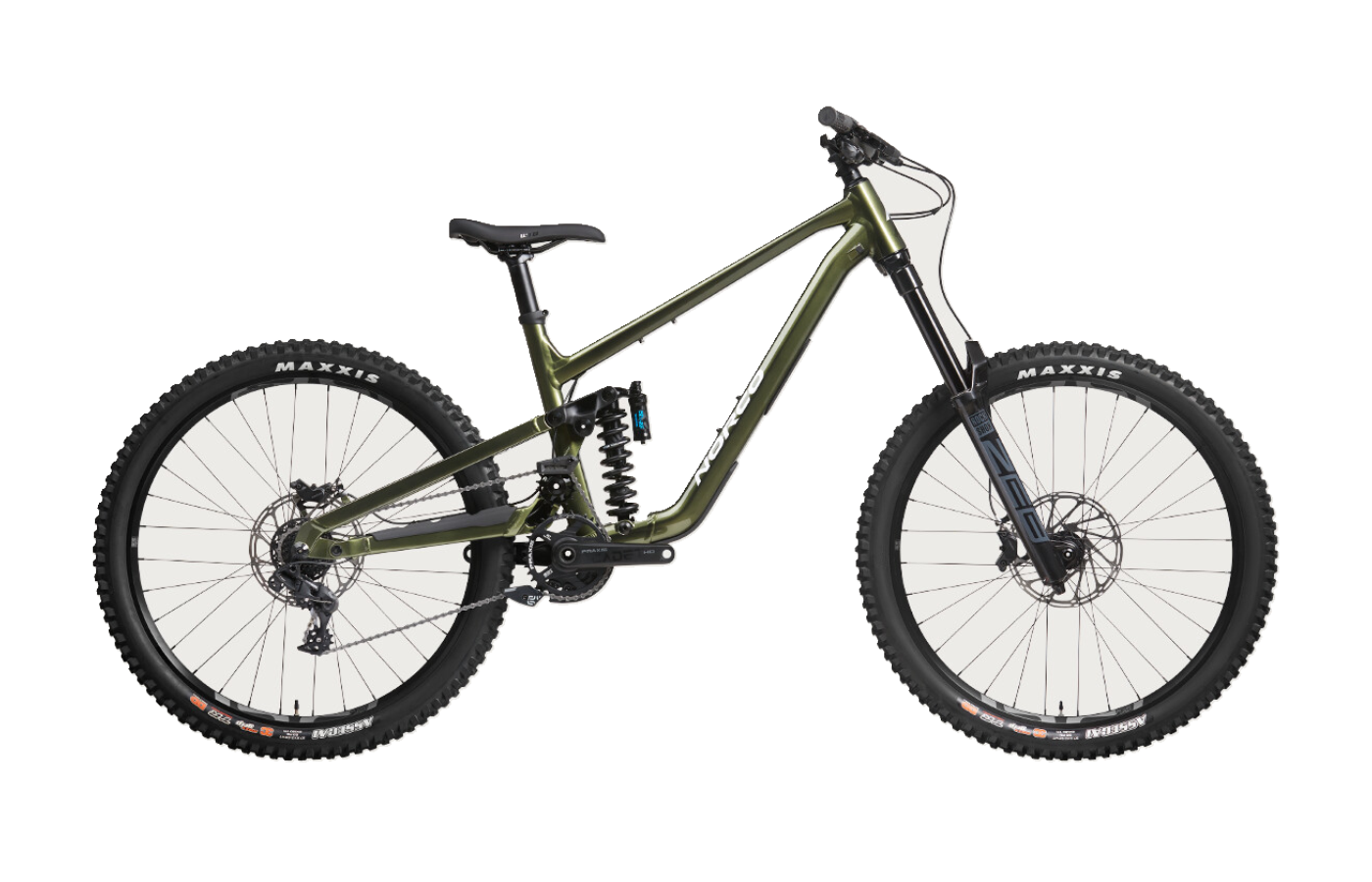
Shore
A high-pivot freeride competitor to the Slayer — the rearward axle path the Enduro hints at, taken further. Best if you want maximum momentum through vertical hits and don't mind the idler-pulley drag.
Compare →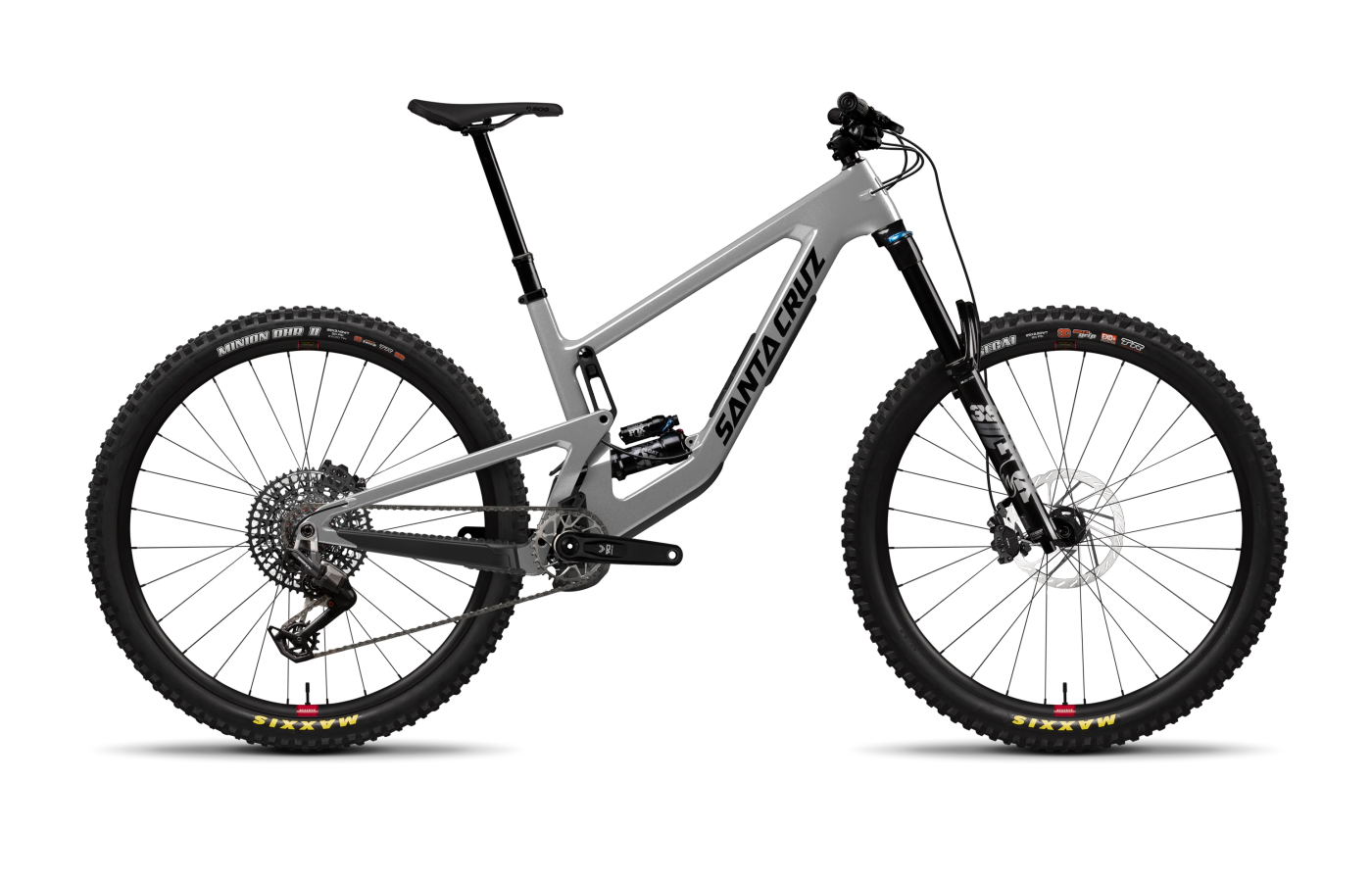
Megatower
The direct enduro-racing rival to the Specialized Enduro. Same 170 mm segment, but Santa Cruz's VPP kinematics give it more mid-stroke support than most riders find on the Enduro's Horst-link platform.
Compare →Spire
A "super-enduro" bike that splits the difference between these two — Slayer-style long-and-slack geometry with a simpler single-pivot suspension that's easier to tune than either of the bikes here.
Compare →