Astr
vsKanzo Adventure
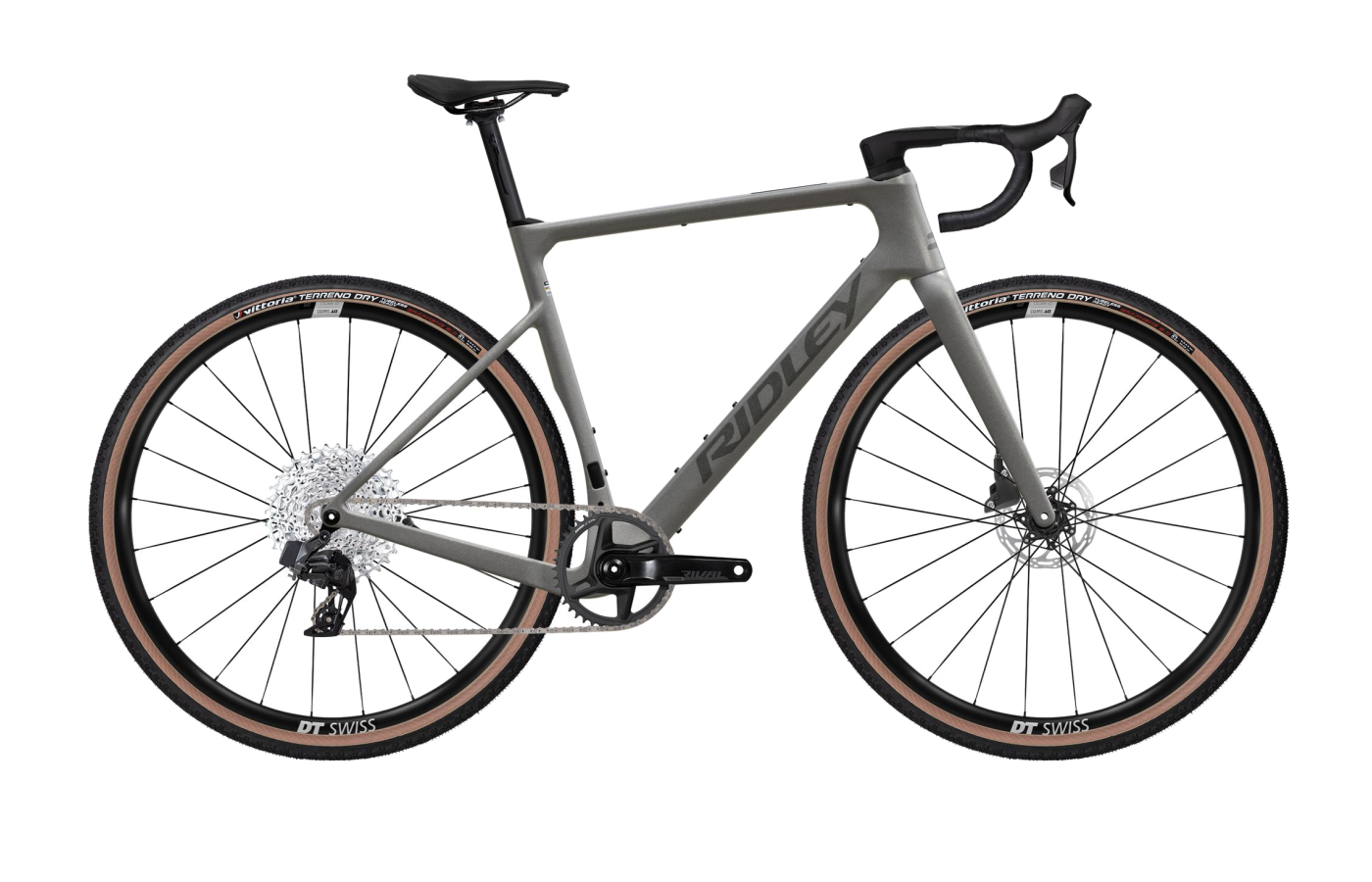
Two Ridleys, two completely different gravel briefs.
The Astr is Ridley's new aero race weapon. The Kanzo Adventure is the bikepacking workhorse — same badge, opposite job description.
Astr
- Aero-bike rigidity — reviewers called it 'very, very stiff' with instant power transfer, 'an aero race bike on fat tires.'
- Class-leading 52 mm clearance on the 1x — 10 mm more than a Canyon Grail and enough for any gravel race tire on the market.
- Rock-solid straight-line stability — 'the definition of planted,' in the reviewer's words, tailor-made for fast bunch racing.
- Firm ride even on 47 mm tires at low pressure — the frame doesn't flex, it just powers through.
- No fork mounts, no fender mounts — strictly a race-day tool.
Kanzo Adventure
- Adventure-ready mounting — fork cages (3 kg/leg), seven down-tube bosses, top-tube bag provisions, and internal dynamo routing.
- 53 mm (29 x 2.1 in) tire clearance — MTB-wide rubber for true off-road bikepacking, more than the Astr's 1x.
- Comfort-biased ride — slack 70.8° head angle, flexing 27.2 mm carbon seatpost, and long 1,041 mm wheelbase at size S.
- ~9 kg build weight on a mid-range trim — not a racing weight.
- Slower, more deliberate steering than the Astr; rewards stability over snap.
Editor’s analysis
Same Belgian brand, same wheel size, same 1x gravel drivetrain — and almost nothing else in common.
The Ridley Astr is brand new for 2025 and unapologetic about what it is: a gravel race bike with the aero DNA of Ridley's Falcon RS road frame. Deep head tube, fork crown that kinks straight into the down tube, D-shaped seatpost, one-piece integrated cockpit on the top trims. Reviewers described a size-M RS at 7.6 kg and called it an 'aero race bike on fat tires.' Tire clearance is still a category-leading 52 mm on the 1x (47 mm with a front derailleur).
The Ridley Kanzo Adventure is the 2022 redesign of Ridley's adventure gravel platform, and it reads like a different product category. Frame claimed at 1,250 g unpainted — Ridley explicitly chose robustness over weight. Clearance goes to a full 29 x 2.1 in (53 mm). Fork mounts carry 3 kg per leg, the down tube has seven bottle/cage bosses, there are hidden top-tube bag mounts, and the internal routing is sized for a dynamo wiring loom. It's a loaded-bikepacking frame that also happens to be fast.
Geometry tells the same story. At size S, the Astr runs a 71° head angle with 425 mm chainstays and a 1,027 mm wheelbase. The Kanzo Adventure — same size S — slackens to 70.8°, stretches chainstays to 435 mm, and adds 14 mm of wheelbase to 1,041 mm. The Kanzo also sits 19 mm taller in stack (569 vs 550) and 5 mm shorter in reach. One bike wants to hold a line at 35 km/h through loose gravel; the other wants to descend a rooty doubletrack with bags strapped to it.
Put it simply: the Astr is the one you buy if you're entered in Unbound. The Kanzo Adventure is the one you buy if you're riding to Unbound.
Where the builds differ.
Comparing our editor's-pick builds side-by-side. Winners highlighted row-by-row — lower price and weight, and the better-spec component, each mark a point.
Build variants & pricing
Both platforms span a wide trim range anchored on SRAM AXS drivetrains and Shimano alloy wheelsets. We've picked the Rival XPLR 1x13 build on each side for apples-to-apples comparison.
The Astr also offers Classified-hub builds (2x range on a 1x chain), and the Kanzo Adventure offers a hub-dynamo top trim with SON lighting. Neither shows up on its sibling.
How they fit, how they steer.
Both compared at size S. The Kanzo Adventure slackens the head tube by 0.8°, grows chainstays 10 mm, and sits 19 mm taller in stack — the Astr trades comfort for a more aggressive, stretched position.
Which size should I buy?
Size recommendations based on stack, reach, and effective top tube. The Kanzo's more upright stack pushes most riders toward the same nominal size as on the Astr, just in a less aggressive posture.
→These are starting points. Flexibility, riding style, and preferred position all shift the answer — if you’re between sizes, a professional fit beats a chart.
What the magazines said.
Published reviews from trusted cycling outlets. Click through for the full write-up.
Which one should you buy?
If you're racing the Belgian waffle ride or Unbound, get the Astr. If you're riding the Tour Divide, get the Kanzo Adventure.
Astr
If fast group rides, gravel races, and holding 35 km/h on washboard are how you spend your weekends, the Astr is the sharper tool. Aero tube shaping, an integrated cockpit on upper builds, and stiff-as-a-road-bike power transfer make it feel quick the moment you accelerate.
Kanzo Adventure
If you're loading up for a multi-day trip, tackling rough terrain, or just want one gravel bike that can do everything without complaint, the Kanzo Adventure is built for it. Extensive mounts, 29 x 2.1 in clearance, and a compliant rear end make it a workhorse across wildly different ride types.
Questions buyers actually ask.
Short answers to the things we get emailed about most often.
01Which one is faster on a gravel race course?
The Astr, without much debate. It was built from the Falcon RS aero road frame, uses a one-piece integrated cockpit on higher trims, and reviewers called it 'rock solid in a straight line' and 'the definition of planted' — exactly the handling profile you want for fast, open gravel events like Unbound.
The Kanzo Adventure is no slouch — reviewers praised its liveliness for an adventure bike — but it's heavier (around 9 kg in mid-range trim) and geometry-wise it prioritizes stability over speed.
02How different is the tire clearance?
Close on paper, meaningfully different in practice.
Astr: 52 mm with a 1x drivetrain, 47 mm with 2x.
Kanzo Adventure: 53 mm, marketed as 29 x 2.1 in — explicitly MTB-tire-wide.
The Astr covers every gravel race tire made. The Kanzo covers that plus mountain-bike rubber, which matters if you're running aggressive knobs on loaded bikepacking trips.
03Can I use either for bikepacking?
The Kanzo Adventure is purpose-built for it. Fork cages rated for 3 kg per leg (or 9 kg with a lowrider), seven bosses on the down tube, three on the seat tube, and hidden top-tube bag mounts. The internal routing is sized for dynamo wiring and the frame is designed to accept a suspension fork if you ever want one.
The Astr has only down-tube and top-tube bottle mounts — no fork cages, no fender mounts, no bikepacking provisions. You can strap a frame bag on, but you're fighting the design.
04How do they compare on geometry?
At size S:
Astr: 71° head angle, 425 mm chainstays, 1,027 mm wheelbase, 550 mm stack, 392 mm reach.
Kanzo Adventure: 70.8° head angle, 435 mm chainstays, 1,041 mm wheelbase, 569 mm stack, 387 mm reach.
The Kanzo is slacker, longer, and taller — classic adventure-gravel stability. The Astr is a touch steeper and lower, with shorter chainstays for sharper response. Neither difference is huge in isolation, but combined they give the bikes genuinely different characters.
05Is the Astr's ride actually harsh?
Reviewers called it 'firm, firm' even on 47 mm Vittoria Terreno tires at 20 PSI, describing the ride as 'quite jarring at times' over exposed rocks at high speed. The frame doesn't flex for compliance — it relies entirely on tire volume.
That's the race-bike trade-off. If you ride mostly smooth or mid-grade gravel, it's not a problem; if your local roads are chunky, you'll feel it over long days.
06Can the Kanzo Adventure take a suspension fork?
Yes — the frame was designed around the option. Ridley kept the head tube short enough and the geometry balanced enough that a short-travel gravel suspension fork (e.g. RockShox Rudy) bolts on without wrecking the handling.
The Astr was not designed for this.
07Which is easier to live with long-term?
The Kanzo Adventure, comfortably. It uses a standard 27.2 mm round seatpost (easy to swap for comfort or a dropper), has conventional mounting threads everywhere, and its integrated cabling is serviceable rather than hidden.
The Astr's one-piece integrated cockpit on upper trims is harder to adjust or replace, and the D-shaped seatpost locks you into Ridley's aero spec. Lower-tier Astr builds use a round post and are friendlier; reviewers specifically called out the Astr 'Essential' (non-RS) frame as the more practical long-term buy.
08Same brand — can I share wheels or parts between them?
Mostly yes on components. Both use 12 x 142 mm rear and 12 x 100 mm front thru-axles, so wheels swap directly. Both ship with the same Shimano RX180 TLR wheelsets and Vittoria Terreno T50 tires on most trims, so out-of-the-box rolling stock is interchangeable.
Cockpits and seatposts don't cross over — the Astr uses integrated/proprietary parts on top trims, while the Kanzo sticks with round, standard-sized components.
Similar bikes
If your priorities don’t map cleanly onto either of these, one of these adjacent bikes probably fits better.

Grail
The most direct rival to the Astr — Canyon's aero gravel racer at a direct-to-consumer price. Catch: clearance tops out at 42 mm, 10 mm shy of the Astr.
Compare →Grizl
Canyon's answer to the Kanzo Adventure — comparable mounting, comparable clearance, and a roughly 30% lower price thanks to the DTC model. No dealer, no demos.
Compare →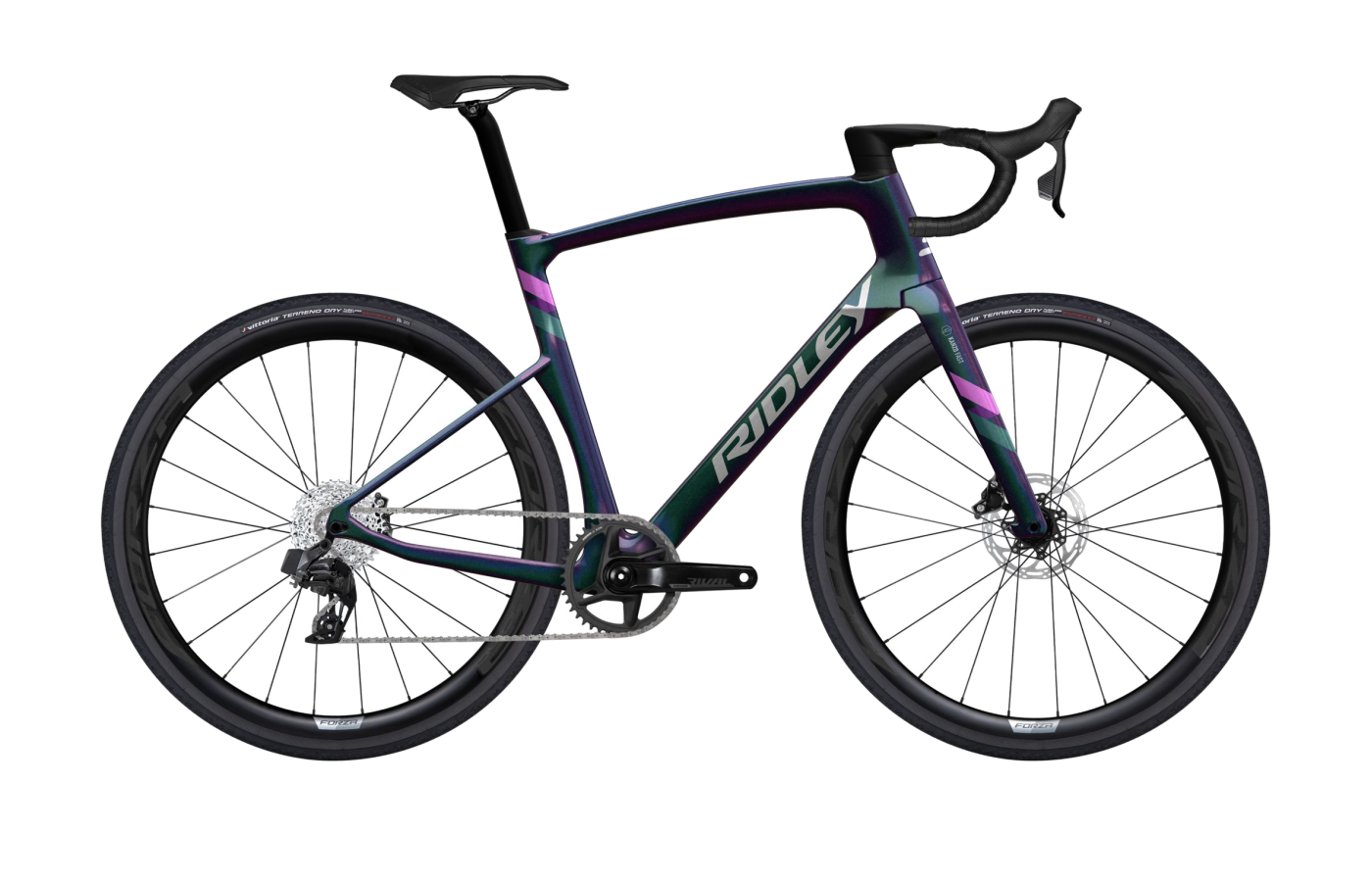
Kanzo Fast
Ridley's previous-generation gravel race bike — sharper aero focus than the Kanzo Adventure but older geometry and narrower tire clearance than the Astr that now supersedes it in the lineup.
Compare →