Alpe d'Huez
vsScylon
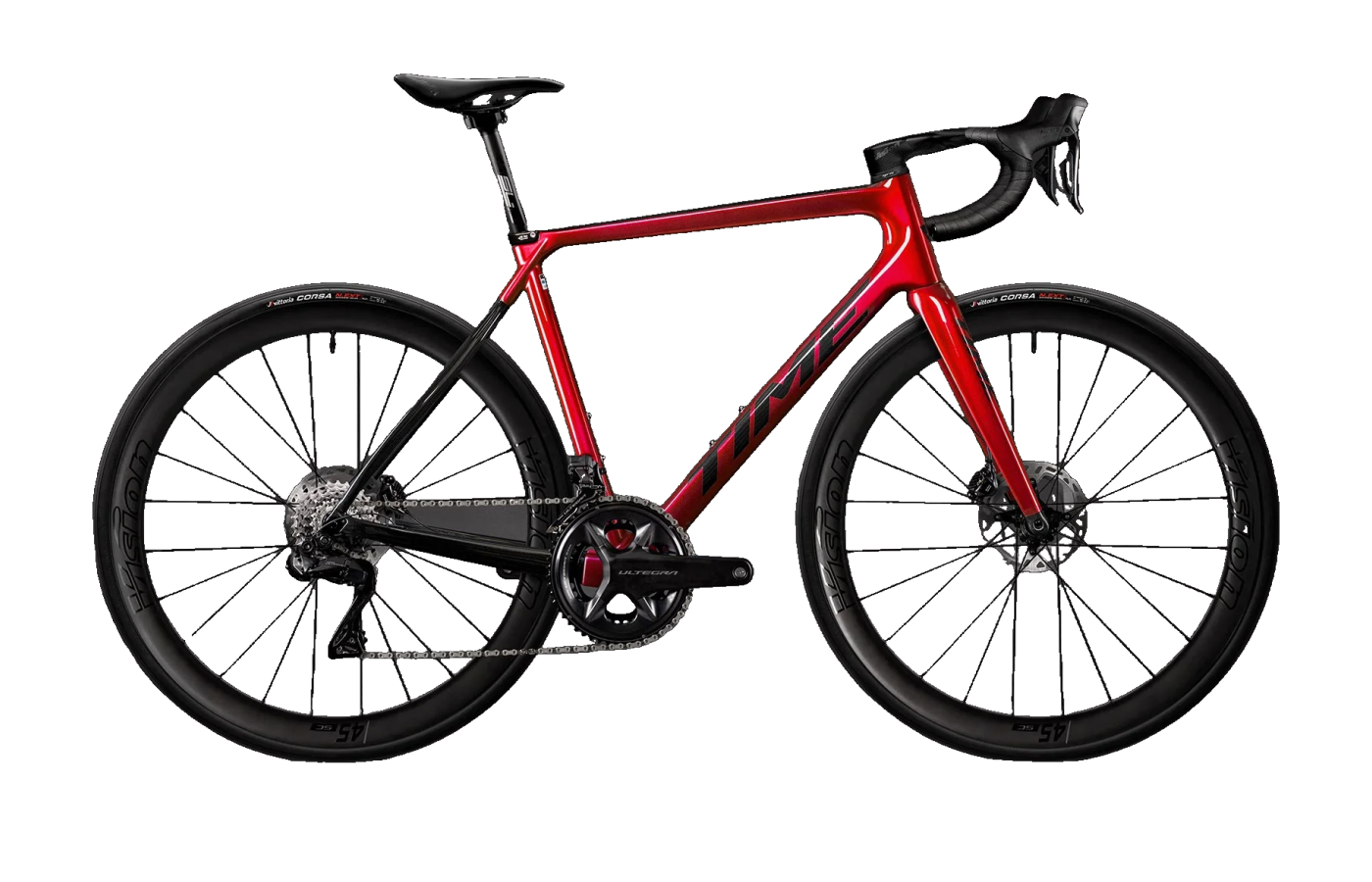
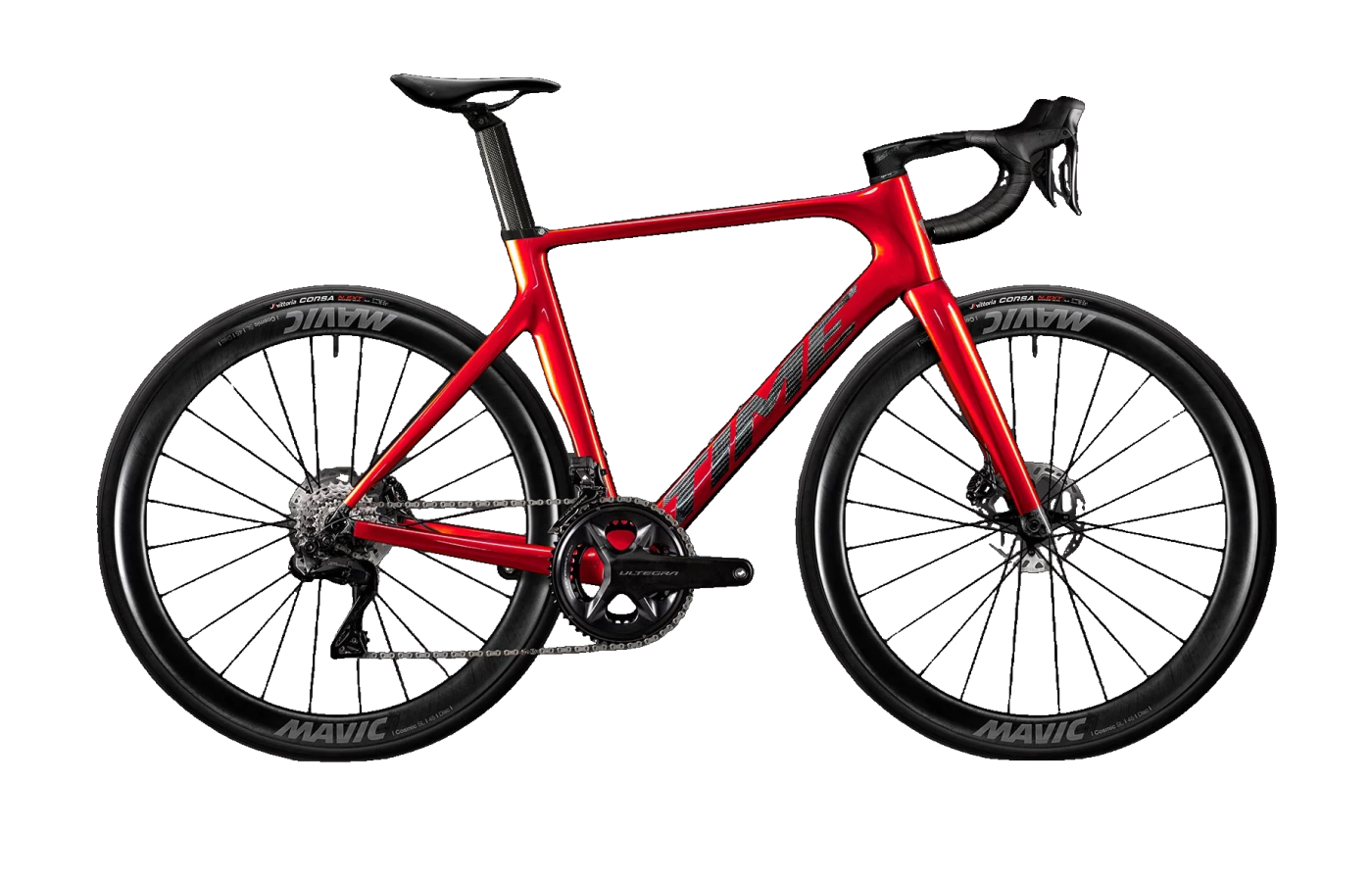
Same factory, two opposite assignments.
The Alpe d'Huez is Time's classical climber. The Scylon Gen 2 is Time's aero superbike — both built on the same braided-carbon process, tuned for different days.
Alpe d'Huez
- Cheaper entry point — $7,469 for Ultegra Di2 vs. $9,419 on the Scylon, roughly $1,950 less for the same groupset.
- Standard 27.2 mm seatpost — extra vertical compliance and easy aftermarket tuning, no proprietary part to source.
- Climber-tuned geometry — shorter 976 mm wheelbase and 73-degree HTA in mid sizes for an eager, direct front end.
- Tire clearance maxes out at 28 mm — rim-brake-era thinking on a 2025 bike.
- Real-world weights aren't class-leading — one tester's XL Ultegra build came in at 8.3 kg.
Scylon
- Aero tube profiles — deeper-section frame and integrated cockpit options built for sustained high-speed efforts.
- Wider 32 mm tire clearance — ships with 30c stock and accepts up to 32c, generous for the aero-road segment.
- Time's vibration damping — one builder likened the smoothness to 'a steel rig with 35 mm tires,' rare for an aero bike.
- Roughly $1,950 more than the Alpe d'Huez at every shared groupset tier.
- Slacker 71.5-degree head tube and longer 996 mm wheelbase trade some climbing eagerness for high-speed stability.
Editor’s analysis
Two bikes from the same Slovakian factory — but one is built to go up, and the other is built to stay flat.
Both the Time Alpe d'Huez and Time Scylon are built using Time's signature Braided Carbon Structure and Resin Transfer Molding — the hand-woven, resin-injected process the brand has been refining in its Slovakian factory for decades. Reviewers describe the resulting ride as 'denser,' 'resonant,' and 'alive' — language you don't hear about most pre-preg flagships. So choosing between them isn't a question of frame quality. It's a question of intent.
The Time Alpe d'Huez is the classical assignment. Round-ish tubes, traditional 73-degree parallel angles in the mid sizes, a universal 27.2 mm seatpost, 28 mm tire clearance, and a 976 mm wheelbase in size S. Reviewers consistently call out two things: how the bike 'glides' on chip-seal and frost-heaved descents, and how it 'earns its name' on sustained 6–10% climbs. It is, deliberately, a rim-brake-era frame translated to discs — quick, communicative, and built for elevation.
The Time Scylon Gen 2 takes the same construction and points it at flat-road speed. Deeper aero tubes, a slacker 71.5-degree head tube angle, 62 mm of trail, a 996 mm wheelbase, and a Kevlar-enhanced fork that one reviewer described as having 'zero deflection' under hard braking. Tire clearance jumps to 32 mm — a generous figure for an aero race bike — and the integrated cockpits and 30c stock tires reinforce the brief. It surges on the flats. It still climbs, just not as eagerly.
On price, the Scylon sits roughly $1,950 above the Alpe d'Huez at every comparable build tier — the Ultegra Di2 Scylon is $9,419 vs. $7,469 for the same groupset on the Alpe d'Huez. That gap pays for the aero tube shapes and the integrated cockpit. If most of your kilometers are uphill or on rough pavement, the Alpe d'Huez is the right tool. If you're hunting Wednesday-night group rides, criteriums, and flat solo efforts, the Scylon is the sharper one.
Where the builds differ.
Comparing our editor's-pick builds side-by-side. Winners highlighted row-by-row — lower price and weight, and the better-spec component, each mark a point.
Build variants & pricing
Both lineups span four builds across Ultegra Di2, Force AXS, Dura-Ace Di2, and Red AXS. The Scylon sits roughly $1,950 above the Alpe d'Huez at every matched tier.
Prices are current US MSRP. Time sells multiple wheel choices per build (Vision Metron 45 RS / 45 SL / SC 45, Mavic Cosmic SL 45, plus 60 RS / 60 SL on the Scylon) — the listed wheelset is representative.
How they fit, how they steer.
Both at size S — the fit-picked size for a 5'8" rider on each bike. The Scylon sits 11 mm higher in stack with 5 mm more reach, and runs a slacker 71.5-degree head tube against the Alpe d'Huez's 72.5-degree angle. Wheelbase grows 20 mm on the Scylon — sharper steering on the climber, more centered stability on the aero bike.
Which size should I buy?
Size recommendations based on stack, reach, and effective top tube length. The Scylon offers a smaller XXS that the Alpe d'Huez doesn't; otherwise the ranges overlap closely.
→These are starting points. Flexibility, riding style, and preferred position all shift the answer — if you’re between sizes, a professional fit beats a chart.
What the magazines said.
Published reviews from trusted cycling outlets. Click through for the full write-up.
Which one should you buy?
If you live in the mountains and want a denser, communicative climber, get the Alpe d'Huez. If you race on the flats and want Time's ride quality in an aero package, get the Scylon.
Alpe d'Huez
If your weeks are stacked with sustained climbs, technical alpine descents, and rough chip-seal back roads, this is the Time to buy. The 27.2 mm seatpost and BCS frame filter the road in a way most race bikes don't, and you save nearly $2,000 over the Scylon at every groupset tier.
Scylon
If most of your hard efforts happen on rolling terrain, group rides, or criteriums — and you want Time's frame feel without giving up aerodynamics — the Scylon is the right one. Wider tire clearance, a stiffer fork, and integrated cockpits built for sustained high speed.
Questions buyers actually ask.
Short answers to the things we get emailed about most often.
01Which one climbs better?
The Alpe d'Huez, by design. It runs a shorter 976 mm wheelbase, a steeper 72.5-degree head tube angle in size S, and a more upright cockpit — reviewers consistently describe it as 'rock solid' on 6–10% gradients and quick to respond to out-of-the-saddle attacks.
The Scylon still climbs well — one tester called it 'light and agile' when the road tilts up — but its slacker 71.5-degree head tube and longer 996 mm wheelbase favor stability over eagerness.
02Which one is faster on the flats?
The Scylon Gen 2, clearly. Its deeper aero tube profiles, integrated-cockpit compatibility, and wider stock tires (30c vs. 28c on the Alpe d'Huez) all push it toward sustained flat-road speed. Reviewers describe it as 'surging forward like a heavy aero race bike' on rolling terrain.
The Alpe d'Huez doesn't have aero pretensions — it's a classical round-tube climber and won't keep up with the Scylon at 40 km/h and above on a still day.
03What's the maximum tire clearance?
Alpe d'Huez: 28 mm. Time describes the clearance as deliberately 'old school' — a holdover from the rim-brake era — and most builds ship with Vittoria Corsa N.EXT 700x28c.
Scylon Gen 2: 32 mm. Stock tires are 30c with 28/30/32c all called out as supported options. That's a generous figure for an aero-road bike and gives the Scylon a real edge on rougher pavement.
04Does either use a proprietary seatpost?
Alpe d'Huez: No — it uses a universal 27.2 mm round seatpost. Reviewers specifically called out the extra vertical deflection this provides over deeper aero posts, and you can swap to any aftermarket post without buying from Time.
Scylon Gen 2: Yes — Time uses a proprietary aero post on the Scylon to match the deeper tube profiles. It's part of how the bike achieves its aero numbers, but it's another part to source if you ever damage it.
05How much more does the Scylon cost?
Roughly $1,950 more at every matched groupset tier. Comparing like-for-like:
- Shimano Ultegra Di2: Alpe d'Huez $7,469 vs. Scylon $9,419 (+$1,950)
- SRAM Force AXS: $7,669 vs. $9,619 (+$1,950)
- Shimano Dura-Ace Di2: $9,289 vs. $11,119 (+$1,830)
- SRAM Red AXS: $9,439 vs. $11,269 (+$1,830)
The gap pays for the aero tube shapes, the integrated cockpit hardware, and the proprietary seatpost.
06Are both built using the same Time process?
Yes. Both frames use Time's Braided Carbon Structure (BCS) — raw carbon woven into 'socks' — combined with Resin Transfer Molding (RTM) to inject resin under pressure. The Scylon Gen 2 uses an M46J / T800 layup with a Kevlar-enhanced fork; the Alpe d'Huez frame uses a Vectran-enhanced layup with Dyneema reinforcement.
Both are hand-built in Time's Slovakian factory, and both carry the same lifetime frame warranty.
07Which is better for rough roads and long days?
Both filter vibration unusually well for racing frames — Time's BCS construction is the common factor. But the Alpe d'Huez has the edge for genuinely rough surfaces: it pairs the BCS frame with a 27.2 mm round seatpost (more vertical compliance) and the 28 mm tires it ships with feel measurably softer than the harsher feedback you'd get from a typical aero bike.
The Scylon offsets this by allowing wider 32 mm tires — so on chip-seal or broken pavement, a 32c Scylon can rival a 28c Alpe d'Huez for comfort while staying faster on the flats.
08Which size should a 5'8" (173 cm) rider pick?
Both bikes fit-pick to size S for a 173 cm rider, which is what's compared on this page. The Scylon's size S sits 11 mm taller in stack (549 mm vs. 538 mm) and 5 mm longer in reach (382 mm vs. 377 mm), so the Scylon will feel slightly longer and more upright at the same nominal size.
The Scylon also offers a smaller XXS that the Alpe d'Huez doesn't, useful for shorter riders who find the Alpe d'Huez XS too long.