Stigmata
vsCrux
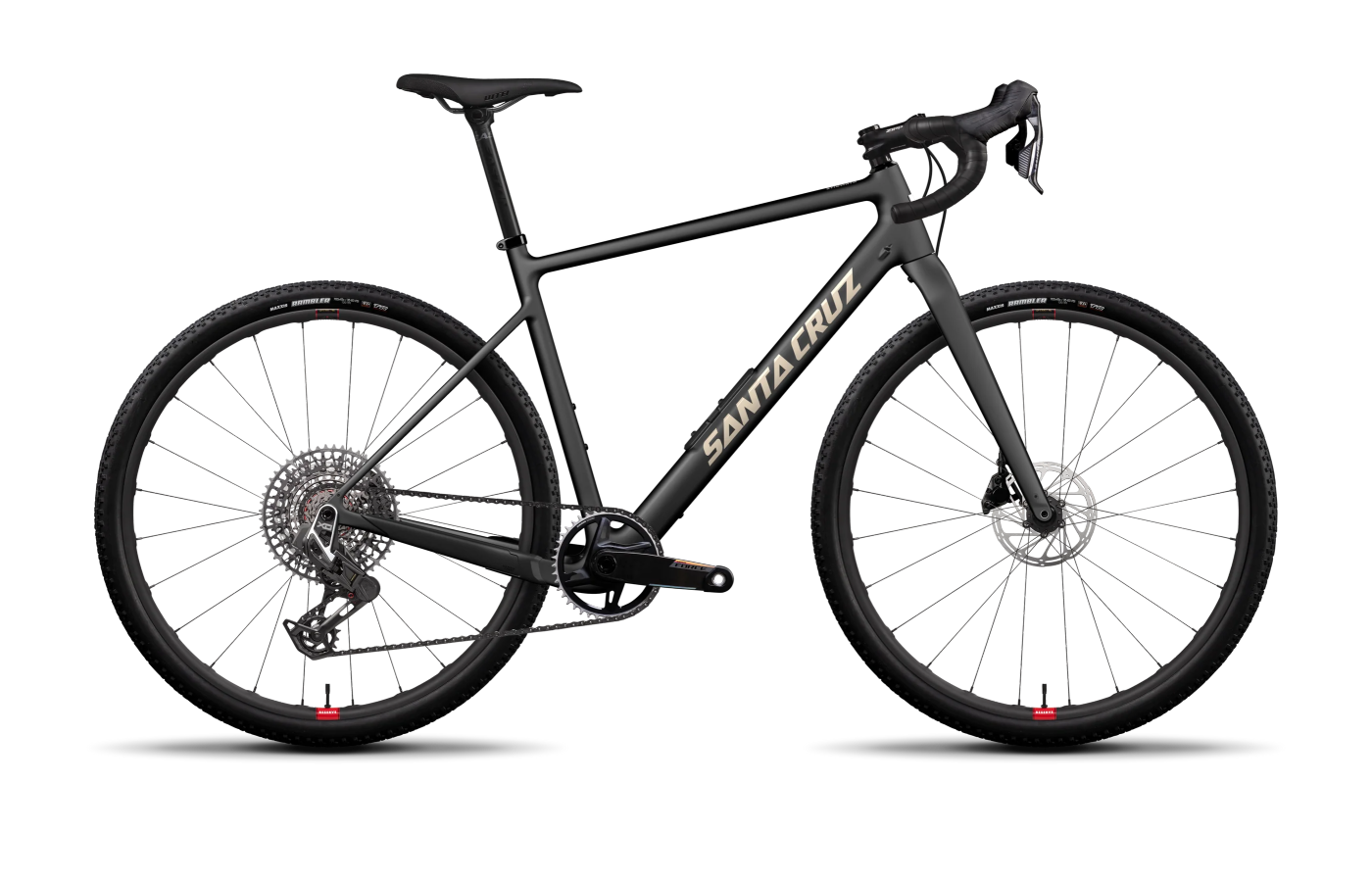
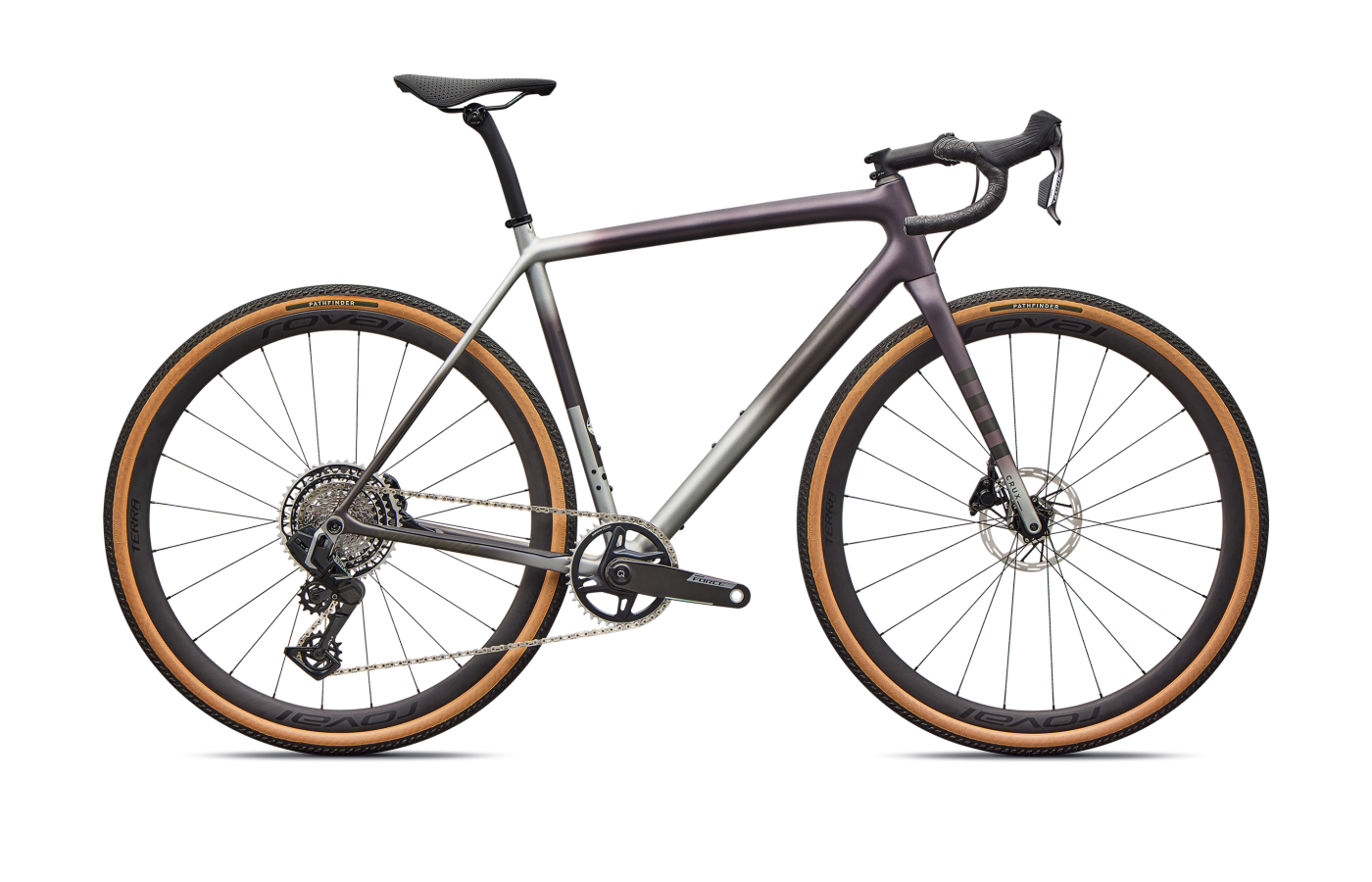
Two carbon gravel bikes, two opposite missions.
The Stigmata is a mountain biker's gravel bike — slack, suspension-corrected, built for chunk. The Crux is a road-racer that happens to clear 47 mm tires.
Stigmata
- Suspension-corrected geometry — frame designed around an optional 40 mm fork, with a 69.5° HTA and 1,043 mm wheelbase that stays calm in chunk.
- 50 mm tire clearance — widest in the segment, opens the door to genuine singletrack and mullet builds.
- Service-friendly frame — external cable routing, threaded BB, round 27.2 mm seatpost, UDH, and an internal 'Glovebox' storage hatch.
- Heavier frame (~1,380 g) than the Crux — climbs feel more 'composed' than 'eager.'
- Only one carbon grade and no sub-$4 k entry — pricing starts where the Crux's mid-tier sits.
Crux
- Class-leading frame weight — 725 g for S-Works, ~825 g for FACT 10r, with full builds as low as 6.94 kg.
- Wide build range — starts at $2,799 (alloy DSW Comp) and scales to $11,999 S-Works; few platforms cover this much ground.
- Direct, road-bike power transfer — stiff bottom bracket and aggressive geometry make it 'an absolute rocket' on smoother dirt and tarmac.
- No frame storage, minimal mounts — not a bikepacking platform.
- Race-firm ride can feel 'almost nervous' on technical descents; demands an engaged pilot.
Editor’s analysis
This isn't gravel-bike-vs-gravel-bike. It's underbike-vs-overbike — the trail-leaning explorer against the lightest race weapon Specialized has ever built.
On paper, the Santa Cruz Stigmata and Specialized Crux are both top-tier carbon gravel race bikes, both run wide tires, both win Unbound. Spend five minutes on the geometry charts and the family resemblance evaporates. The Stigmata's head tube angle is a full 2 degrees slacker than the Crux at equivalent fit-picked sizes. Wheelbase is 20 mm longer. Tire clearance is 3 mm wider. These aren't subtle dialect differences — they're different languages.
The Stigmata is the rare drop-bar bike engineered to be less stiff than its predecessor. Santa Cruz pulled roughly 10–12% of lateral stiffness out of the Carbon CC frame on purpose, then suspension-corrected the front end for a 40 mm fork. The result is a 1,380 g frame that 'tracks in a straight line through the chunk' (Velo) and lets riders brake later into rough corners. It is, as one reviewer put it, 'as aero as a Jeep' — and Santa Cruz makes zero claims to the contrary.
The Specialized Crux is the philosophical opposite: an Aethos road bike with knobbier tires. The S-Works frame is 725 g — lighter than most flagship road frames — and the Pro/Expert FACT 10r isn't far behind at ~825 g. That weight comes from nominally round tubes, no aero shaping, and zero on-frame storage. The payoff is climbing that reviewers compare to a 'mountain goat' and acceleration that 'doesn't hesitate.' The cost is a chassis some testers found 'almost a hair nervous' on rough descents.
Put plainly: the Stigmata is the bike you buy if your gravel rides include singletrack you'd usually want a hardtail for. The Crux is the bike you buy if your gravel rides are 100-mile races where the dirt sections are the slow part.
Where the builds differ.
Comparing our editor's-pick builds side-by-side. Winners highlighted row-by-row — lower price and weight, and the better-spec component, each mark a point.
Build variants & pricing
The Crux spans more ground — $2,799 alloy up to $11,999 S-Works. The Stigmata is carbon-only and starts at $4,149.
Prices are current US MSRP and shift between model years. Specialized offers an alloy DSW Comp at $2,799; Santa Cruz has no aluminum option, and every Stigmata frame is the same top-tier Carbon CC layup.
How they fit, how they steer.
Stigmata SM and Crux 54 are the fit-picked sizes for a 5'8" rider on each bike. The Stigmata sits 4 mm taller in stack with 2 mm more reach, but the headline is the head tube angle: 69.5° vs 71.5°. Wheelbase runs 20 mm longer on the Stigmata; chainstays are nearly identical (423 vs 425 mm).
Which size should I buy?
Size recommendations are based on stack, reach, and effective top tube. The Crux is offered in six sizes from 49 to 61; the Stigmata in six from XS to XXL.
→These are starting points. Flexibility, riding style, and preferred position all shift the answer — if you’re between sizes, a professional fit beats a chart.
What the magazines said.
Published reviews from trusted cycling outlets. Click through for the full write-up.
Which one should you buy?
If you ride singletrack on drop bars and chase 'underbiking,' get the Stigmata. If you race fast gravel and want the lightest carbon platform on the market, get the Crux.
Stigmata
If your weekends look more like 'drop bars on hardtail terrain' than 'fast group road ride with a dirt section,' the Stigmata's slack geometry, 50 mm clearance, and 40 mm fork compatibility are exactly what you want. It rewards confidence on chunky descents and shrugs off long days on rough surfaces.
Crux
If you want a bike that climbs like a road bike, accelerates out of corners like a road bike, and only really hates the rougher 10% of your route, the Crux is the lightest, sharpest tool in the segment. It demands skill on technical descents but pays it back in pure speed.
Questions buyers actually ask.
Short answers to the things we get emailed about most often.
01Which is faster on smooth gravel and pavement?
The Specialized Crux, by a meaningful margin. Reviewers consistently call it the 'most road-capable gravel bike' on the market, with Pathfinder Pro tires that have a slick center tread and a frame light enough that complete builds dip into road-bike territory (6.94 kg for the S-Works). On paved or hardpack sections it 'keeps up with the roadies like it's no big issue' (Cycling News).
The Stigmata, by contrast, was famously described as 'as aero as a Jeep' — and Santa Cruz makes zero aero claims. On smooth surfaces the Crux will pull away.
02Which handles rough terrain and singletrack better?
The Stigmata, decisively. Its 69.5° head tube angle, 1,043 mm wheelbase (size SM), and engineered frame compliance let testers 'brake later and harder' on technical descents. Multiple reviewers reported it was the first gravel bike they felt comfortable Scandi-flicking through loose corners.
The Crux is the opposite: testers describe it as 'a Bucking Bronco' on rough terrain, and one called it 'almost a hair nervous' compared to more relaxed gravel bikes. It's a precise, demanding chassis that punishes poor line choice.
03What's the maximum tire clearance on each?
Stigmata: 50 mm (700c) in 1x setups — the widest in the gravel-race segment, and enough room for genuine cross-country tires.
Crux: 47 mm (700c) or 2.1" (650b). Still generous, and reviewers note it's enough to switch between fast-rolling Pathfinders and knobbier rubber for muddy cyclocross conditions.
The Stigmata's extra 3 mm matters mostly if you're planning to run 2.0"+ mountain bike tires; for typical 40–45 mm gravel rubber, both have ample room.
04Can I add a suspension fork to either?
The Stigmata is explicitly suspension-corrected for a 40 mm travel fork (430 mm axle-to-crown), and Santa Cruz sells the Force 1x AXS RSV Rudy build with a RockShox Rudy XPLR pre-installed. Reviewers found the suspension transformed the bike — 'cush' over washboard, faster on technical descents.
The Crux is not suspension-corrected. Its geometry is designed around a rigid carbon fork, and adding a suspension fork would significantly raise the front end and slacken the head angle in ways Specialized hasn't engineered for. If you want suspension on a Specialized gravel bike, the Diverge STR is the right platform.
05How do the frames compare on weight and stiffness?
The numbers diverge sharply. Crux S-Works frame: 725 g claimed. Crux FACT 10r (Pro/Expert/Comp): ~825 g. Stigmata Carbon CC frame: ~1,380 g — significantly heavier, and Santa Cruz intentionally reduced lateral stiffness by 10–12% from the previous generation.
This isn't a bug for the Stigmata; it's the design intent. The extra mass and reduced stiffness buy compliance and durability for chunkier terrain. The Crux's featherweight construction buys explosive climbing and acceleration but a firmer ride on rough surfaces.
06Are the integrated cockpits and proprietary parts an issue?
Both bikes are refreshingly conventional. The Stigmata uses a standard 70 mm Zipp Service Course alloy stem, separate alloy or carbon bar, threaded BSA bottom bracket, and round 27.2 mm seatpost — and routes cables externally past the headset.
The Crux uses the same threaded BSA bottom bracket, a round 27.2 mm Roval Alpinist seatpost, and a conventional two-piece alloy cockpit. Both bikes are easy for a home mechanic to work on, easy to upgrade, and easy to fit. Neither runs hoses through the headset.
07Which has more frame storage and mounting options?
Stigmata wins clearly. It has the in-frame 'Glovebox' down-tube storage (with neoprene tool wallet and tube purse included), subtle fender mounts on fork and rear triangle, and standard bottle bosses. It's still not a fully-mounted bikepacking platform — there are no rack mounts — but it's far more equipped than the Crux.
The Crux is intentionally minimalist: bottle bosses and a third (down-tube) bottle mount, and that's it. No frame storage, no fender mounts, no rack mounts. Specialized positions the Crux as a race bike; if you want mounts, the Diverge is the answer.
08Which holds long-term value better?
Both have strong cases. The Stigmata comes with a lifetime warranty on the frame and on the Reserve 25|GR carbon wheels found on higher builds — a meaningful long-term upside that several reviewers explicitly called out. The frame is also 'future-proof' in the sense that you can start rigid and add a 40 mm fork later without fighting the geometry.
The Crux's value lies in the frame itself. Many reviewers recommend buying the Comp or Expert and upgrading wheels and drivetrain over time, since the FACT 10r frame is 'nearly all of the performance' of the S-Works at half the price. Both Specialized and Santa Cruz offer crash-replacement programs.
Similar bikes
If your priorities don’t map cleanly onto either of these, one of these adjacent bikes probably fits better.
Szepter
The closest spiritual cousin to the Stigmata — MTB-influenced geometry with a suspension fork as standard equipment. The YT Szepter trades the Santa Cruz badge for a more accessible direct-to-consumer price.
Compare →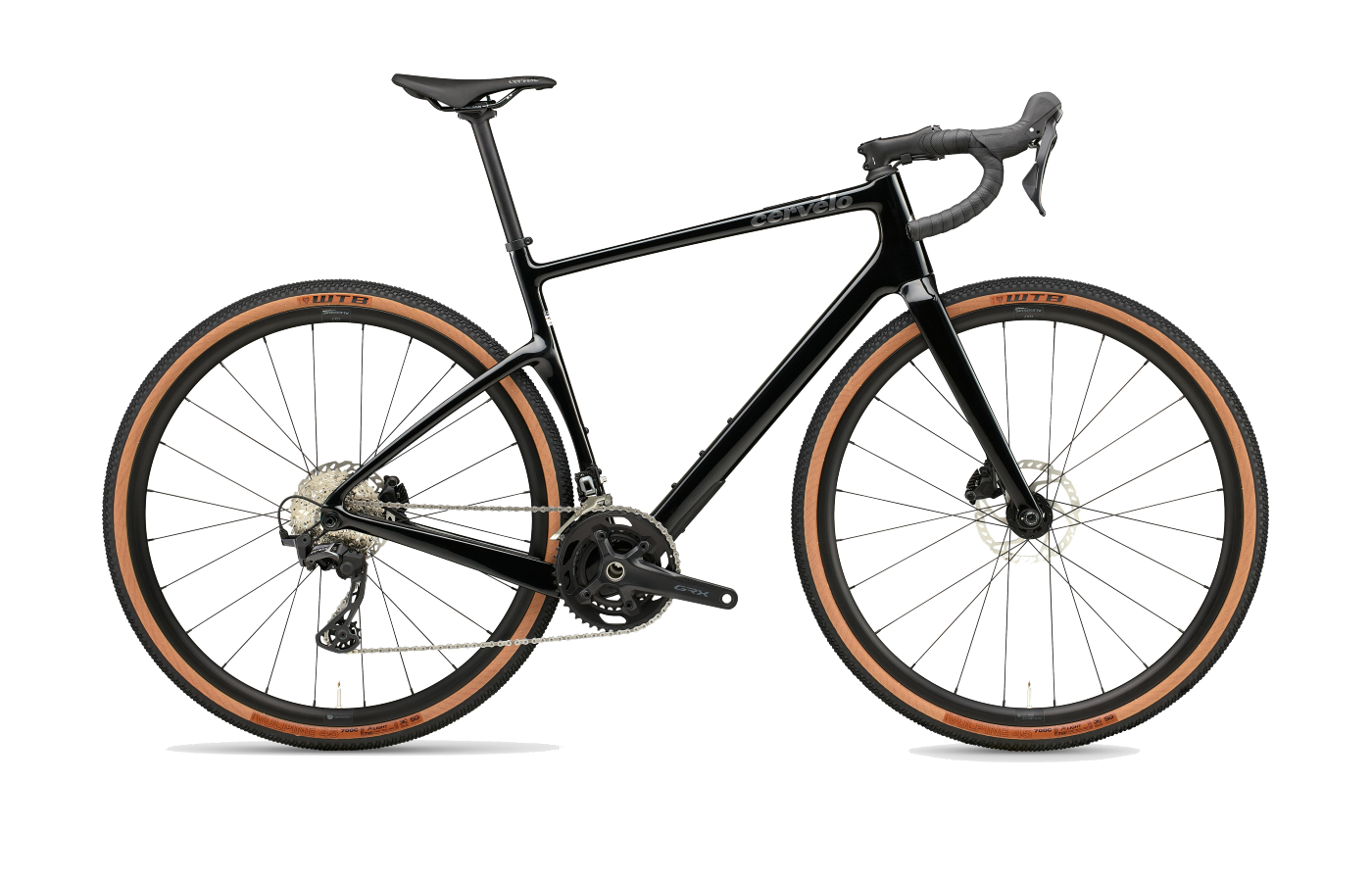
Aspero
If the Crux is a road bike for gravel, the Cervelo Aspero is the aero version. A pure flat-out racer for riders who measure their gravel days in average watts, not technical lines.
Compare →Grizl
Same off-road intent as the Stigmata, but with the mounts the Stigmata refuses — fenders, racks, multi-day bikepacking. The Canyon Grizl is the value play for riders who pack heavy.
Compare →