Cinder Cone
vsFire Mountain
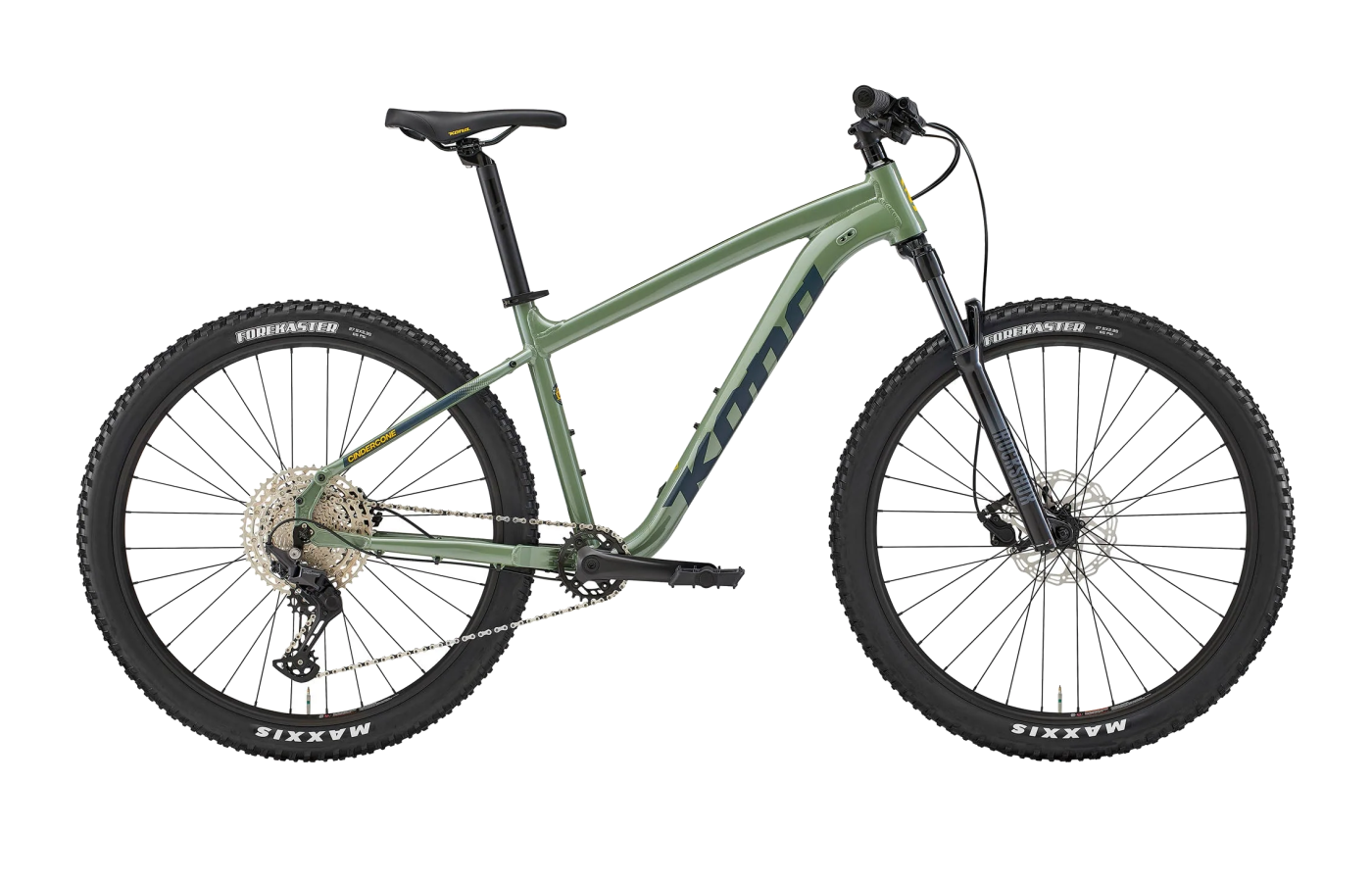
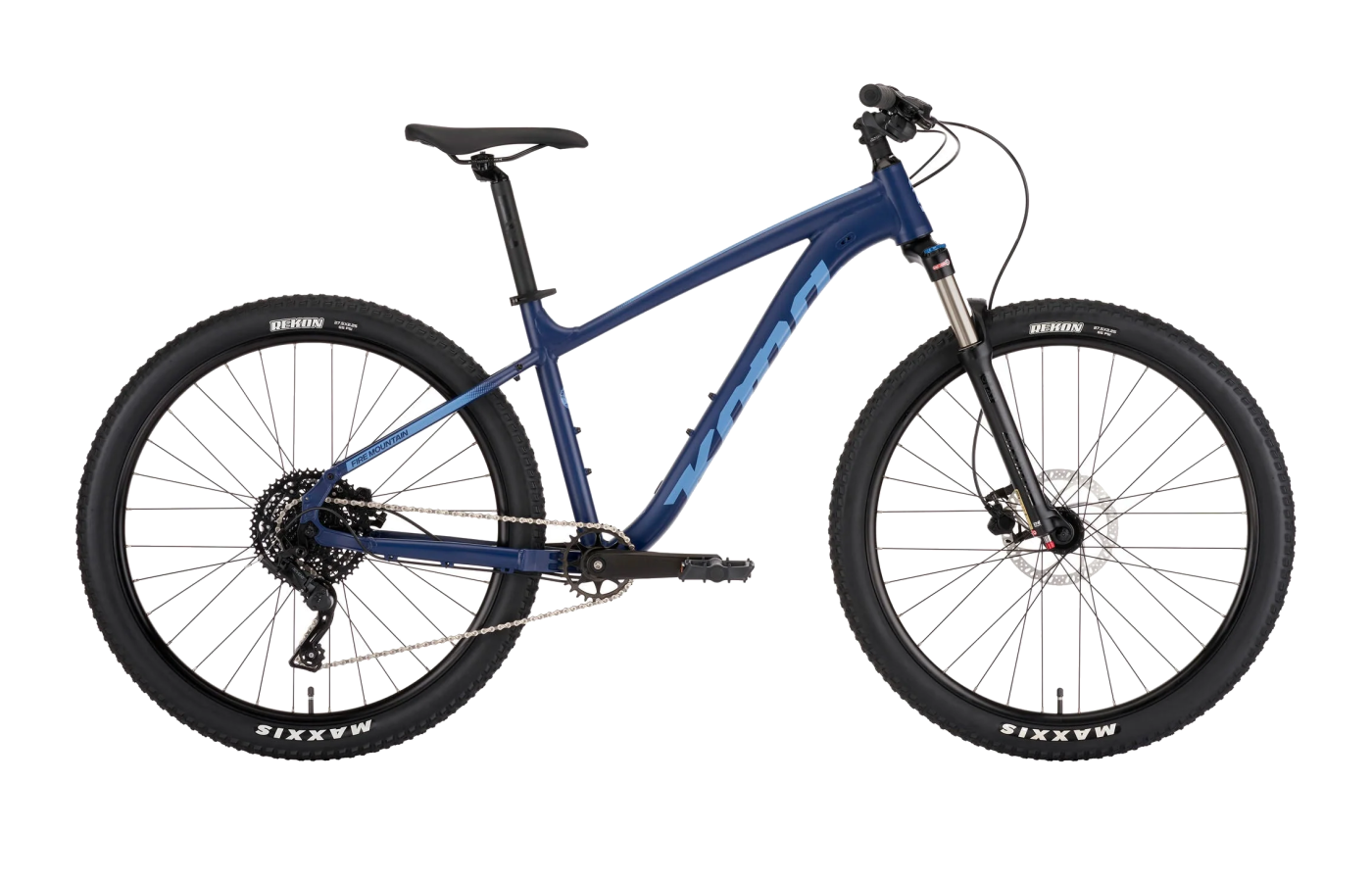
Same frame, $150 of fork.
The Cinder Cone and Fire Mountain share geometry almost to the millimeter. The price gap buys an air fork, an 11-speed Deore drivetrain, and grippier tires.
Cinder Cone
- Air-sprung fork — RockShox Judy Silver TK Solo Air with rebound and lockout; tunable to your weight, not a fixed coil rate.
- Deore 1x11 drivetrain with an 11–51T cassette and a clutch derailleur; reviewers call it "bomb-proof."
- Tubeless-ready out of the box — WTB ST i27 TCS rims plus 2.35" Maxxis Forekasters that reviewers praise in the wet.
- $150 more than the Fire Mountain for what's mechanically the same frame.
- 100 mm of travel and a 68-degree head tube cap how rowdy you can get before wanting more bike.
Fire Mountain
- Cheapest way onto the platform at $749 — same Kona 6061 frame and same trail geometry as the Cinder Cone.
- Hydraulic disc brakes stock (Tektro HDM275) at a price where most rivals still ship mechanical.
- microSHIFT Advent 1x9 with clutch — simple, durable, and easier for beginners than a multi-chainring setup.
- Coil-spring SR Suntour fork can't be tuned to rider weight — comfort drops if you're heavy or light.
- Narrower 11–46T range and 9 speeds make the steepest climbs harder than the Cinder Cone's 11–51T.
Editor’s analysis
These are sibling bikes, not rivals — and the question is whether $150 buys enough to matter.
Both the Cinder Cone and the Fire Mountain are built around the same Kona 6061 aluminum hardtail frame: 68-degree head tube, 75-degree seat tube, 435 mm chainstays, 27.5-inch wheels. In size Medium, the stack and reach numbers are identical down to the millimeter (599 mm / 440 mm). Park them next to each other and the only frame-level differences are paint and the small XS option Kona only catalogs on the Fire Mountain.
What you actually pay for at $899 is the fork. The Cinder Cone gets a 100 mm RockShox Judy Silver TK Solo Air with rebound and a lockout — air-sprung, so you can dial pressure to your weight. The Fire Mountain runs a 100 mm SR Suntour XCR or RST Omega coil unit, which means the spring rate is whatever Kona spec'd, full stop. For anyone outside the average-rider window — lighter teens, heavier adults — that's a meaningful comfort and traction gap.
The drivetrain story is the same shape. Cinder Cone runs Shimano Deore 1x11 with an 11–51T cassette and a 28T ring; reviewers call the Deore clutch derailleur "bomb-proof." Fire Mountain runs microSHIFT Advent 1x9 (11–46T), also with a clutch, also reliable, but with narrower range and a less crisp shift feel. The Cinder Cone also gets WTB ST i27 TCS tubeless-ready rims and Maxxis Forekaster 2.35" tires that reviewers praise specifically for wet grip; the Fire Mountain uses Alex DP27K rims and narrower 2.25" Trail Boss or Rekon rubber.
If your riding is rail trails, gravel paths, the occasional easy singletrack, and the bike-rack-on-the-car kind of trip, the Fire Mountain is genuinely enough. If you intend to learn to descend, dabble in XC, or upgrade pieces over time, the Cinder Cone's air fork and tubeless-ready wheels give you a platform that won't cap your progression by month six.
Where the builds differ.
Comparing our editor's-pick builds side-by-side. Winners highlighted row-by-row — lower price and weight, and the better-spec component, each mark a point.
Build variants & pricing
Each model ships in a single complete build. The Cinder Cone is $899; the Fire Mountain is $749.
Prices are current US MSRP. Component spec varies slightly by region and model year — Kona has substituted brake brands (Tektro vs. Shimano MT-201) and fork suppliers (SR Suntour XCR vs. RST Omega) on the Fire Mountain depending on availability.
How they fit, how they steer.
In size Medium the two bikes are mechanically identical: 599 mm stack, 440 mm reach, 68-degree head tube, 75-degree seat tube, 435 mm chainstays, 1139 mm wheelbase. The Fire Mountain adds an XS that the Cinder Cone doesn't.
Which size should I buy?
Sizing is by stack, reach, and effective top tube. Both run S–XL with the same numbers; only the Fire Mountain offers an XS for shorter riders.
→These are starting points. Flexibility, riding style, and preferred position all shift the answer — if you’re between sizes, a professional fit beats a chart.
What the magazines said.
Published reviews from trusted cycling outlets. Click through for the full write-up.
Which one should you buy?
If you want a hardtail to learn and grow on, get the Cinder Cone. If you mostly want a reliable bike for paths, light singletrack, and commuting, the Fire Mountain saves you $150 with no real loss.
Cinder Cone
If you've outgrown smooth doubletrack and want to start riding actual singletrack — roots, rocks, small drops — the air fork, wider gear range, and grippier tires make the Cinder Cone the bike that won't hold you back. It's also the better long-term upgrade platform: tubeless-ready wheels, Deore drivetrain, internal dropper routing.
Fire Mountain
If your riding is mostly rail trails, easy singletrack, or doubling as a commuter, the Fire Mountain delivers a Kona aluminum frame with hydraulic discs at $749 — and that's hard to beat. It's a real off-road bike, not a department-store imitation, and it'll get you started without burning a four-figure budget.
Questions buyers actually ask.
Short answers to the things we get emailed about most often.
01Is the Cinder Cone worth the extra $150 over the Fire Mountain?
For most riders who plan to actually ride trails — yes. The two biggest jumps are the fork (air-sprung Judy Silver vs. coil SR Suntour) and the drivetrain (Shimano Deore 1x11 with an 11–51T cassette vs. microSHIFT Advent 1x9 with 11–46T). The air fork alone is worth a meaningful chunk of that gap because it can be tuned to your weight; coil forks can't.
If your riding is paved paths, gravel, and the very occasional fire road, save the $150 and put it toward a helmet, shoes, or a tune-up after the first season.
02How is the geometry different between them?
It isn't, in any meaningful way. In sizes S, M, L, and XL the two bikes share the same stack, reach, head tube angle, seat tube angle, chainstay length, and wheelbase. Both run a 68-degree head tube, a 75-degree seat tube, 435 mm chainstays, and 27.5-inch wheels.
The only frame-level difference is that the Fire Mountain catalogs an additional XS size (with a slightly slacker 67.5-degree head tube and 425 mm chainstays) that the Cinder Cone doesn't offer.
03Are these bikes good for actual singletrack, or just gravel paths?
Both can ride singletrack, but the Cinder Cone is the one reviewers describe as "strong in the descents" and "playful." Its 100 mm air fork plus the 2.35" Maxxis Forekasters give you real grip and adjustability on roots and rocks.
The Fire Mountain handles light singletrack and rolling terrain well, but the coil fork and narrower 2.25" tires mean it's happier on smoother trails. For anything technical, the Cinder Cone is clearly the better tool.
04Can I convert either bike to tubeless?
The Cinder Cone is the easier conversion: its WTB ST i27 TCS rims are explicitly tubeless-ready and ship with rim tape installed. You'd just need sealant, valves, and ideally tubeless-compatible tires (the stock Forekasters can be run tubeless with mixed results).
The Fire Mountain's Alex DP27K rims aren't marketed as tubeless-ready, and the stock WTB Trail Boss / Maxxis Rekon tires in 2.25" aren't all tubeless-compatible either. It's possible but not the path of least resistance.
05Is the microSHIFT drivetrain on the Fire Mountain reliable?
Yes — microSHIFT Advent is a well-regarded budget 9-speed group with a clutch derailleur, and reviewers consistently call out its smooth shifting at the Fire Mountain's price point. It's not as crisp as Shimano Deore and the 11–46T cassette gives less low-gear range than the Cinder Cone's 11–51T, but for general trail riding and climbing average grades, it's perfectly capable.
Replacement parts are widely available and inexpensive.
06Which one should a first mountain bike be?
For a true beginner whose riding is mostly mellow — bike paths, fire roads, an occasional trail — the Fire Mountain is the smarter buy. It's $749, hydraulic-disc-braked, and won't feel like a wasted investment if mountain biking turns out to not be your thing.
For a beginner who's already certain they want to learn to ride singletrack and progress, the Cinder Cone is worth the extra $150 because the air fork and Deore drivetrain extend how far you can ride before you outgrow the bike.
07What about Kona's frame warranty?
Reviewers cite a 25-year frame warranty on the Cinder Cone (per Bike-test's coverage of both the 2023 and 2024 models). The Fire Mountain ships with the same Kona 6061 aluminum frame construction, but Kona's warranty terms can vary by model and region — check the current spec on Kona's site for your country before assuming the same coverage applies.
08Can I upgrade the Fire Mountain to match the Cinder Cone over time?
Mostly, yes. Swapping the SR Suntour coil fork for an air fork (a used RockShox Judy or a Manitou Machete) is the highest-impact upgrade — you can find one used for under $200. A drivetrain swap to a wider-range 1x10 or 1x11 is also straightforward.
The one thing you can't easily upgrade past is the wheelset, since the Fire Mountain's quick-release hubs limit your options for high-end aftermarket wheels — most modern trail wheels are bolt-through. If you know you'll want to upgrade a lot, just buy the Cinder Cone.
Similar bikes
If your priorities don’t map cleanly onto either of these, one of these adjacent bikes probably fits better.
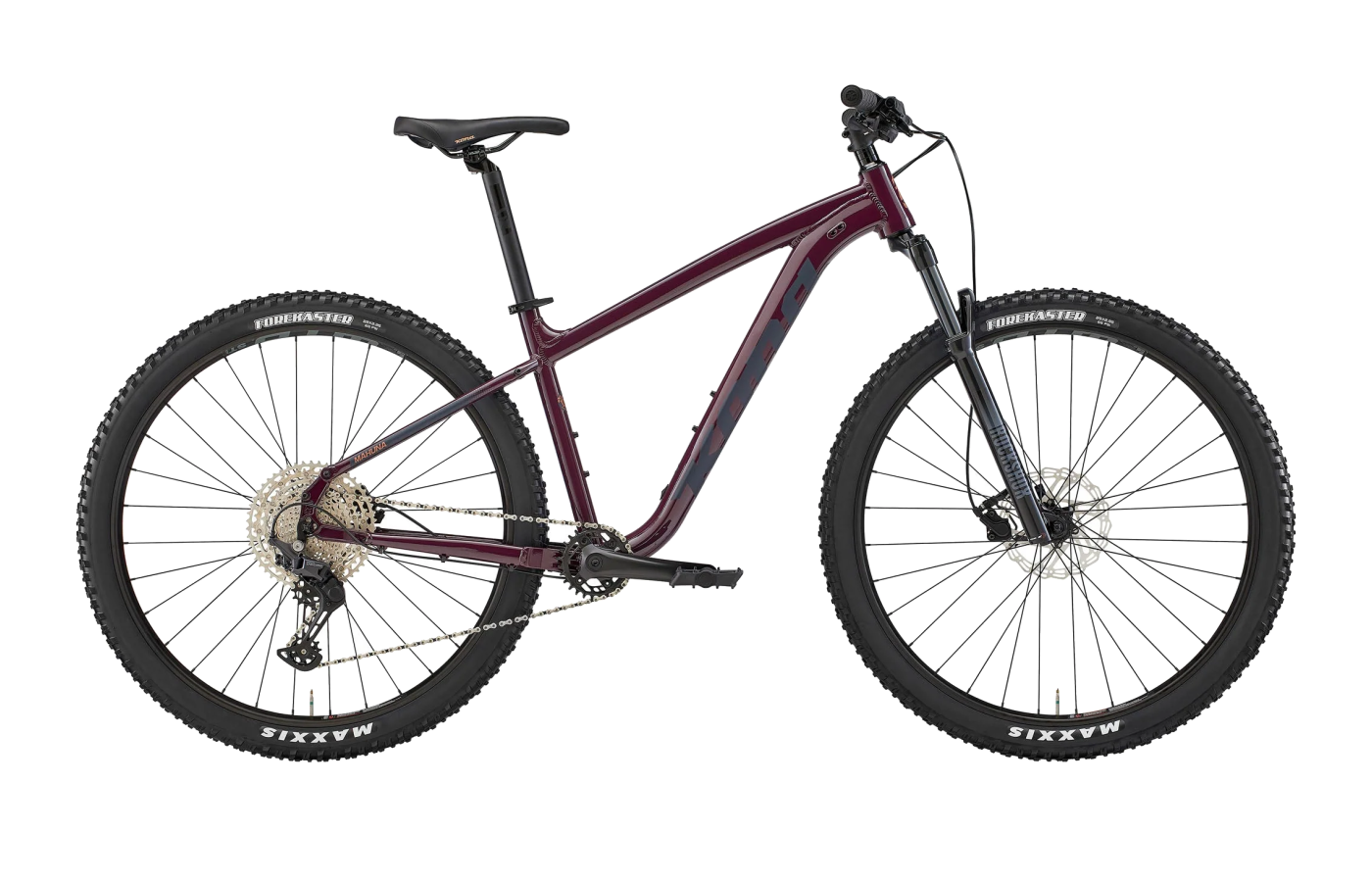
Mahuna
The natural step up from the Cinder Cone — same Kona DNA, but on 29-inch wheels with slightly more aggressive trail kit. Pick this if you want better rollover and high-speed stability on rougher trails.
Compare →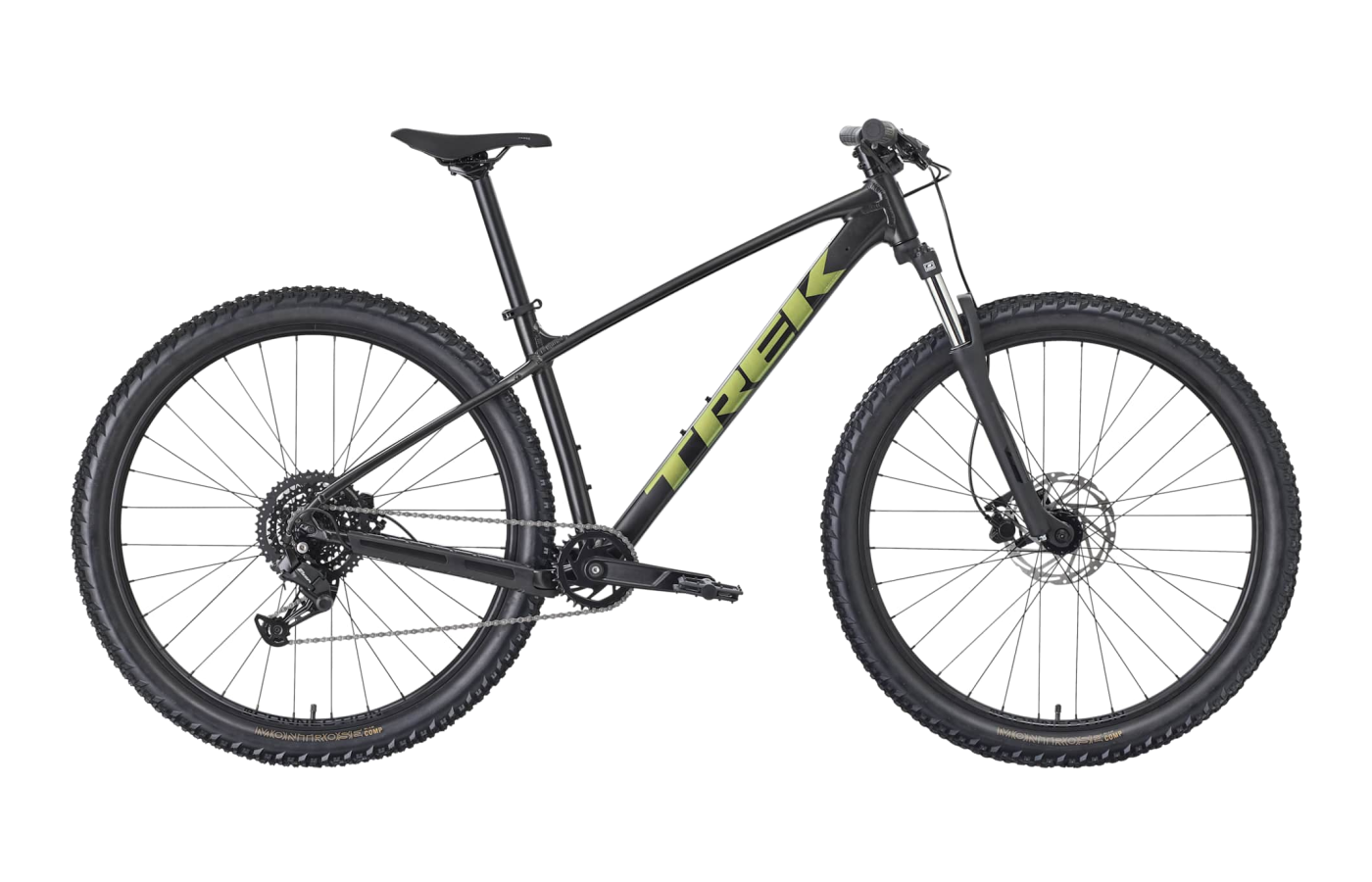
Marlin
The default cross-shop in this segment. Trek's dealer network and consistent updates make the Marlin a perennial benchmark, with builds spanning roughly the same $700–$1,200 range as the Cinder Cone and Fire Mountain.
Compare →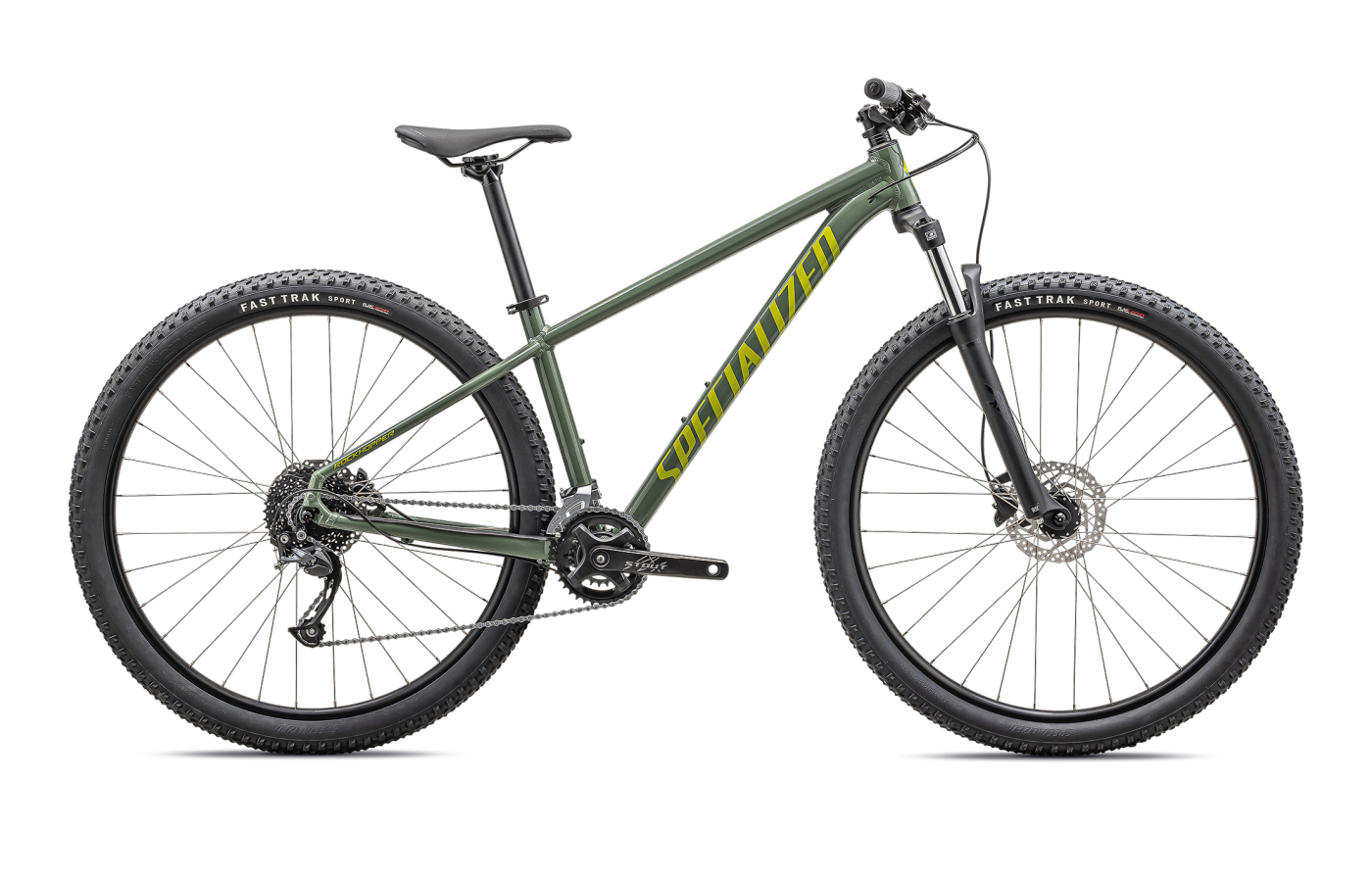
Rockhopper
Specialized's answer at this price — a deep build ladder from sub-$700 mechanical-brake versions up into air-fork territory. Useful if you want one platform to compare across multiple budgets.
Compare →