Status 140
vsStumpjumper
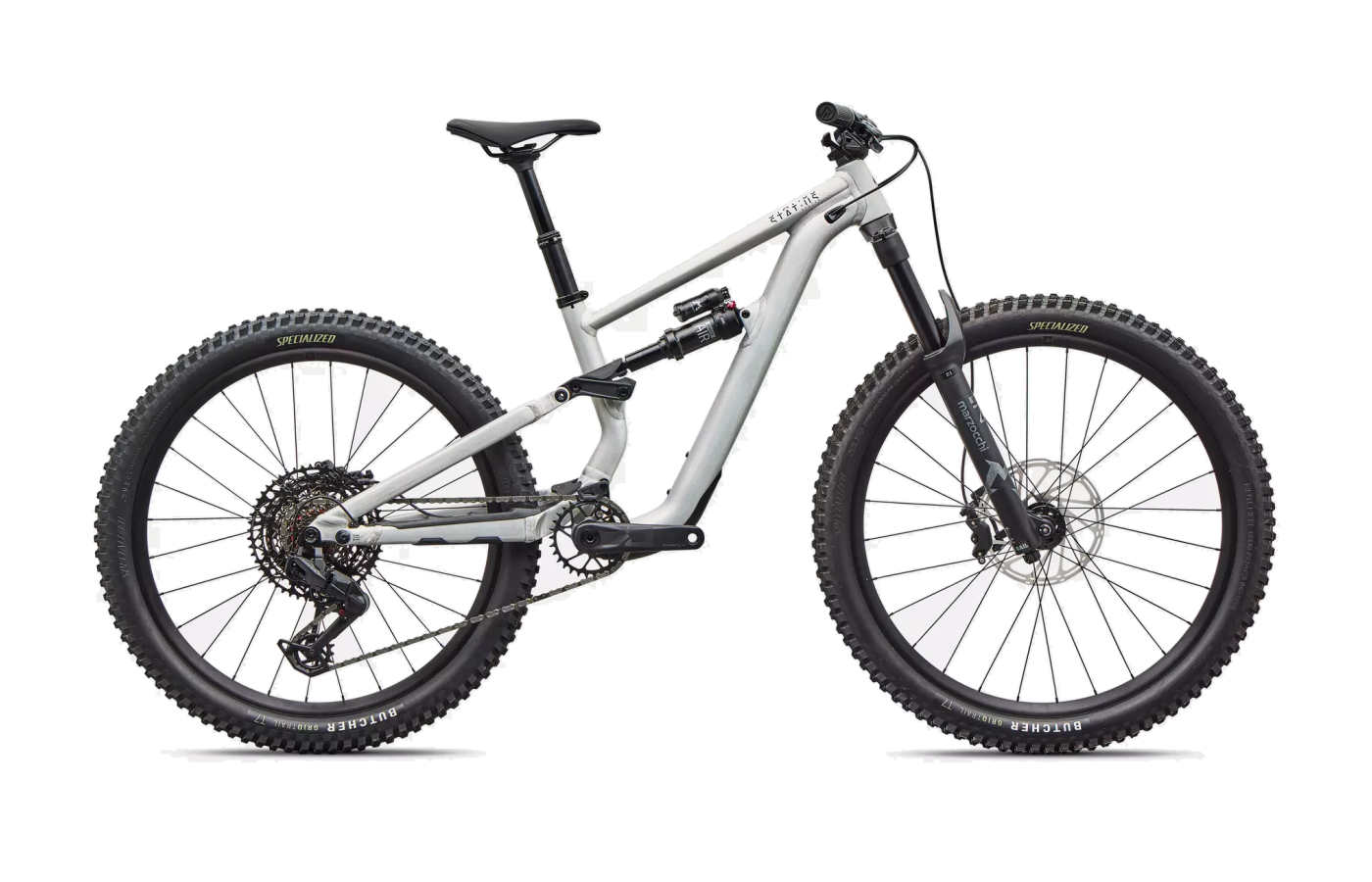
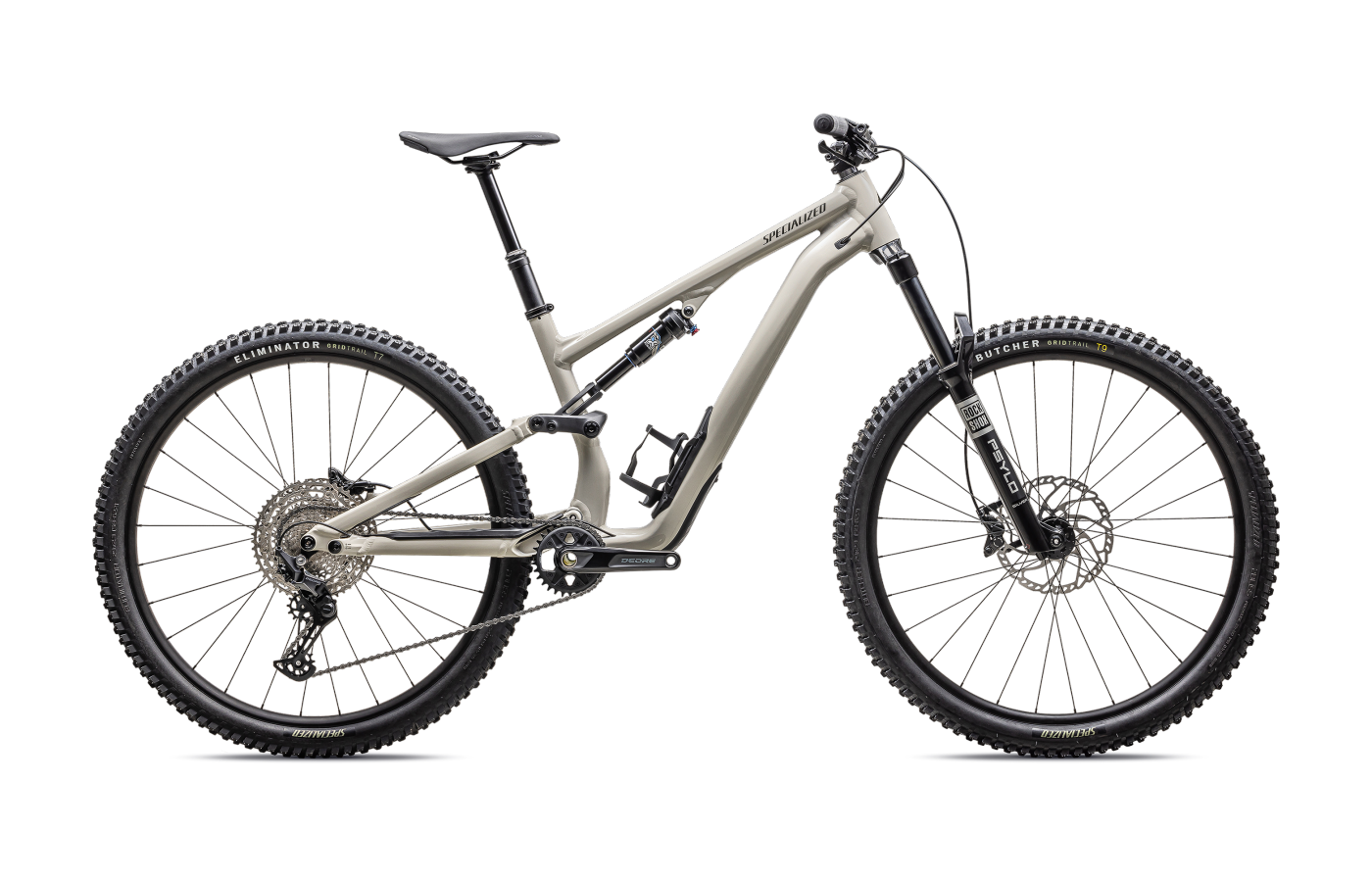
Same brand, different job descriptions.
The Status 140 is a bombproof alloy party bike for under $3k. The Stumpjumper 15 is Specialized's do-it-all trail flagship — with a range that climbs to $12k.
Status 140
- Under $3k — the cheapest way into a serious, modern, gravity-oriented Specialized.
- Bombproof M5 alloy with beefed-up square tubing and a flip-chip — engineered to be thrashed without carbon anxiety.
- Playful geometry — short 427–431 mm chainstays and a 64° HTA make it a flick-and-pop bike, not a plow.
- Heavy (~15.3 kg) — reviewers uniformly flag it as slow on the climbs.
- No carbon option, no Fox Factory upgrades — you cap out at the $2,999 Zero build.
Stumpjumper
- GENIE shock is genuinely different — plush off the top, massively progressive at the end. Flow MTB 'never hit full travel.'
- Wide adjustability — three headset cup positions (63°/64.5°/65.5°) plus a chainstay flip chip lets one bike cover mild trail to bike-park duty.
- Full build range — alloy at $2,999, carbon from $4,999, all the way to S-Works LTD at $11,999.
- Carbon frames are wireless-only — no mechanical shifting, SRAM AXS Transmission is effectively mandatory.
- Alloy builds are heavy (~16.6 kg on the base model) — you pay the weight tax to get in under $3k.
Editor’s analysis
One of these bikes is built to be thrashed. The other is built to adapt — to the climb, the descent, the rider, the terrain.
The Specialized Status 140 and Specialized Stumpjumper 15 share a badge and little else. Both run 140–145 mm of rear travel, both use a Horst-link four-bar, both come from the same Morgan Hill engineering team. But the Status is alloy-only and caps out at $2,999, while the Stumpjumper 15 starts at $2,999 and runs to $11,999 in S-Works LTD trim. That price spread tells you what each bike is really for.
The Status 140 is the gravity-minded rider's entry ticket — a no-frills M5 alloy frame with a flip-chip at the dropout pivot, Marzocchi Z1 fork, Bomber Air shock, and 140 mm travel front and rear. PinkBike called it a bike that 'likes to party': short 427–431 mm chainstays, a 64° head angle in the low setting, and a mixed-wheel setup (29/27.5 on S1–S5; 27.5/26 on the S0 Zero) that snaps from corner to corner. Reviewers uniformly flagged it as heavy, overbuilt, and 'no speed demon on the climbs' — but exactly the bike you want when you'd rather ride laps at the park than baby a carbon frame.
The Stumpjumper 15 is the opposite philosophy. It gets Specialized's FACT 11m carbon on all but the cheapest builds, 145 mm rear travel paired with a 150 mm fork, and the proprietary Fox GENIE shock — a dual-chamber air spring that Flow Mountain Bike described as 'hyper-sensitive' in the first 70% of travel before ramping hard to stop bottom-outs. Three-position headset cups and a flip chip let you tune the HTA between 63° and 65.5°. Reviewers consistently tagged it as 'snappy, versatile, supple, playful' — a genuine quiver-killer.
Put simply: if you're buying one bike to beat on, and the math says $3k is the ceiling, the Status is purpose-built for that. If you want the bike that can be a plush mile-muncher one weekend and a bike-park-capable shredder the next — and you can stretch to carbon — the Stumpjumper is the one. They're not really competing for the same buyer.
Where the builds differ.
Comparing our editor's-pick builds side-by-side. Winners highlighted row-by-row — lower price and weight, and the better-spec component, each mark a point.
Build variants & pricing
Both platforms meet at $2,999 — and diverge hard. The Status ends there; the Stumpjumper keeps climbing for another $9k.
Editor's picks are both at $2,999 to keep the spec table apples-to-apples: the Status 140 Zero (SRAM Eagle 70 T-Type, Marzocchi Z1) vs the Stumpjumper 15 Alloy (Shimano Deore, RockShox Psylo Silver). Step up into Stumpjumper carbon and you leave the Status lineup entirely.
How they fit, how they steer.
Fit-picked for a 5'8" rider on each bike. The Status S0 is the mullet 27.5/26 'Zero' build with a 390 mm reach — short and flickable. The Stumpjumper S3 is the full 29/27.5 mixed-wheel at 450 mm reach, 627 mm stack, and a 435 mm chainstay — longer, taller, more planted.
Which size should I buy?
Size recommendations based on stack, reach, and effective top tube. Status runs S0–S5 (with S0 as a dedicated smaller-rider 'Zero' setup); Stumpjumper runs S1–S6.
→These are starting points. Flexibility, riding style, and preferred position all shift the answer — if you’re between sizes, a professional fit beats a chart.
What the magazines said.
Published reviews from trusted cycling outlets. Click through for the full write-up.
Which one should you buy?
If you want a bombproof alloy bike for under $3k that likes to party, get the Status 140. If you want one bike that can do everything from mile-munching to bike park, get the Stumpjumper 15.
Status 140
If your weekends are bike-park laps, jump lines, and flow trails — and you'd rather spend money on lift tickets than bike upgrades — this is the bike. Overbuilt alloy, Marzocchi workhorse suspension, and geometry that rewards getting sideways.
Stumpjumper
If you want one bike that climbs efficiently, descends confidently, and can be tuned from mellow trail to enduro duty, the Stumpjumper 15 is the benchmark. The GENIE shock and adjustable geometry genuinely earn the 'quiver-killer' label — but you pay for the privilege.
Questions buyers actually ask.
Short answers to the things we get emailed about most often.
01Which climbs better?
The Stumpjumper 15, and it's not particularly close. Its 76.5–77° effective seat tube angle puts you over the bottom bracket for efficient pedaling, and reviewers from Flow MTB and The Loam Wolf specifically praise the GENIE shock's ability to keep the rear wheel glued to the ground on technical climbs — Specialized claims a 57% traction gain.
The Status 140 climbs — reviewers say the 77.6° seat tube angle (high setting) is 'much more modern' than the previous gen — but at 15+ kg with burly tires and workhorse suspension, PinkBike was blunt: it's 'no speed demon up the hill.' It'll winch you to the top; it won't flatter your fitness.
02How much travel does each bike have?
Status 140: 140 mm front, 140 mm rear. The fork is a Marzocchi Z1 across the lineup; the shock is a Marzocchi Bomber Air.
Stumpjumper 15: 145 mm rear, 150 mm front (140 mm front on size S1; 160 mm front on the coil Alloy build). Carbon builds get the Fox GENIE shock; the base Alloy gets an X-Fusion 02 Pro RL. Sizes S3–S6 run full 29; S1–S2 run mixed-wheel (29/27.5).
03Is the Stumpjumper's GENIE shock reliable?
The consensus is yes. Flow MTB and Enduro MTB both reported their test shocks 'worked without fault,' and Specialized says the GENIE uses mostly standard Fox internals — it can be serviced by most Fox-authorized suspension facilities. There is one caveat from the reviews: the inline design (no piggyback) can 'get real hot' on long, sustained descents.
Longer-term, some reviewers flagged proprietary-shock anxiety given Specialized's history with the Brain platform. Worth knowing the frame takes a standard 210x55 mm shock if you ever want to swap it out.
04Which is better value?
Under $3k, the Status 140 Zero ($2,999) and the Stumpjumper 15 Alloy ($2,999) are the head-to-head. The Status gets you SRAM's newer Eagle 70 T-Type drivetrain and the Marzocchi Z1/Bomber Air combo that reviewers consistently praised as robust workhorse suspension.
The Stumpjumper Alloy gets you Shimano Deore M6100, a RockShox Psylo Silver fork, and X-Fusion 02 Pro RL shock — lower-tier suspension than the Status, but the Stumpjumper platform (adjustable geometry, SWAT storage, refined kinematics) and an easier upgrade path. For aggressive park riding, the Status is the better value at that price. For broader trail use, the Stumpjumper frame justifies the tradeoff.
05Can the Stumpjumper be set up as a mullet?
Yes. Sizes S1 and S2 ship mullet from the factory (29 front / 27.5 rear). Sizes S3–S6 are 29/29 stock but can be converted via Specialized's aftermarket mullet link — ~$100–300 depending on market — without voiding warranty.
The Status 140 is always mixed-wheel: the Zero sizes run 27.5/26, and S1–S5 run 29/27.5. No 29/29 option exists.
06Which is more durable?
Both are durable by design, but they're durable for different reasons. The Status 140's M5 alloy frame is intentionally overbuilt — square-section tubing, gusseted seat tube, designed around riders who are hard on equipment. [R]evolution MTB flat-out said it'll 'last you a couple of years' of heavy abuse without frame attention.
The Stumpjumper 15's carbon (FACT 11m) is more fragile to rock strikes and crashes by nature, though Specialized backs both platforms with a lifetime frame warranty and lifetime pivot-bearing replacement to the original owner. If you consistently damage bikes, the Status alloy is the more forgiving choice.
07Is the Status 140 right for a taller rider?
It can be, but check the geometry first. The Status runs S0–S5, with the Zero variant limited to size S0 (designed for smaller riders with the mullet 27.5/26 setup). S1–S5 are the standard 29/27.5 frames with reach scaling up through the range, and chainstays that grow to 436 mm on S4/S5.
Taller riders will fit fine on S3–S5, but note that reviewers specifically called out that the Status frame is 'overbuilt' — expect a heavier bike than the Stumpjumper Alloy at the same price, let alone the carbon builds.
08What warranty do they come with?
Both get Specialized's lifetime frame warranty to the original owner against manufacturing defects, plus lifetime pivot-bearing replacement. Specialized also offers crash-replacement pricing (typically 40–60% off a new frame) for riders who damage their frame in a crash. The alloy Status is arguably cheaper to deal with in a crash scenario because a replacement frame kit is inexpensive relative to carbon.
Similar bikes
If your priorities don’t map cleanly onto either of these, one of these adjacent bikes probably fits better.

Ripmo AF
The budget alloy benchmark — a coil-friendly DW-Link platform with enduro-capable travel, priced much closer to the Status 140 than the Stumpjumper. If you want one bike that punches up into bike-park duty without the Stumpjumper's carbon premium, start here.
Compare →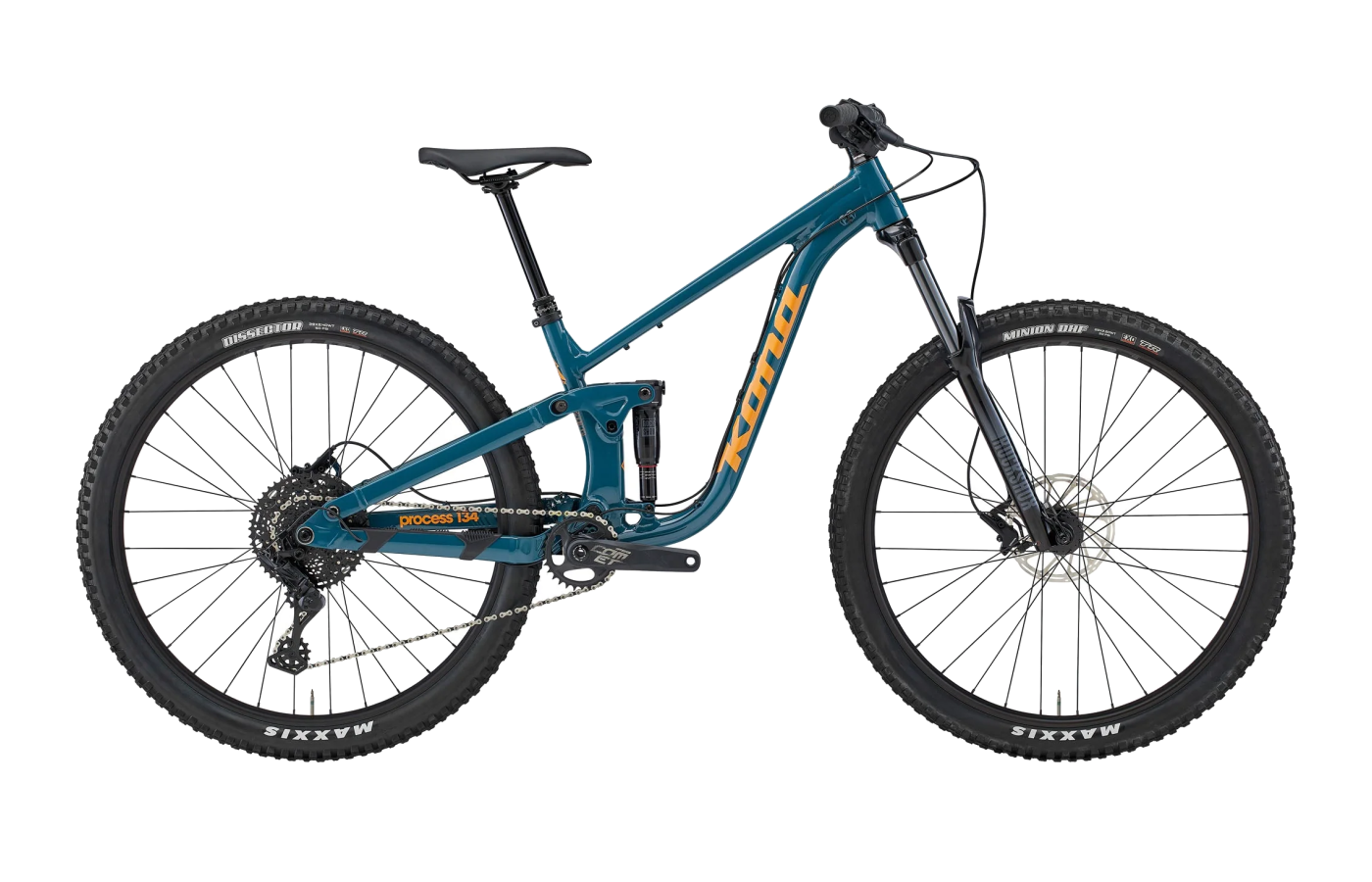
Process 134
A direct spiritual sibling to the Status — 134 mm trail travel, alloy frame, 'fun over fast' character. Lighter than the Status but equally committed to being a get-rowdy-with-it, low-maintenance trail bike.
Compare →Jeffsy
The direct-to-consumer play — trail-capable carbon at aggressive pricing that undercuts the Stumpjumper's mid-tier builds. You lose Specialized's dealer network; you gain a spec sheet that often reads like the next tier up.
Compare →