Crux
vsDomane
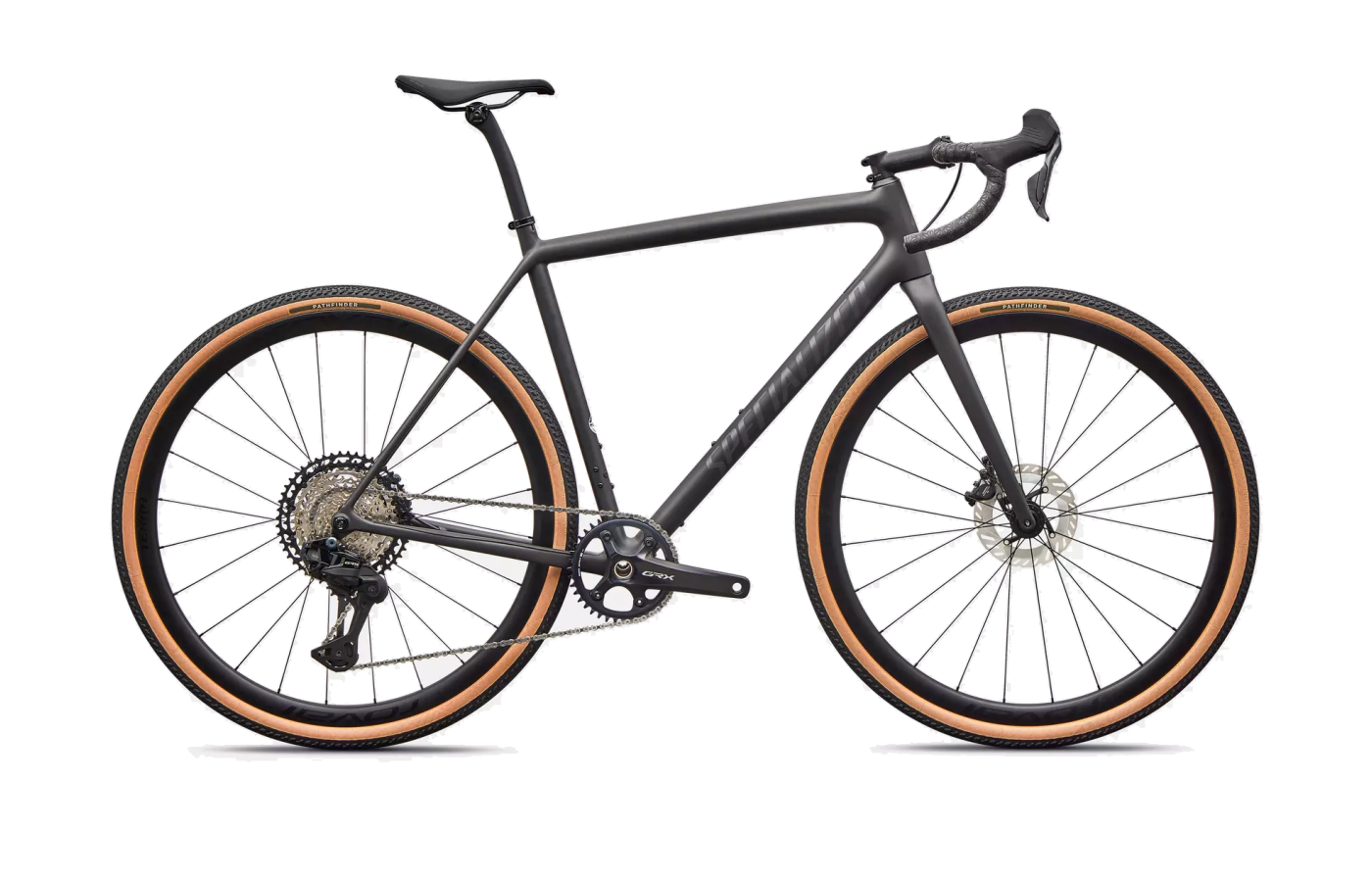
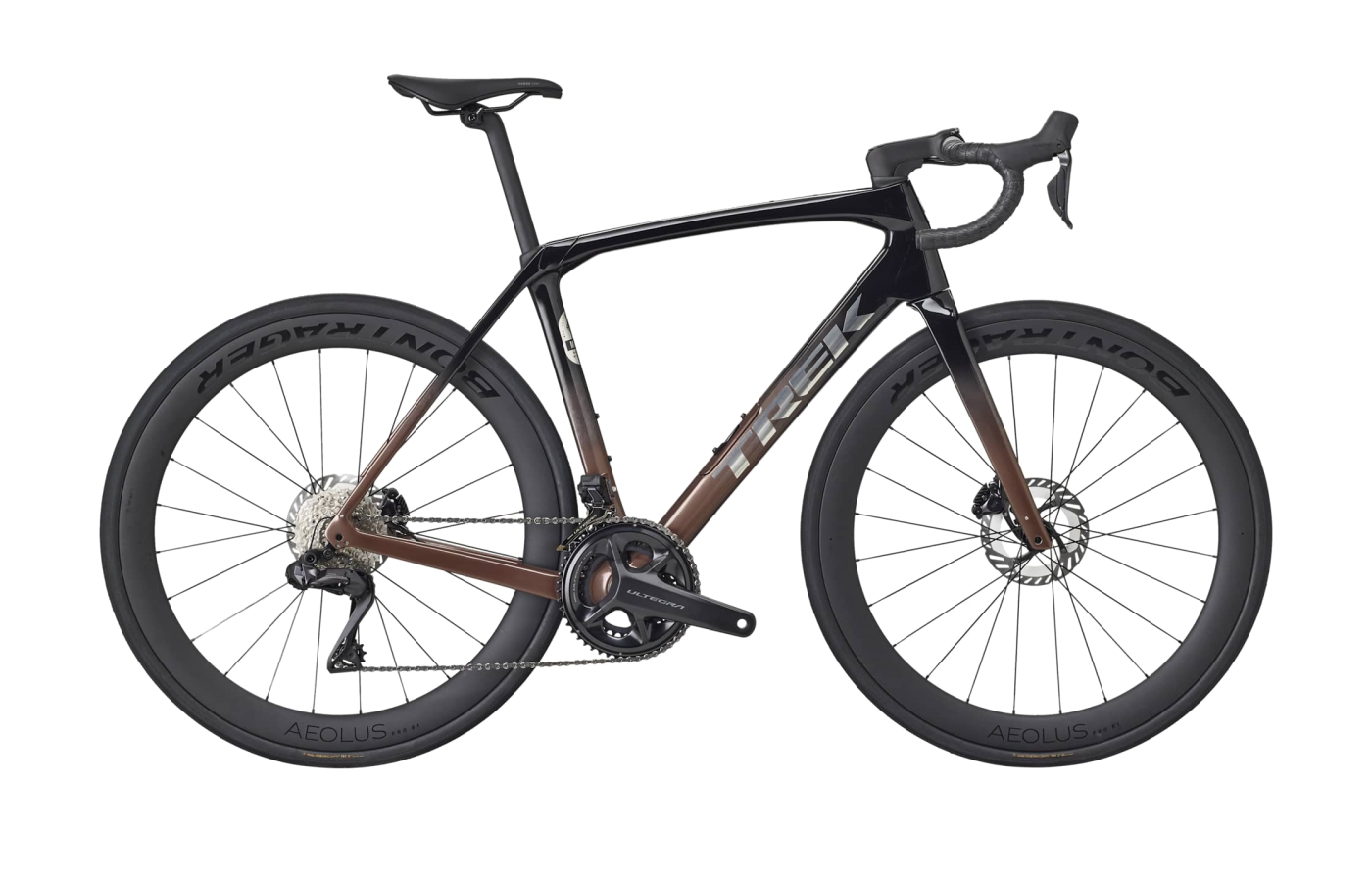
Race-bred gravel meets endurance road.
The Crux is a 7 kg do-everything dropbar built around 47 mm tires. The Domane is a feature-loaded all-road bike with a damper out back.
Crux
- Featherweight frame — S-Works at a claimed 725 g; complete bikes from 6.94 kg.
- 47 mm tire clearance (or 2.1" 650b) — true CX/gravel-race capability without a second frame.
- Refreshingly hassle-free standards — BSA threaded BB, 27.2 mm seatpost, two-piece cockpit. Maintenance is straightforward.
- Stiff, race-oriented ride — testers describe big hits as 'harsh' without going to wider, lower-pressure rubber.
- Almost no mounts — no fender or rack bosses, limited bikepacking utility, and no support for mechanical 2x.
Domane
- Best-in-class endurance comfort — rear IsoSpeed plus 32 mm tires neutralize broken tarmac.
- Built-in utility — internal downtube storage, fender mounts, top-tube bag mounts, three bottle bosses.
- Wide build range — from a $1,199 Claris AL 2 to a $12,499 Red AXS SLR 9, including a class-leading aluminum tier.
- Heavier than the Crux at every tier — and the stock Bontrager Paradigm wheels and R3 tires are widely panned for dulling the ride.
- Internal cable routing through the headset bearing is a documented long-term service headache — replacing bearings means disconnecting hydraulic lines.
Editor’s analysis
Both have drop bars and 32 mm-or-wider tires — but they answer different questions. The Crux asks how light? The Domane asks how comfortable?
The Specialized Crux and Trek Domane share the all-road shopping cart, but they were drawn up by different schools. The Crux is built on the Aethos's lightweight philosophy — round tubes, a 27.2 mm seatpost, threaded BSA bottom bracket, no integration anywhere — and ends up at a claimed 725 g for the S-Works frame. The Domane is the opposite instinct: 800-series OCLV carbon, the IsoSpeed rear decoupler, internal downtube storage, fully internal cable routing, and Kammtail aero shaping. One bike subtracts; the other adds.
Geometry tells the same story. At their fit-picked sizes (Crux 54, Domane 50 for a 5'8" rider), the Crux runs a longer 388 mm reach against the Domane's 368 mm — a 20 mm gap that puts you noticeably more stretched on the Specialized. The Domane's 75–80 mm bottom bracket drop and ~60 mm trail make it one of the most planted bikes in its class; the Crux sits higher (72 mm drop on most sizes) and steers sharper. Reviewers describe the Crux as 'snappy' and 'flickable'; the Domane gets called 'planted' and 'surefooted.'
On surfaces, they only partly overlap. The Crux clears 47 mm tires (or 2.1" 650b), is the lightest gravel bike most testers have ridden, and 'climbs like a mountain goat.' The trade is that on chunky terrain it's described as 'a Bucking Bronco' — fast but unforgiving. The Domane clears up to 38 mm officially (some testers fit 40+), runs IsoSpeed and 32 mm tires for damping, and reviewers call it 'astonishingly comfortable' on broken tarmac and pothole carpet. It does light gravel happily; it does not pretend to be a CX bike.
Put bluntly: the Crux is a gravel race bike that road-rides surprisingly well. The Domane is an endurance road bike that gravel-rides surprisingly well. They overlap in the middle — fast group rides, mixed surfaces, long days — but pick the wrong one and you'll either be sore on washboard or under-tired on dirt.
Where the builds differ.
Comparing our editor's-pick builds side-by-side. Winners highlighted row-by-row — lower price and weight, and the better-spec component, each mark a point.
Build variants & pricing
The Crux runs from a $2,799 alloy DSW Comp to a $11,999 S-Works. The Domane spans even further — $1,199 Claris alloy up to $12,499 Red AXS.
Prices are current US MSRP. Editor's picks are tier-matched: Crux Expert at $6,299 (GRX Di2 1x, FACT 10r carbon) vs Domane SL 7 Gen 4 at $6,799 (Ultegra Di2 2x, 500 Series OCLV) — same one-down Shimano electronic tier, same mid-grade carbon, $500 apart.
How they fit, how they steer.
Different sizing conventions — Crux 54 vs Domane 50 — but both are the fit-picked size for the same rider. The Crux runs 20 mm longer reach (388 vs 368) and 14 mm lower stack (560 vs 546); the Domane drops the bottom bracket lower and slackens the head angle.
Which size should I buy?
Pick by stack, reach, and effective top-tube length. Both lineups are deep — the Crux runs 49–61, the Domane 47–62 — so most riders will find a fit in the middle of either chart.
→These are starting points. Flexibility, riding style, and preferred position all shift the answer — if you’re between sizes, a professional fit beats a chart.
What the magazines said.
Published reviews from trusted cycling outlets. Click through for the full write-up.
Which one should you buy?
If you race gravel or want one bike that's light enough to road-ride, get the Crux. If most miles are paved and you want the smoothest ride in the segment, get the Domane.
Crux
If your weekends are fast group gravel, cyclocross, or mixed-surface rides where the pace is on, the Crux is the sharper tool. It's lighter than most road bikes, accelerates 'like the clappers,' and clears 47 mm rubber when the route gets rough. Just don't expect plushness — this is a race bike.
Domane
If you ride long days on imperfect tarmac and dip onto light gravel for shortcuts, the Domane is the most comfortable bike in this conversation. IsoSpeed plus 32 mm tires erase road buzz; internal storage, fender mounts, and the AL tier make it work as a year-round one-bike garage.
Questions buyers actually ask.
Short answers to the things we get emailed about most often.
01Which is faster on pavement?
Closer than you'd think. The Specialized Crux is 800–1,500 g lighter than an equivalent Trek Domane trim, with 'road-bike levels of power transfer' (Cycling News) and a stock 38–40 mm Pathfinder tire whose slick center tread rolls fast on tarmac. Reviewers consistently describe it as the 'most road-capable gravel bike' they've tested and say it 'keeps up with the roadies like it's no big issue.'
The Domane has the aero edge — Kammtail tube shaping and deep 51 mm Aeolus wheels on the SLR/SL builds — but stock Bontrager R3 tires and Paradigm wheels are widely criticized as 'wooden' and slow. With a wheel/tire upgrade reviewers say the Domane 'wakes up' and feels like a 'comfortable race bike.' Stock-for-stock, on smooth roads, it's a wash.
02Which handles real gravel better?
The Crux, comfortably. It clears 700×47 mm tires (or 2.1" 650b), uses a steeper 71.5–72° head angle and 425 mm chainstays from its cyclocross DNA, and reviewers call it 'snappy, nimble and responsive' on gravel and singletrack. It will dance over chunky terrain rather than bludgeon through it.
The Domane clears 38 mm officially (testers report fitting 40–43 mm) and is tuned for stability — a 75–80 mm bottom bracket drop, ~60 mm trail, ~1,000 mm wheelbase. Velo described its off-road feel as 'rally car' — composed on smooth gravel, but the geometry is 'road-first' and standard road derailleurs without a clutch will chain-slap on rougher sections.
03How comfortable is each over four-hour days?
The Domane is the benchmark. The rear IsoSpeed decoupler is described as 'astonishingly comfortable' and Trek tuned the Gen 4 to match the softest setting of the previous adjustable system. Combined with stock 32 mm tubeless tires and a tall stack, reviewers say the 'numbers on the bike computer melt away.'
The Crux has no mechanical damping. Compliance comes from the carbon layup, the 27.2 mm exposed seatpost, and (mostly) tire choice. Reviewers found the rear end commendable but the front end 'ever so slightly harsh on bigger hits' and 'exaggerated vibrations' through the thin fork on rough terrain. On smooth roads it's fine; on washboard gravel, hands fatigue.
04What's the weight difference?
Substantial. The Crux S-Works comes in around 6.94 kg in size 56 with a claimed 725 g frame. The mid-tier Crux Expert is 7.95–8.1 kg. Even the alloy DSW Comp is around 9.4 kg.
The Domane SLR 9 is 7.34 kg (Dura-Ace Di2) or 7.58 kg (Red AXS) for the flagship. The SL 7 Gen 4 — our editor's pick — comes in at 8.42 kg, and the SL 5 at 9.09 kg. The IsoSpeed hardware and storage compartment add weight no amount of carbon layup will erase. Tier-for-tier, the Crux is roughly 500–800 g lighter.
05Does the Domane really do gravel, or is the Crux a better all-rounder?
The Domane is a road bike that does light gravel well. With 38 mm clearance and a low-slung, planted geometry, it handles fire road and chip-seal happily and many testers run 40 mm setups successfully. But on technical singletrack or sustained chunk it gives up to a real gravel bike.
The Crux is a gravel race bike that does road surprisingly well. Drop the tires to 32 mm slicks and reviewers say it 'returns to the tarmac and keeps up with the roadies.' If your one-bike use case includes any actual gravel racing, cyclocross, or rough off-road, the Crux is the better all-rounder. If it's 90% paved, the Domane wins.
06What about reliability and known issues?
The Domane Gen 4 has two well-documented issues. The first is a creaking/slipping seatpost tied to the IsoSpeed wedge — Trek has issued multiple revised wedges (Revision 2 and Revision 4) to fix it, but reviewers report parts can be backordered. The second is the headset-routed cables: replacing upper headset bearings requires disconnecting hydraulic lines and re-bar-taping, and the upper bearing is exposed to sweat and road spray.
The Crux is a simpler animal. BSA threaded bottom bracket, external seat clamp, two-piece cockpit, partially external cable routing — reviewers call it 'refreshingly hassle-free.' One tester reported isolated issues with their Expert (loose headset, broken spoke) but the platform is broadly considered low-maintenance.
07Can either run a 2x mechanical drivetrain?
Crux: No — the frame's cable routing won't accommodate a front derailleur cable, so 2x is electronic-only. 1x mechanical (GRX, Apex) is fine.
Domane: Yes. The lineup includes 2x mechanical builds across the SL 5 (105 R7120), AL 5 (105 R7120), AL 4 (Tiagra), and AL 2 (Claris). If you want a modern dropbar with cable shifting and a front derailleur, the Domane is one of the few flagship platforms still offering it from the factory.
08Which lineup has better budget builds?
The Domane, by a clear margin. Trek goes down to the AL 2 Gen 4 at $1,199 (Claris 8-speed) and the AL 5 at $2,099 (105 12-speed) — both on a refined Alpha Aluminum frame that won BikeRadar's Budget Road Bike of the Year for 2024.
The Crux stops at the DSW Comp at $2,799 (alloy frame, SRAM Apex) — well-built but more than twice the Domane's entry price. If your budget is under $2,000 and you want a new dropbar bike from either of these brands, the Domane is your only option here.
Similar bikes
If your priorities don’t map cleanly onto either of these, one of these adjacent bikes probably fits better.
Diverge
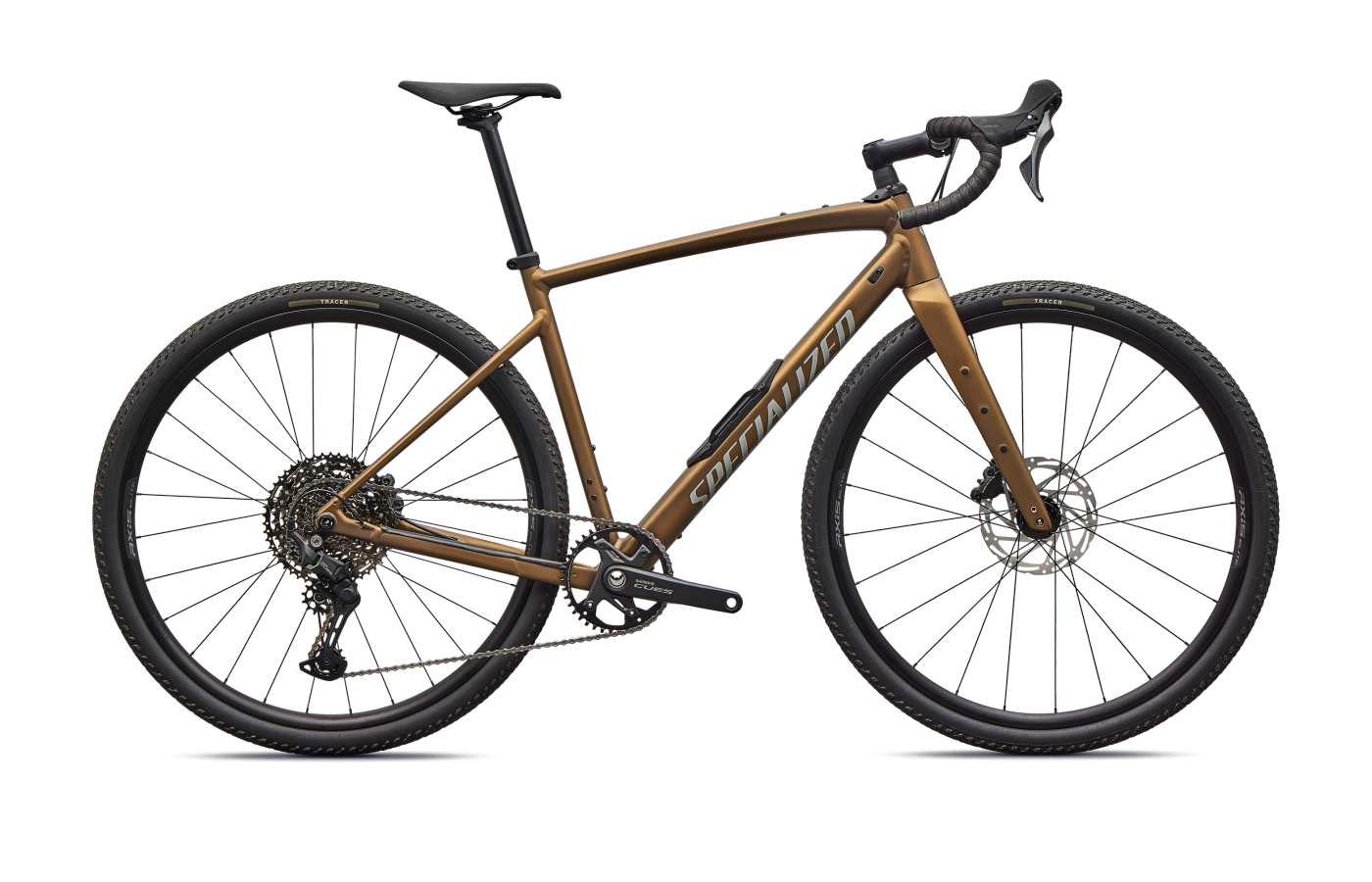
Specialized's other gravel play — same family, opposite philosophy. Future Shock front suspension, slacker geometry, and the rack and bikepacking mounts the Crux refuses to add. The right choice if you find the Crux too aggressive and want to load it up.
Compare →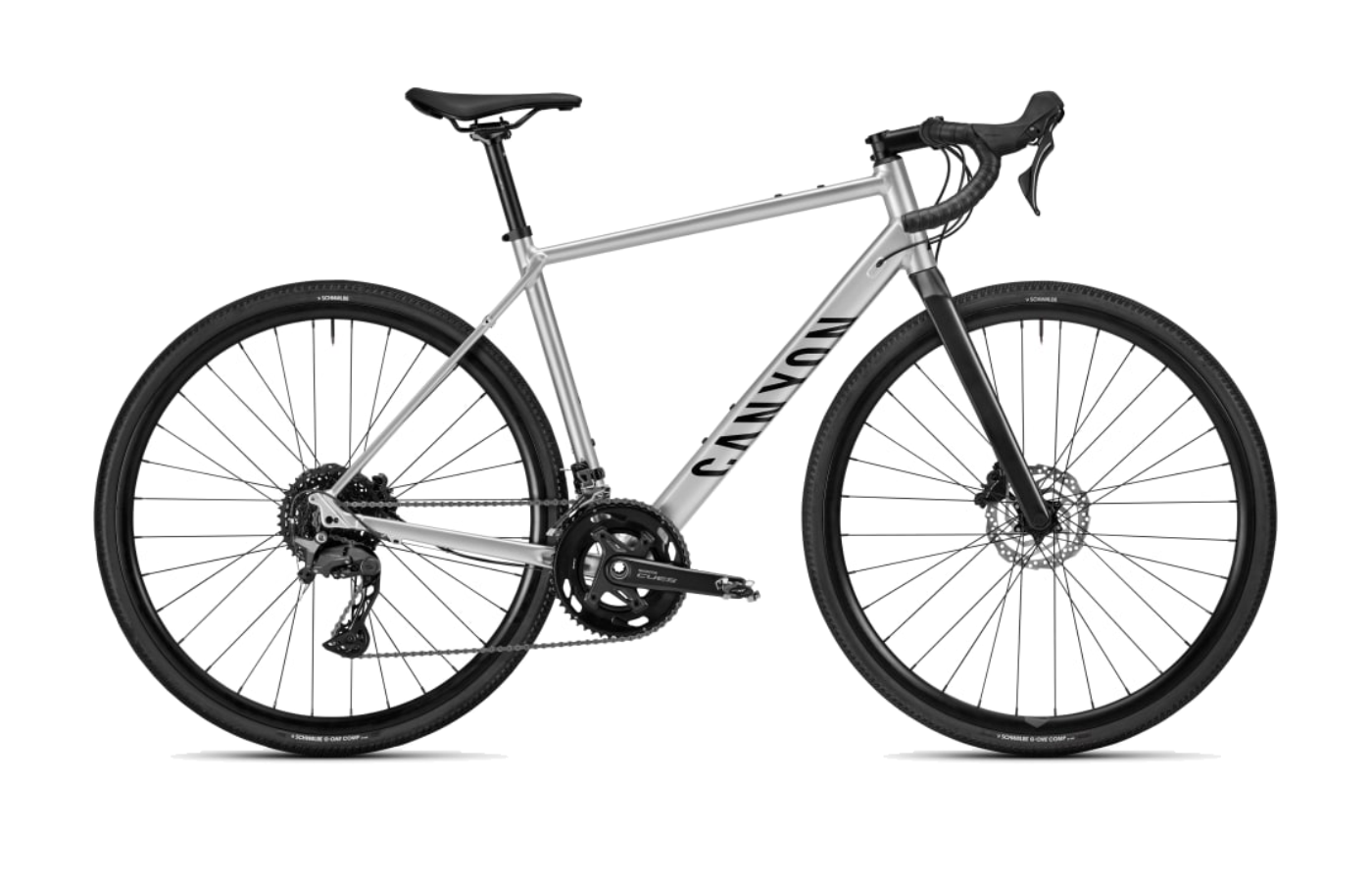
Endurace
Canyon's endurance flagship — direct-to-consumer pricing typically lands you a higher component tier than the Domane for the same money. The catch is no local dealer, no test ride.
Compare →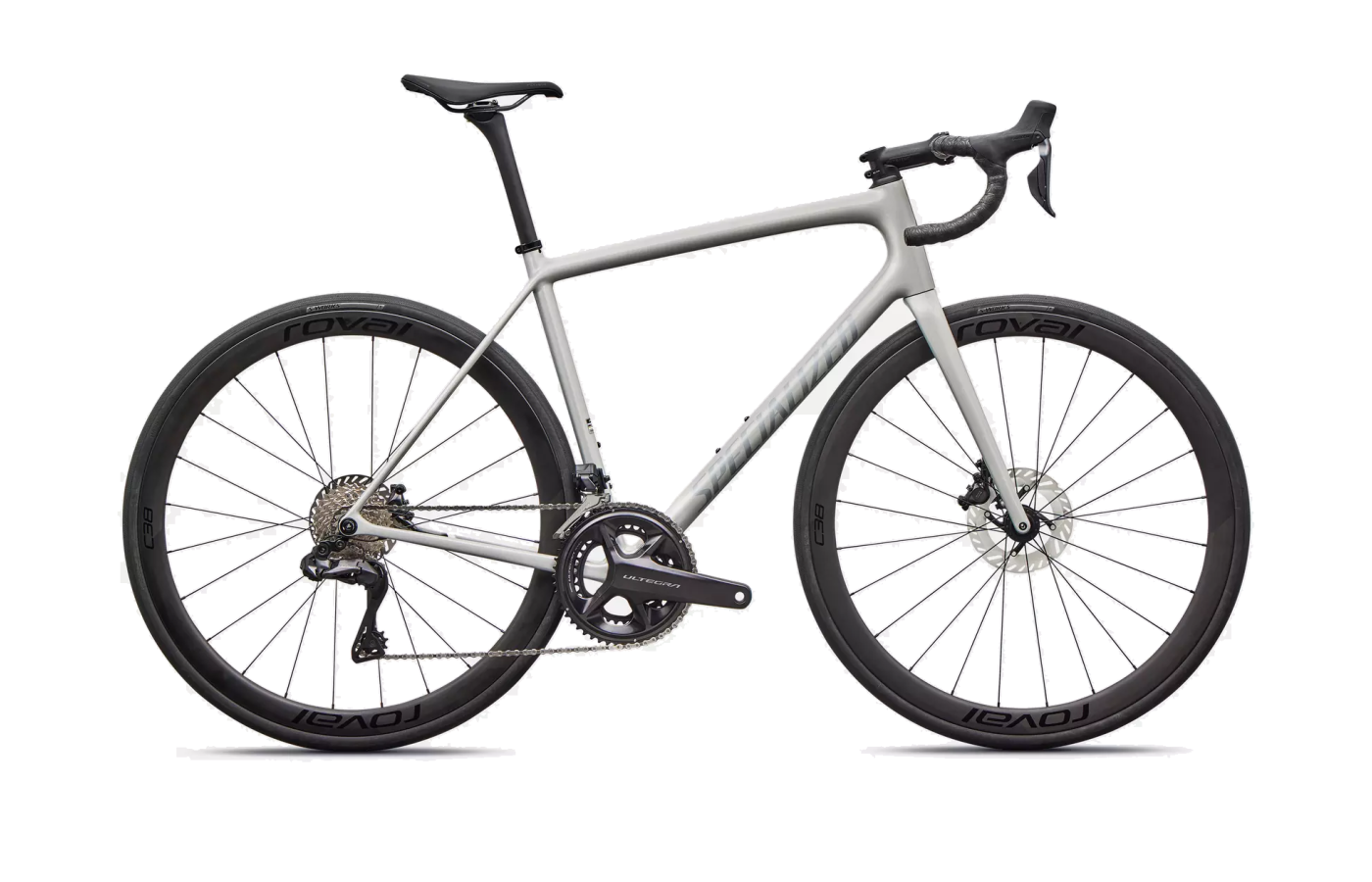
Aethos
If the Crux's round tubes and 6.x kg weight appeal but you've never actually ridden gravel, this is the road-only sibling. Same minimalist Aethos design language, narrower clearance, even lighter.
Compare →