Ostro VAM
vsDogma F
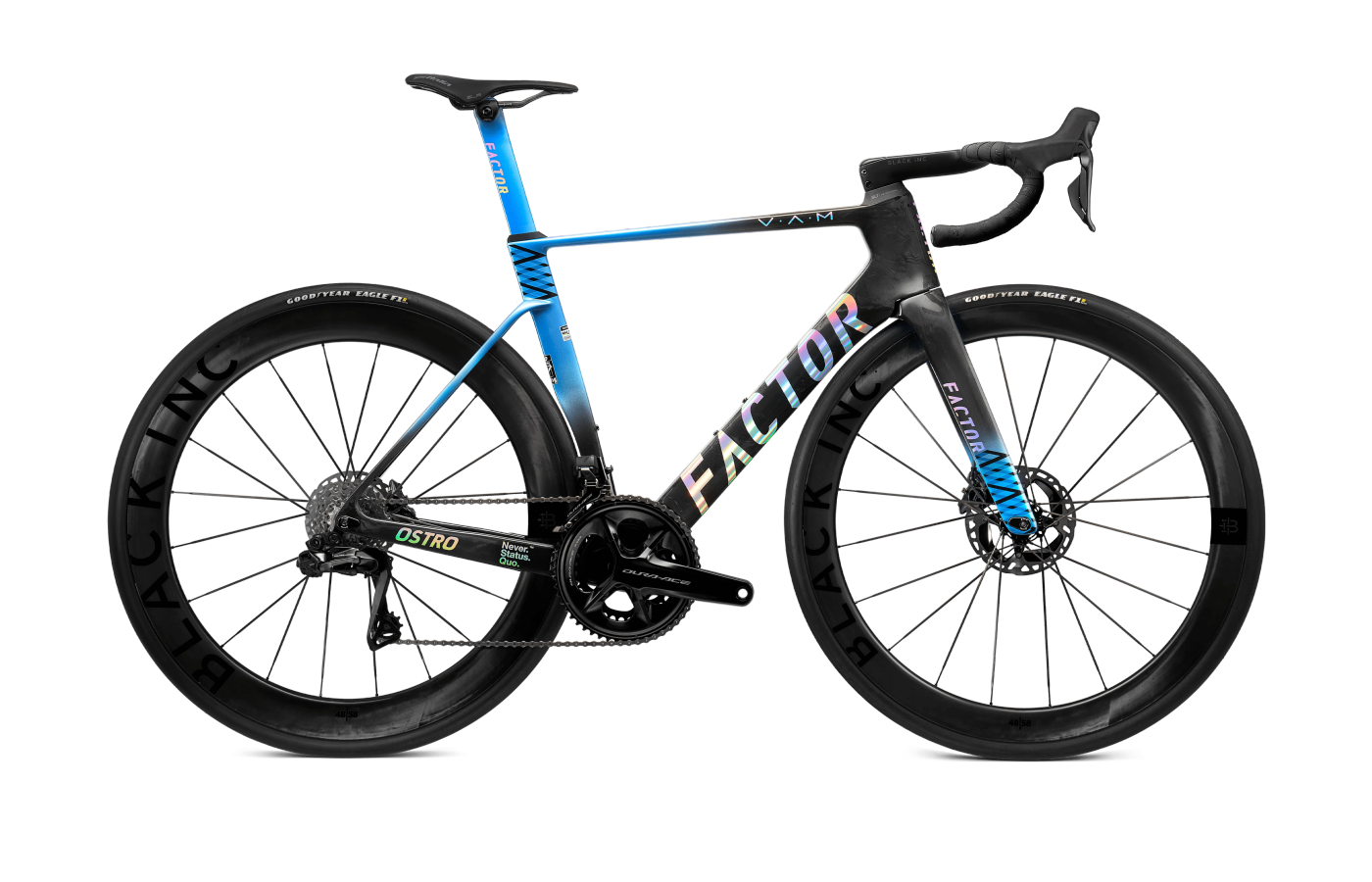
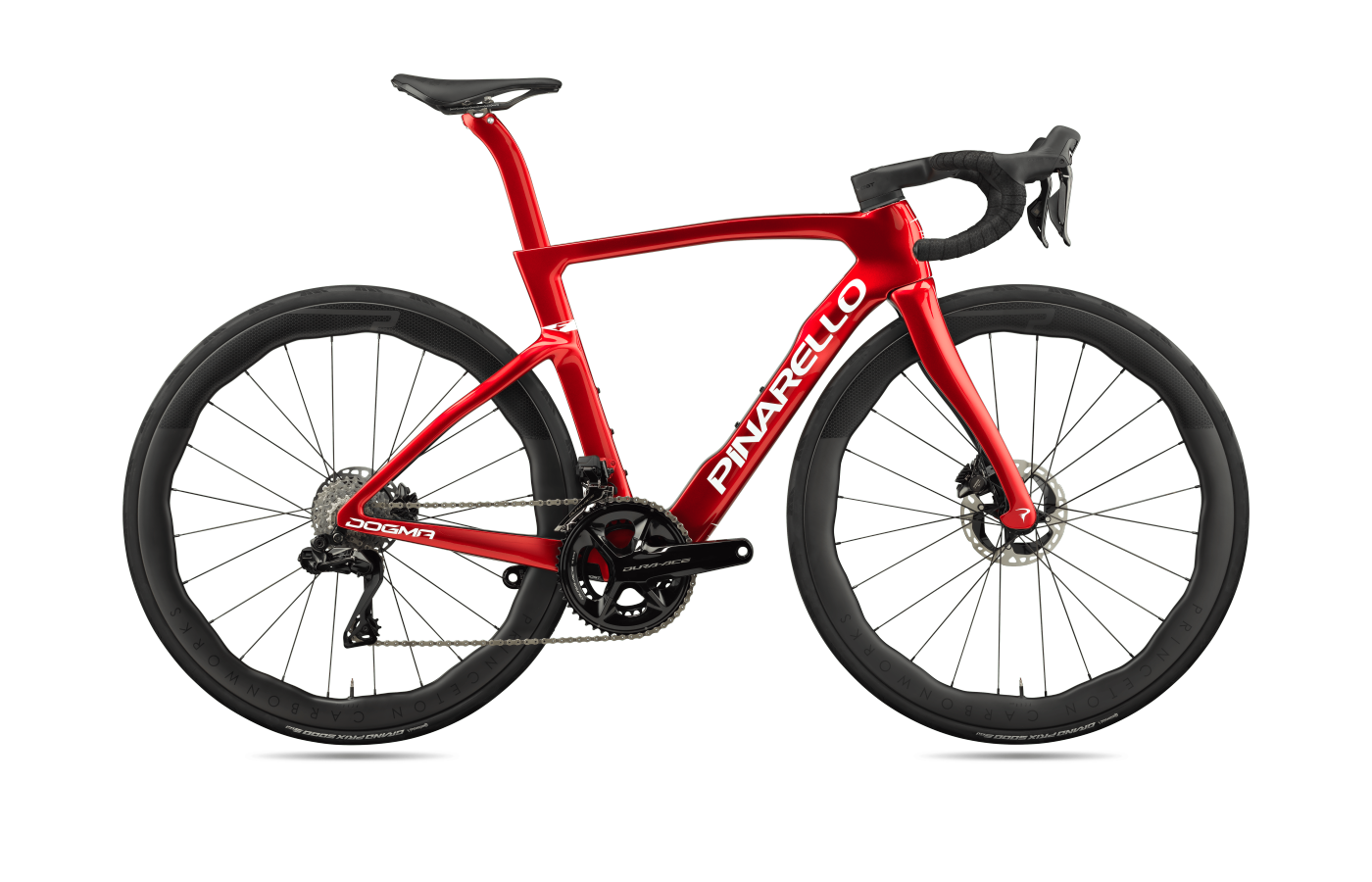
Two flagships, two temperaments.
The Factor Ostro VAM is the engineer's superbike — light, aero, and surprisingly civil. The Pinarello Dogma F is the racer's tool, sharpened to a single point.
Ostro VAM
- Compliance without the weight penalty — a 15 mm slimmed seatpost and dropped stays soak the rear, while the frame still hits 820 g painted at size 54.
- Constant trail across all 7 sizes — four fork offsets keep handling identical from a 45 to a 61, a fit-engineering rarity.
- CeramicSpeed throughout, standard — T47 bottom bracket and SLT headset bearings on every build, not just the flagship.
- Stock Goodyear Eagle F1 tires are repeatedly flagged as flat-prone — budget for a tubeless GP5000 swap.
- Carbon-spoke Black Inc wheels are stiff and light but harder to service if you damage one.
Dogma F
- Reference-point handling at speed — the 47 mm fork rake is the most-praised geometry change in the segment this cycle.
- Frame stiffness at the limit — Toray M40X carbon delivers "not a whiff of flex" through the bottom bracket under sprint loads.
- Italian threaded BB — low-creak, easy-service, no proprietary tools required.
- Race-bred firmness can feel jarring on rough roads — Pinarello points compliance-seeking buyers at the Dogma X instead.
- The 2025 model swaps the previous CeramicSpeed SLT headset for sealed bearings in an aluminum cage — a downgrade that hurts long-term given the integrated routing.
Editor’s analysis
Both bikes win WorldTour stages. Only one of them is built to be ridden by anyone but a WorldTour pro.
On paper, these two share a DNA: deep aero tubes, integrated cockpits, Dura-Ace Di2, deep carbon wheels. Both clock in around 6.7-6.8 kg in their top trim. Both sit in the all-rounder aero-race bracket the segment converged on after the Tarmac SL8 set the template. But the philosophies underneath could not be further apart.
The Factor Ostro VAM is the bike that refuses to pick a fight with itself. Reviewers consistently use the phrase "jack of all trades, but to a really high standard" — it's stiff but not harsh, fast but not nervous, aero but not crosswind-twitchy. Factor offset four different fork rakes across seven sizes to hold trail at a near-constant 57-58.6 mm — a level of size-specific engineering most brands skip. The result is a bike that climbs like a 6.7 kg climbing bike, holds 41 km/h on the flats, and descends like a much slacker bike. The CeramicSpeed T47 bottom bracket and SLT headset bearings are standard, not upcharges.
The Pinarello Dogma F is the opposite move: pick the lane, sharpen the lane, ignore everything else. Reviewers describe the frame as "one of the stiffest I've ever ridden" with "not a whiff of flex anywhere" — and that's exactly the brief. Pinarello increased the fork rake from 43 to 47 mm at the request of Ineos Grenadiers riders, shortening trail to make low-speed steering whip-sharp while letting the longer wheelbase carry the high-speed line. Road.cc explicitly warns that on "typical UK roads" the Dogma F's vibration becomes "a touch jarring after a while" — Pinarello's answer is to point you at the more compliant Dogma X.
There's also a $3,400 gap at the Dura-Ace tier — the Pinarello costs nearly 28% more for what is, by most objective measures, the same component package on a stiffer, less compliant frame. You're paying for the Pinarello name, the Ineos pedigree, and a degree of handling refinement that you have to be very quick to actually exploit. The Factor Ostro VAM is the one most amateurs should buy. The Dogma F is the one a few of them will want anyway.
Where the builds differ.
Comparing our editor's-pick builds side-by-side. Winners highlighted row-by-row — lower price and weight, and the better-spec component, each mark a point.
Build variants & pricing
Factor offers four builds spanning $10.4k–$12.6k, including Ultegra and Force tiers. Pinarello sells the Dogma F only at flagship — Dura-Ace and Red, both $15,750.
Prices are current US MSRP. The lack of a sub-flagship Dogma F build is intentional — Pinarello positions the F7 and Dogma X for buyers seeking lower price points. The Factor lineup makes the platform accessible at roughly $5,000 less than the Pinarello floor.
How they fit, how they steer.
Factor's 54 sits 9 mm lower at the head tube than Pinarello's 510 (542 vs 551 mm stack), with effectively identical reach (384 vs 385 mm). The Factor uses a slacker 72.5° head tube angle and runs a constant ~58 mm trail; the Dogma F is 72.8° with shorter trail thanks to the new 47 mm fork rake.
Which size should I buy?
Pinarello offers 11 sizes (425–600), Factor seven (45–61). Both span the same fit envelope, but the Dogma F's finer increments give an edge if you sit between two sizes.
→These are starting points. Flexibility, riding style, and preferred position all shift the answer — if you’re between sizes, a professional fit beats a chart.
What the magazines said.
Published reviews from trusted cycling outlets. Click through for the full write-up.
Which one should you buy?
If you want a do-everything race bike with civility built in, get the Factor. If you want the WorldTour weapon and the badge to match, get the Pinarello.
Ostro VAM
If you want one bike for crits, climbs, group rides, and the occasional century — and you want Dura-Ace, CeramicSpeed bearings, and aero wheels in the box at a price that isn't insulting — the Ostro VAM is the smarter spend. It also doesn't punish you on rough pavement, which Pinarello can't honestly claim.
Dogma F
If you race, the roads are smooth, and the Ineos heritage actually matters to you, the Dogma F delivers the sharpest handling in the category and a frame stiffness that rewards every watt. Just know what you're buying — race-day refinement at a $15,750 entry price, not an everyday companion.
Questions buyers actually ask.
Short answers to the things we get emailed about most often.
01Which is faster on the flats?
The Factor Ostro VAM, by a small margin in independent wind-tunnel work. Cyclingnews ranked it "one of the fastest" in their tunnel test against top-tier rivals, and Factor claims a 7-watt saving at 48 km/h over the previous Ostro generation. Pinarello claims a 0.2% CdA reduction on the new Dogma F but declined to translate that into watts when pressed by Cyclist.
In practical terms, the two are close enough that the wheels and the rider's position will dominate any timed result.
02Which climbs better?
Both. A Dura-Ace Ostro VAM hits a claimed 6.7 kg complete; the Dura-Ace Dogma F is 6.77 kg at size 53 — a difference too small to matter on the road. Reviewers consistently call the Ostro VAM a "willing partner uphill" that punches above its weight; the Dogma F is praised as a "natural climber" with "snappy responsiveness on sharper ramps."
BikeRadar found the Dogma F lacked some out-of-saddle urgency versus the more endurance-focused Dogma X, but that's an internal Pinarello comparison, not a knock against the Ostro VAM.
03What's the maximum tire clearance?
Factor Ostro VAM: 32 mm officially.
Pinarello Dogma F: 30 mm officially (BikeRadar measured this; Cyclist quoted 32 mm but the official Pinarello number is 30). Both ship with 28 mm Continental GP5000 S TR tires as standard.
Neither has the clearance for proper rough-road or gravel duty — for that, look at endurance frames like the Roubaix or the Pinarello Dogma X.
04How does the geometry differ at the same size?
At the size picked for a 5'8" rider — Factor 54, Pinarello 510 — the reach is essentially identical (384 vs 385 mm) but the Dogma F sits 9 mm taller at the head tube (551 vs 542 mm stack). The Factor uses a 72.5° head tube angle versus 72.8° on the Pinarello.
The big handling story is trail: Factor uses four different fork offsets across seven sizes to hold trail near-constant at 57–58.6 mm. Pinarello increased fork rake from 43 to 47 mm on the new Dogma F to shorten trail and sharpen low-speed steering — a change requested by Ineos Grenadiers riders.
05Why is the Pinarello so much more expensive?
There is no clean answer that doesn't include the brand. At Dura-Ace, the Dogma F is $15,750 versus $12,299 for the Ostro VAM — a $3,451 gap for what is, by most metrics, a lighter component spec on the Factor (Black Inc carbon-spoke wheels are notably lighter than the Princeton Peak 4550s).
Road.cc rated the Dogma F's value at 4/10 and noted it costs roughly £1,000 more than an S-Works Tarmac SL8 with a power meter included. Pinarello's pricing reflects WorldTour heritage, the Ineos partnership, and Italian-made cachet — none of which show up on a watts-per-dollar chart.
06Are the integrated cockpits serviceable?
Both use proprietary one-piece cockpits with internal hose routing, so changing bar width or stem length means buying a new unit and re-routing — a 60–90 minute shop job in either case.
The Factor's Black Inc Aero Barstem comes with an unusual perk: at order time, Factor lets you spec your bar width, stem length, saddle setback, and crank length at no extra cost. That's unusual at this price tier and removes most of the after-purchase swap pain.
The Pinarello MOST Talon Ultra Fast offers 28 length/width combinations from the factory but locks you into the MOST ecosystem because of its proprietary elliptical steerer.
07Do either come with a power meter?
Not as standard. Factor lets you spec a Quarq or Shimano power meter at order time on the Dura-Ace and Force builds for a transparent upcharge — the SRAM Red and Force builds in this lineup are listed with the power meter spec already.
The Dura-Ace Dogma F does not include a power meter, which BikeRadar called out as a notable omission at the $15,750 price point — particularly since the slightly cheaper Dogma X does include one.
08Long-term, which holds up better?
The Factor frame benefits from Factor's in-house Taiwan facility and an unusually transparent material story (Toray, Nippon Graphite, pitch-based fiber, TeXtreme). The V2 also fixed the V1's seatpost-clamp slipping issue with a redesigned wedge — reviewers confirmed it works.
The Pinarello frame is universally praised as "top tier throughout," but the 2025 model downgraded the headset from a CeramicSpeed SLT (lifetime warranty) to a sealed bearing in an aluminum cage. Given how labor-intensive a headset service is on an integrated-routing frame, this is a real concern for owners planning to keep the bike past three years.
Similar bikes
If your priorities don’t map cleanly onto either of these, one of these adjacent bikes probably fits better.
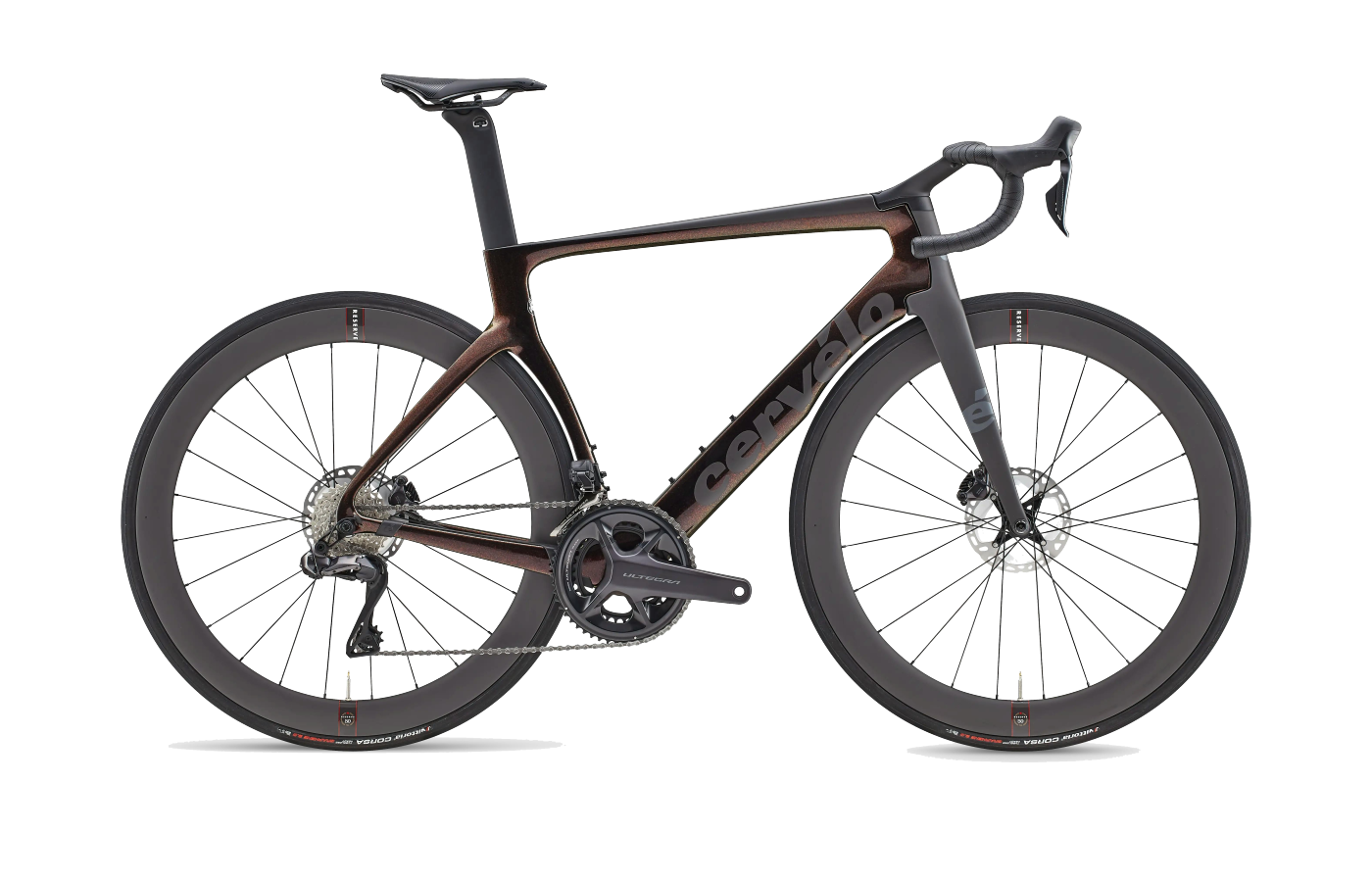
S5
The aero-only specialist of the bunch — Cervélo's S5 picks the same lane as the Dogma F (pure speed above 35 km/h) but with a more livable ride and a wider build range that starts well below either of these two.
Compare →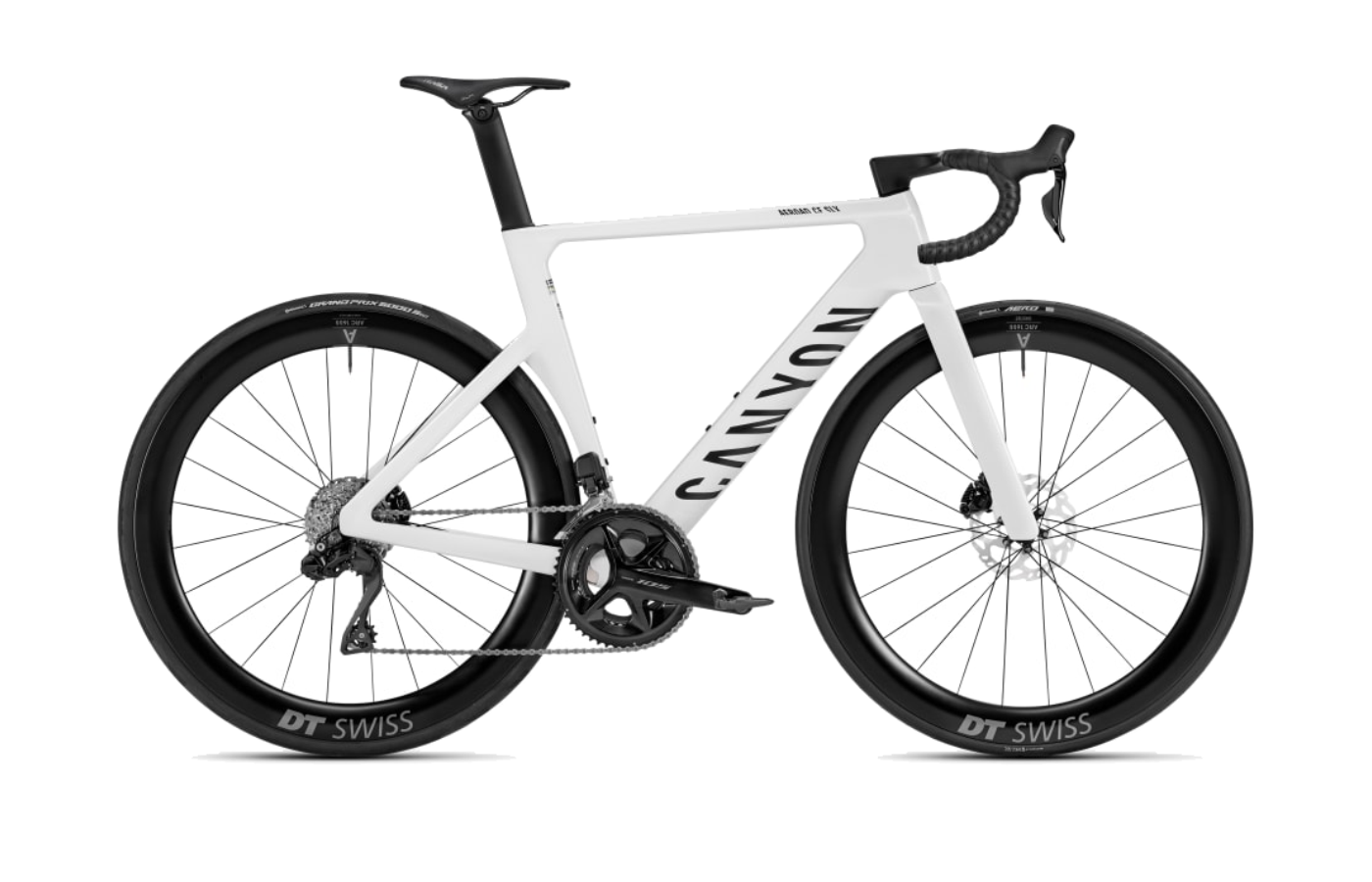
Aeroad
Same WorldTour-aero philosophy as the Dogma F at roughly half the price — the direct-to-consumer catch is no dealer network and no demos. Best if you already know your fit.
Compare →
V4Rs
Pinarello's natural Italian rival, raced to multiple Tour wins under Pogačar. The V4Rs is a touch lighter and a touch more compliant than the Dogma F, and it costs less at the Dura-Ace tier.
Compare →