Lux Trail
vsEpic
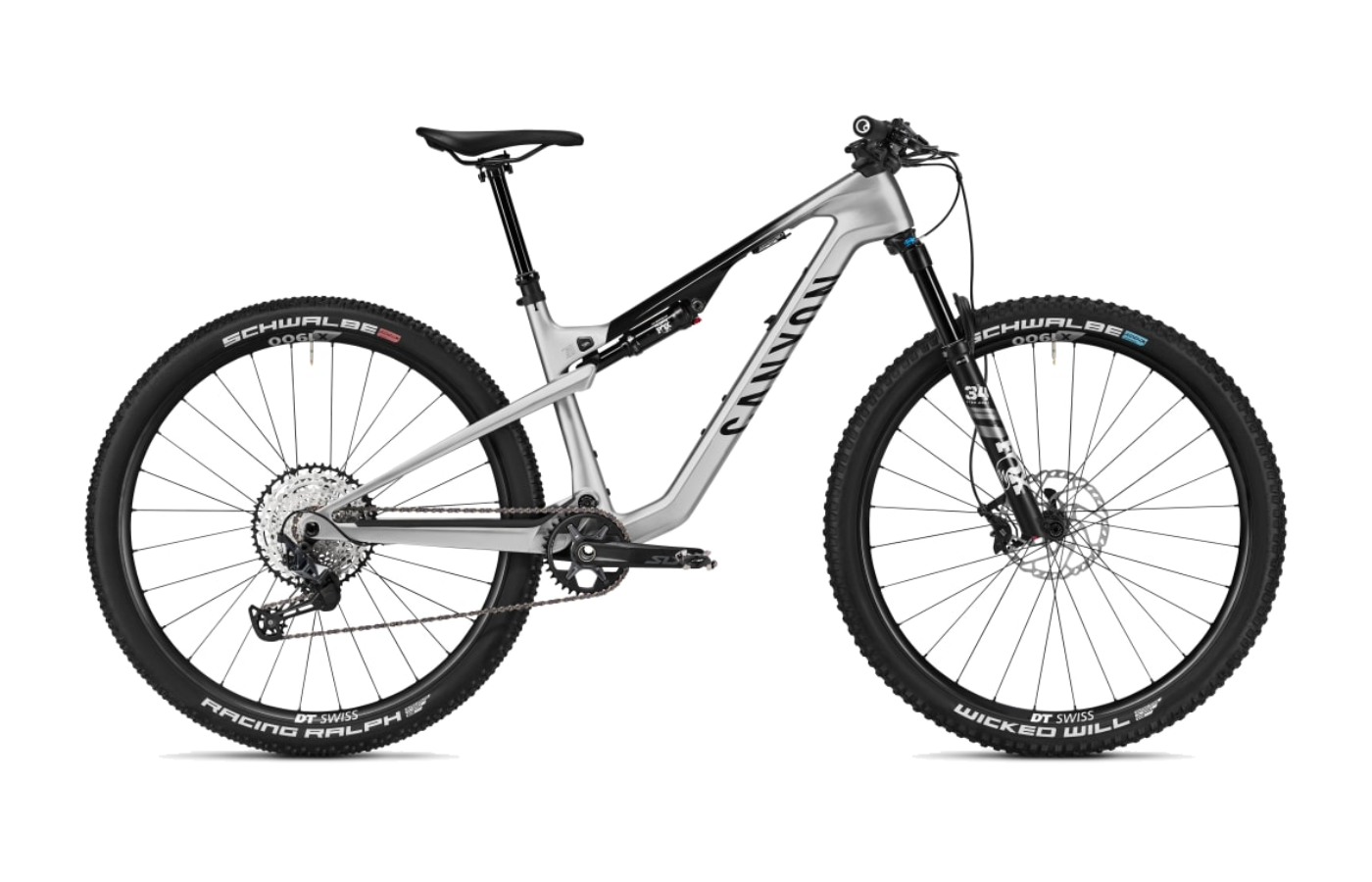
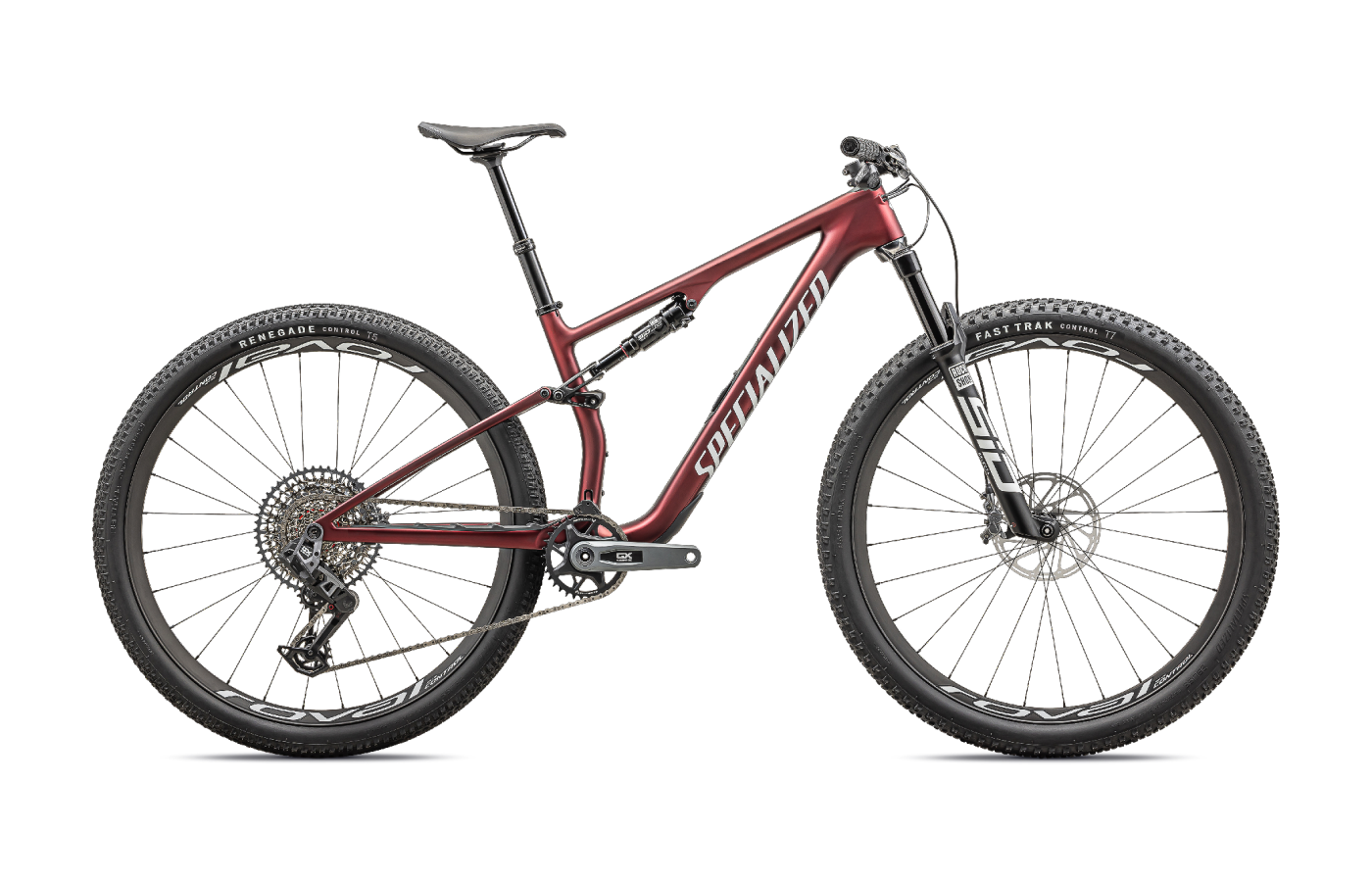
Two short-travel rigs, two budgets.
The Lux Trail is Canyon's direct-to-consumer marathon weapon. The Epic 8 is Specialized's slack, electronics-ready XC race platform — at nearly double the entry price.
Lux Trail
- Direct-to-consumer pricing — a full-carbon Fox 34 / SLX build is $3,499; Specialized doesn't sell anything close at that price.
- Lighter at the same trim — Flow's CFR test bike weighed 11.28 kg confirmed; even the Deore CF 6 lands around 12.9 kg per Pinkbike.
- Marathon-ready frame features — two full-size bottles in every size, integrated downtube tool roll, threaded BSA BB.
- 67° head angle and 115 mm rear travel hit their limit on steep, technical descents — multiple reviewers wanted it slacker.
- Through-headset cable routing complicates bearing service; MBR also reports the storage door warps and lets water in over time.
Epic
- Trail-bike descending in an XC chassis — 65.9° HTA, 328 mm BB, and the "Magic Middle" SIDLuxe tune give it the most composed downhill feel in the category.
- Full 120 mm rear travel (vs 115 mm on the Lux Trail) plus a more active kinematic — better on chunky, square-edged hits.
- Eight-build lineup with real headroom — from $4,499 alloy-wheeled Comp to $14,999 S-Works with Flight Attendant electronic damping.
- Entry price is $1,000 above the most expensive Lux Trail; the dollar-per-spec gap to Canyon is enormous.
- S-Works build has up to nine batteries to manage; SRAM Level brakes drew complaints across reviews for excess dead stroke.
Editor’s analysis
This isn't really a spec fight — it's a question of what kind of fast you want, and how much you're willing to pay to get it.
On paper the Canyon Lux Trail and Specialized Epic 8 sit in the same fashionable corner of cross-country: ~120 mm of travel, full-carbon front triangles, 29" wheels, threaded BB, internal storage. Both are pitched as the modern answer to the question "what if an XC bike could descend?" But the geometry numbers diverge sharply, and the price ladders even more so.
Canyon plays it conservative on geometry. The Lux Trail runs a 67° head angle, a 460 mm reach in size M, and 115 mm of rear travel paired to a 120 mm Fox 34 Stepcast. Reviewers describe it as urgent and "flickable" on flowing singletrack — Flow calls it a "mini trail bike," MBR makes it their go-to for unassisted speed. But the same reviewers note its limit on truly steep terrain: Pinkbike's Dario DiGiulio called the descending feel "sharp and a bit squirrelly," and MBR's tester wanted it "longer and slacker." The Lux Trail is built to cover ground, not to hammer chunder.
The Specialized Epic 8 went the opposite direction. A 65.9° head angle (low setting), a 75.5° seat angle, 120 mm front and rear, and a famously low ~328 mm bottom bracket give it a stance reviewers compared to a featherweight trail bike. The new "Magic Middle" SIDLuxe tune lets it pedal like a race bike but blow off square-edged hits without the clunkiness of the old Brain shock. It's the more capable descender of the two — and Specialized priced it accordingly.
The catch is the price chasm. The Lux Trail tops out at $3,499 in the US lineup; the Epic 8 starts at $4,499 and runs to $14,999. There is no apples-to-apples build pairing. If you treat your local trails like a race stage and want the slackest, fastest-down XC bike on the market, the Epic 8 is built for you. If you'd rather pocket the difference, fit two bottles plus a tool roll inside the frame, and ride longer instead of harder, the Lux Trail is one of the best deals in the category.
Where the builds differ.
Comparing our editor's-pick builds side-by-side. Winners highlighted row-by-row — lower price and weight, and the better-spec component, each mark a point.
Build variants & pricing
The Lux Trail spans only $200 of range across three CF builds. The Epic 8 spans more than $10,000 across eight, with no overlap at the bottom of the Specialized ladder.
Editor's picks are tier-mismatched on purpose: Canyon's top trim is Shimano SLX mechanical at $3,499, while the cheapest Epic 8 with comparable suspension lands at $6,499 with SRAM GX AXS Transmission. That $3,000 delta is the platform gap, not a build-selection artifact.
How they fit, how they steer.
Both at size M — same stack (598 mm), but the Epic is 10 mm shorter in reach (450 vs 460 mm) and 1.1° slacker at the head (65.9° vs 67°). Wheelbases land within a millimeter; chainstays are an identical 435 mm.
Which size should I buy?
Size recommendations based on stack, reach, and effective top tube. Both ranges overlap closely from S to XL; the Lux Trail extends slightly further at the small end (XS reach 412 vs 390 mm).
→These are starting points. Flexibility, riding style, and preferred position all shift the answer — if you’re between sizes, a professional fit beats a chart.
What the magazines said.
Published reviews from trusted cycling outlets. Click through for the full write-up.
Which one should you buy?
If you want the fastest, slackest, most descent-capable XC bike on the market, get the Epic 8. If you want 90% of that for half the money, get the Lux Trail.
Lux Trail
If most of your riding is long days on flowing trails — XC marathons, all-day backcountry loops, the occasional race — the Lux Trail does it for thousands less than anything Specialized sells. Two-bottle frames, integrated tool roll, and a Fox-34-equipped CF build at $3,499 add up to one of the best values in the category.
Epic
If you race XC at the pointy end, treat every group ride like a Strava hunt, and want the most capable descending geometry currently available in a 120 mm chassis — the Epic 8 is the benchmark. The slack head angle and "Magic Middle" tune buy you time on descents that older XC bikes simply couldn't hold.
Questions buyers actually ask.
Short answers to the things we get emailed about most often.
01Which is the more capable descender?
The Specialized Epic 8, by a clear margin. Its 65.9° head angle (low setting) is a full 1.1° slacker than the Lux Trail's 67°, and it sits roughly 6 mm lower at the bottom bracket — reviewers from Pinkbike, Flow, and BikeRadar all describe a "stuck to the ground" cornering feel and "outrageously good" stability at speed.
The Lux Trail is no slouch on flowing trails, but Pinkbike's Dario DiGiulio called its descending nature "sharp and a bit squirrelly," and MBR's long-term tester explicitly wanted it longer and slacker. On steep, chunky terrain the Lux Trail starts to feel tucked-under where the Epic still has room to push.
02How much rear travel do they have?
Lux Trail: 115 mm rear, 120 mm fork (Fox 34 Stepcast). MBR measured their long-term test bike at closer to 105 mm of usable travel.
Epic 8: 120 mm front and rear (RockShox SID / SIDLuxe).
Only 5 mm separates them on paper, but the Epic's longer-stroke shock and more linear leverage rate let it deal with bigger square-edged hits than the Lux Trail's spec sheet suggests it should.
03Is the Canyon really that much cheaper?
Yes — and the gap is structural, not a sale. The Lux Trail lineup tops out at $3,499 in the US (CF 7 with Shimano SLX, Fox Performance suspension, DT Swiss alloy wheels). The Epic 8 lineup starts at $4,499 for the alloy-wheeled Comp build and runs to $14,999 for the S-Works.
There is no Epic 8 build at the Lux Trail's price. If you've allocated under $4,000 for a new XC bike, Specialized doesn't have a current-generation answer in this travel bracket.
04What about frame storage and bottle mounts?
Both have downtube storage (Canyon's tool roll, Specialized's SWAT 4.0 box). Reviewers split on execution: SWAT 4.0 is praised across the board as "flush, rattle-free, well-sealed," while MBR reports the Canyon storage door slowly warps and lets water into the downtube on long-term test bikes.
The Lux Trail does score points for fitting two full-size bottles inside the front triangle on every size, which matters for marathon riders who'd rather not run a hydration pack.
05What about cockpit cable routing — is it serviceable?
Both run cables through the headset. That's a maintenance penalty on either bike: replacing headset bearings, brake hoses, or cables means partial disassembly of the front end.
Reviewers were notably harsher on the Canyon implementation. Pinkbike, Flow, and MBR all flagged it as one of the Lux Trail's biggest long-term ownership negatives. The Epic 8 gets the same critique on the S-Works model, but the Pro and Expert frames use more conventional head-tube ports — a quieter win for serviceability if you're shopping mid-tier.
06Which has the better suspension platform for climbing?
Both pedal well, but they get there differently. The Epic 8 leans on its "Magic Middle" SIDLuxe shock tune — a digressive compression mode that resists rider inputs but "pops open" on impact. Reviewers report ~20% less pedal bob than the previous Epic EVO without needing the lockout.
The Lux Trail uses a more conventional three-position FOX Float SL Performance Elite remote to firm up the rear when the trail points up. It's effective, and reviewers praise the climbing posture from the steep 76° seat angle, but the cockpit gets crowded with the lockout cable.
07Are there mid-tier alternatives I should consider?
Yes — see the alt-bike grid below. The Cannondale Scalpel uses size-specific chainstays for better balance on larger frames; the Trek Supercaliber runs only 80 mm of rear travel for a near-hardtail feel; the Rocky Mountain Element pushes geometry even further with a 130 mm fork and a 65° head angle.
If budget is the primary driver, also worth a look at YT's Izzo, which sits in the same direct-to-consumer lane as the Lux Trail at similar pricing.
08What's the warranty on each?
Both come with lifetime frame warranties to the original owner against manufacturing defects. Both also offer crash-replacement programs for damaged frames at reduced pricing. Canyon's direct-to-consumer model means warranty issues are handled by mail rather than at a local dealer — a meaningful difference if you'd rather hand the bike to a shop than ship it.
Similar bikes
If your priorities don’t map cleanly onto either of these, one of these adjacent bikes probably fits better.
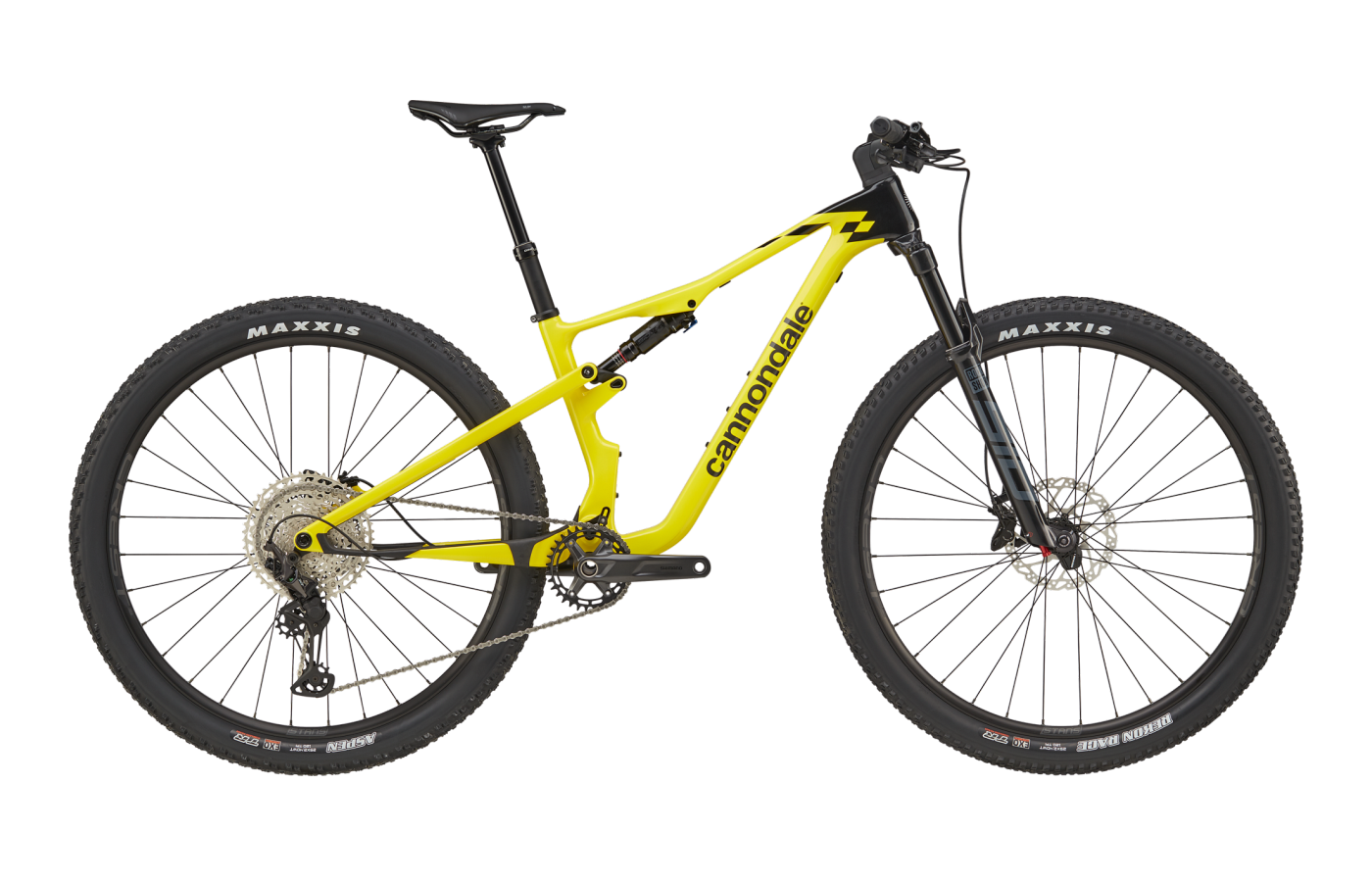
Scalpel
The Cannondale Scalpel is the direct rival that splits the difference — full-fat 120 mm XC race kinematics with size-specific chainstays that keep larger frames from feeling front-heavy the way the Epic's fixed 435 mm rear can on an XL.
Compare →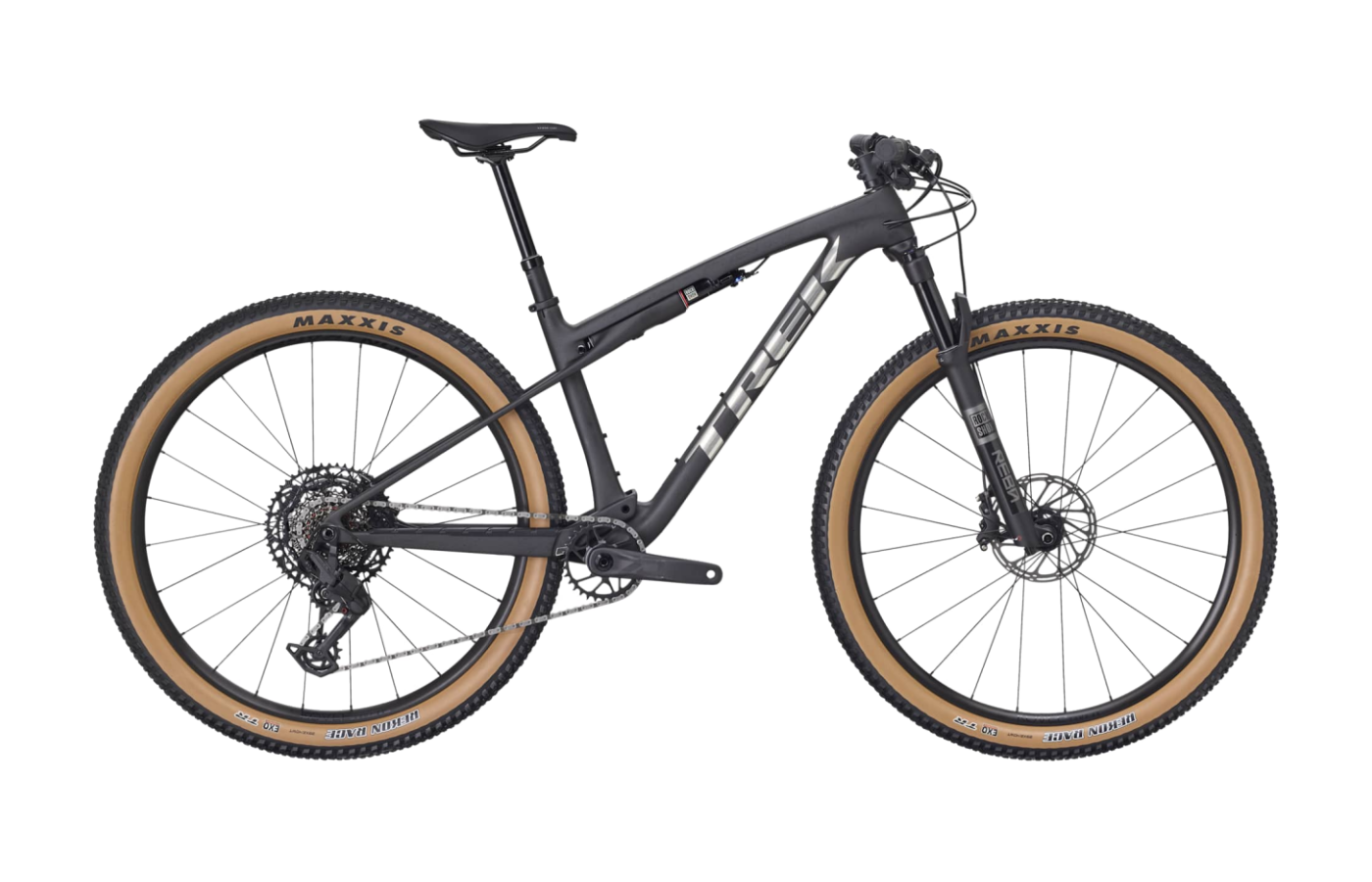
Supercaliber
The Trek Supercaliber is the purist's pick — only 80 mm of rear travel via the IsoStrut, so it rides closer to a hardtail than either of these but takes the worst edge off square hits. For racers who think 120 mm is too much.
Compare →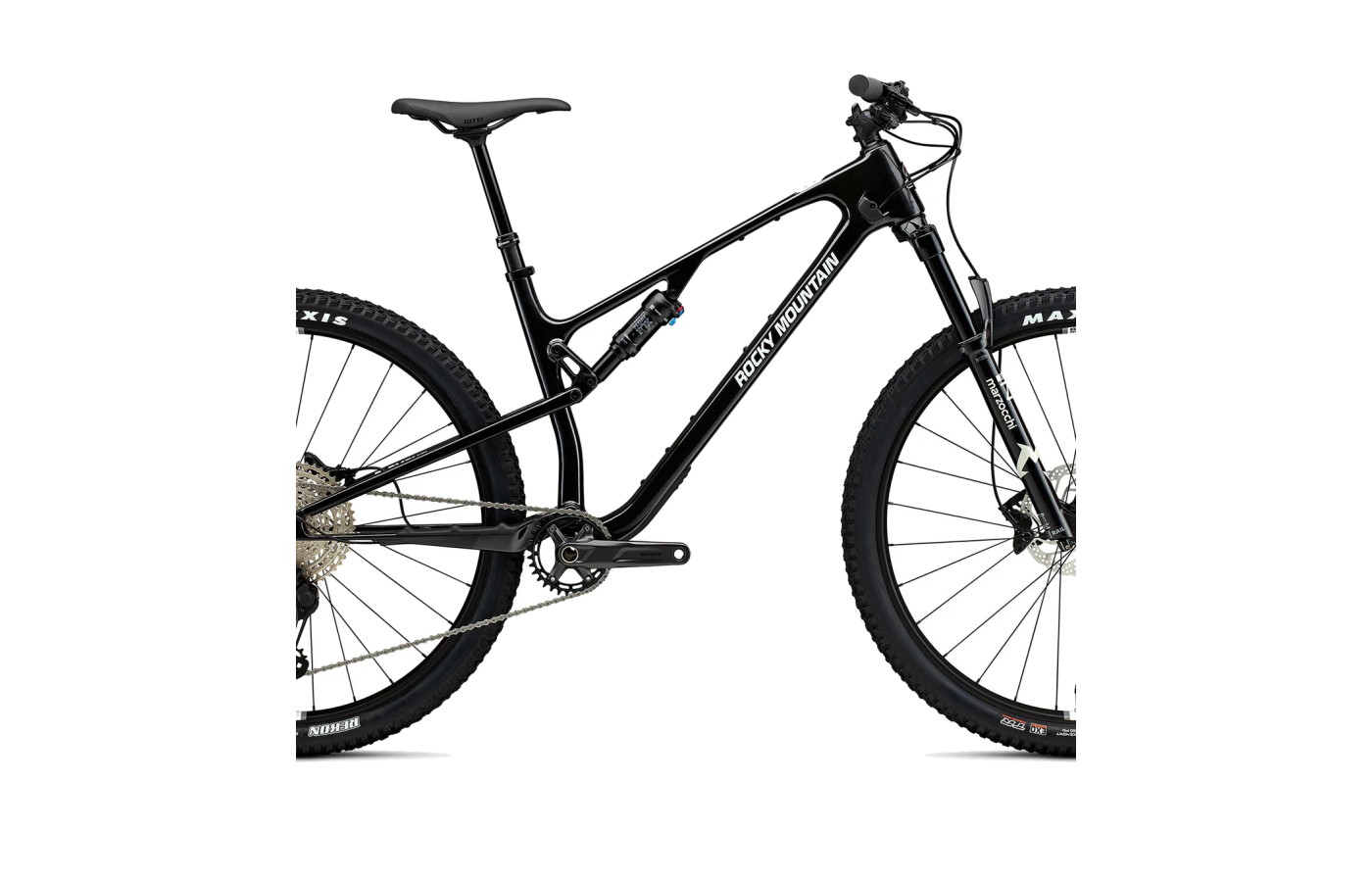
Element
The Rocky Mountain Element pushes the downcountry idea further than the Epic — 130 mm fork, 65° head angle, real trail-bike confidence on descents. Pick this if even the Epic 8's geometry doesn't feel slack enough.
Compare →