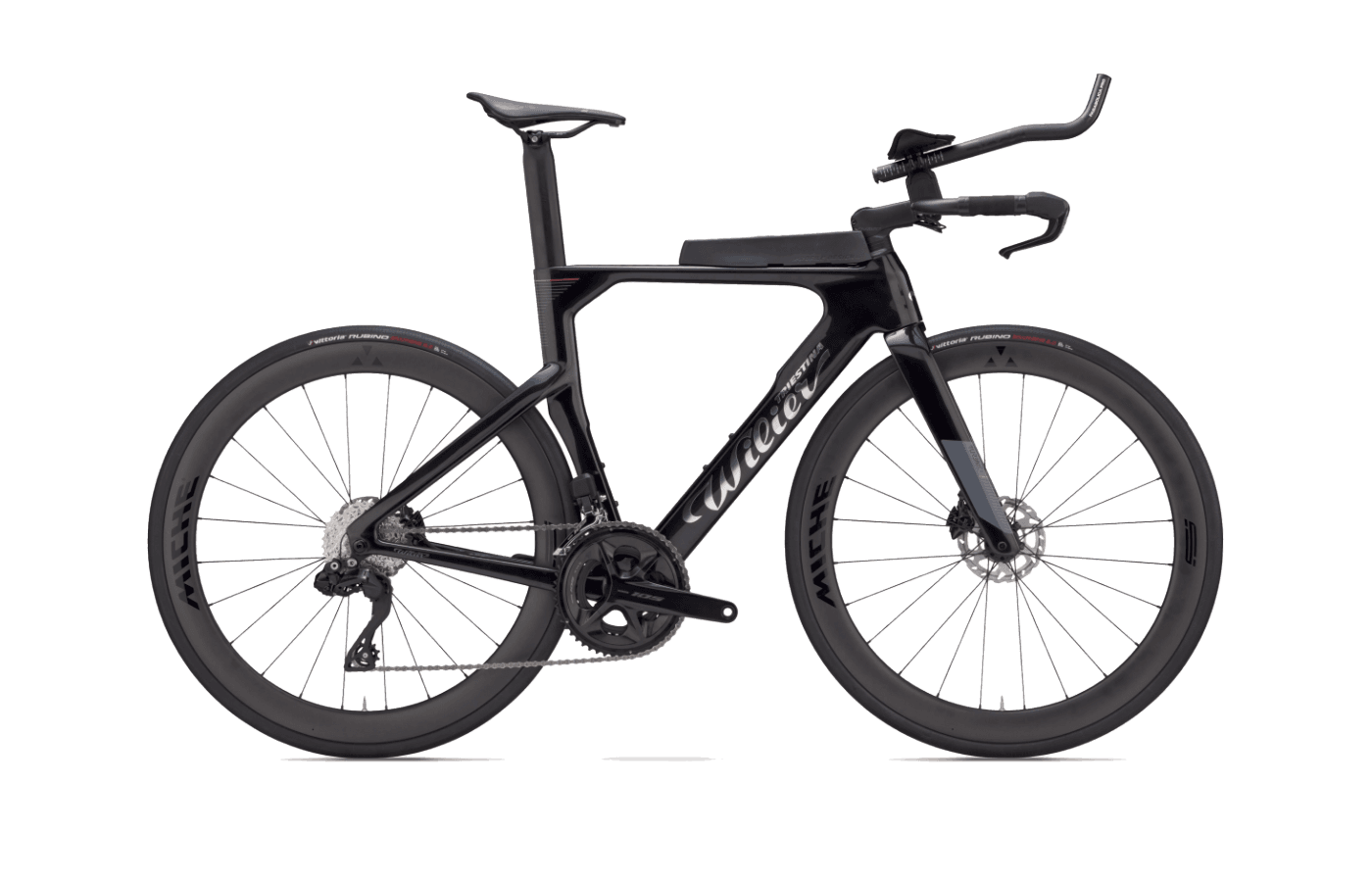
Turbine SL
The Wilier Turbine SL is Wilier’s more accessible time trial and triathlon platform, introduced for the 2026 model year as a bike that borrows from the Supersonica SLR without chasing the same level of extremity. Its emphasis is clearly on triathlon use—particularly long-distance racing—where sustainable position, fit range, and practical integration matter as much as outright aerodynamic efficiency. Rather than being built around the most aggressive UCI-driven TT constraints, the Turbine SL is designed to give riders a fast position that is easier to live with over extended hours.
The frame reflects that brief. Wilier highlights full cable integration, a broad down tube intended to manage airflow around the bottle area, and an asymmetrical fork shaped around the braking system. The fit concept is equally central: the dedicated seatpost and seat tube arrangement allow the saddle to move forward by about 2 cm relative to the bottom bracket center, reinforcing the bike’s tri-specific intent. Modern usability is also a major part of the package, with support for fully electronic drivetrains only, a front-derailleur solution that can be repositioned for 1x or 2x setups, UDH compatibility, clearance for up to 32 mm tires, and an optional Aerokit hydration system with a stated capacity of up to 1100 ml. Taken together, the Turbine SL sits in the market as a contemporary, integrated tri bike that aims to be fast without becoming needlessly difficult to fit, equip, or race.
Geometry & fit.
3 sizes published.
The published geometry supports Wilier’s claim that the Turbine SL is aimed at a more manageable triathlon fit rather than an ultra-low, highly specialized TT posture. Stack figures of 490 mm (XS/S), 522 mm (M), and 554 mm (L/XL) are paired with reaches of 385, 405, and 425 mm respectively, giving the bike a relatively tall-fronted foundation for a dedicated aero platform. That should make it easier for riders to achieve a sustainable long-course position without relying on excessive spacer height, while the adjustable cockpit preserves room to lower the front end if needed.
The front-end geometry also points toward stable handling. Head tube angles are 71 degrees on XS/S and 72 degrees on M and L/XL, which are not especially steep for this category, and wheelbases of 980 mm, 1002 mm, and 1032 mm suggest a bike intended to remain composed at speed rather than hyper-reactive. Seat tube angles from 78.5 to 80.2 degrees are firmly tri-oriented, helping riders rotate forward over the bottom bracket for an efficient aero position and smoother transition to the run. Overall, the numbers indicate a bike biased toward confidence, positional flexibility, and long-distance comfort rather than the sharpest possible steering or the lowest possible front end.
Where the handlebar sits relative to the bottom bracket — the single most important fit pair.
01Fit geometry3 values
03Handling geometry3 values
Which size should I buy?
Slide your height to see the recommended size. GearWise's fit algorithm works from the published stack, reach, and ETT — the brand's own recommendation may differ.
→Calculated from GearWise's own stack / reach / ETT algorithm — the brand's size chart may recommend a different size, and a proper bike fit beats any calculator.
The lineup.
1 build, ranging $6,490.
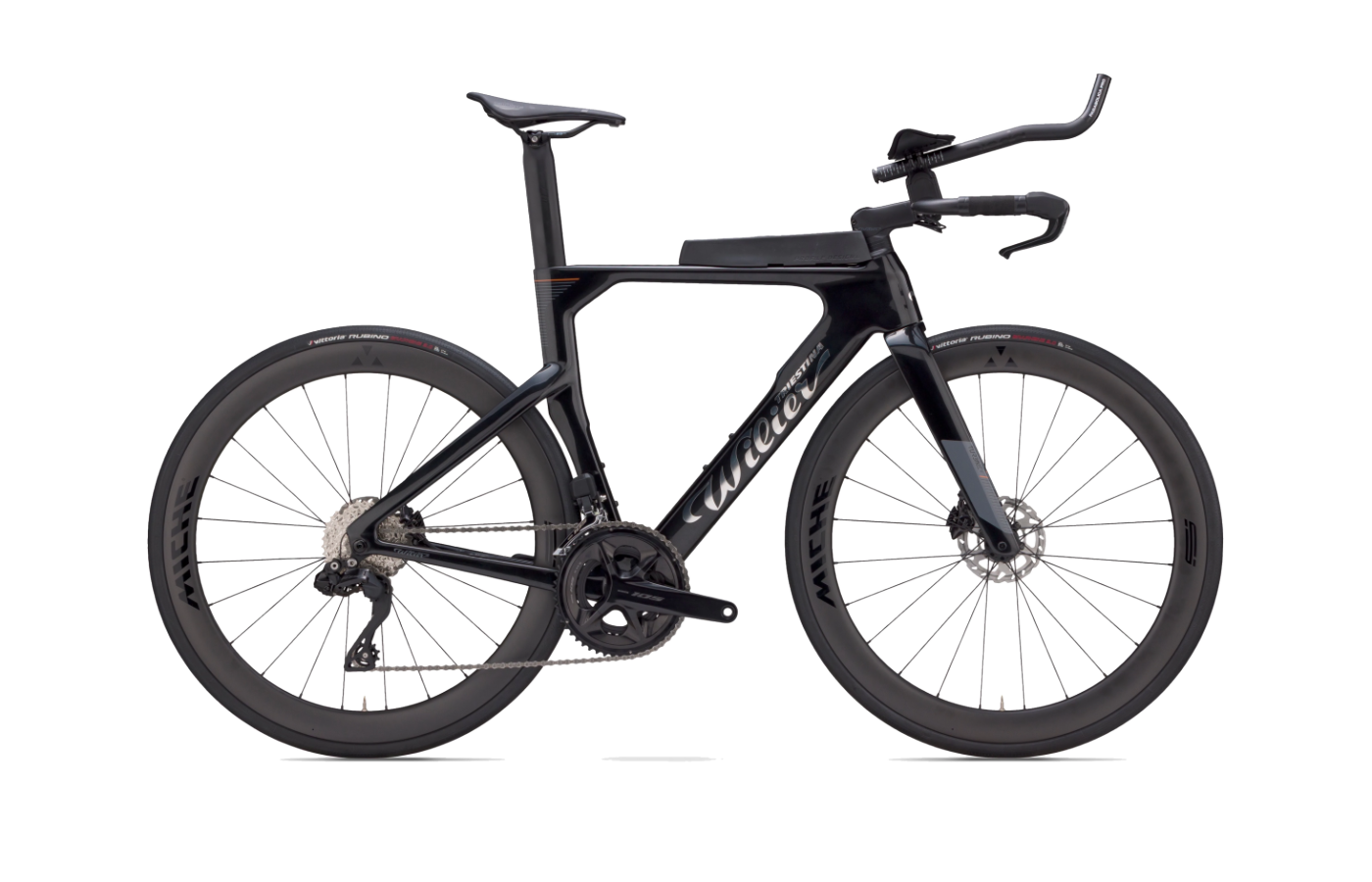
Wilier lists the Turbine SL in a single complete build: Shimano 105 Di2 2x12 R7170 with Miche S 50 Carbon wheels. That spec positions the bike as a comparatively attainable entry into a fully integrated carbon triathlon platform, while still using a modern electronic drivetrain consistent with the frame’s electronic-only design brief.
The component choices make sense for the model’s intended role. Shimano 105 Di2 gives the bike current-generation 12-speed electronic shifting and hydraulic disc braking without pushing it into flagship-level pricing territory, while the Miche S 50 Carbon wheelset aligns with the bike’s aero focus for triathlon use. With only one listed build, the value proposition is straightforward: the Turbine SL is offered as a complete, ready-to-race package centered on practical electronic performance rather than a wide spread of trim levels.