Alpe d'Huez X
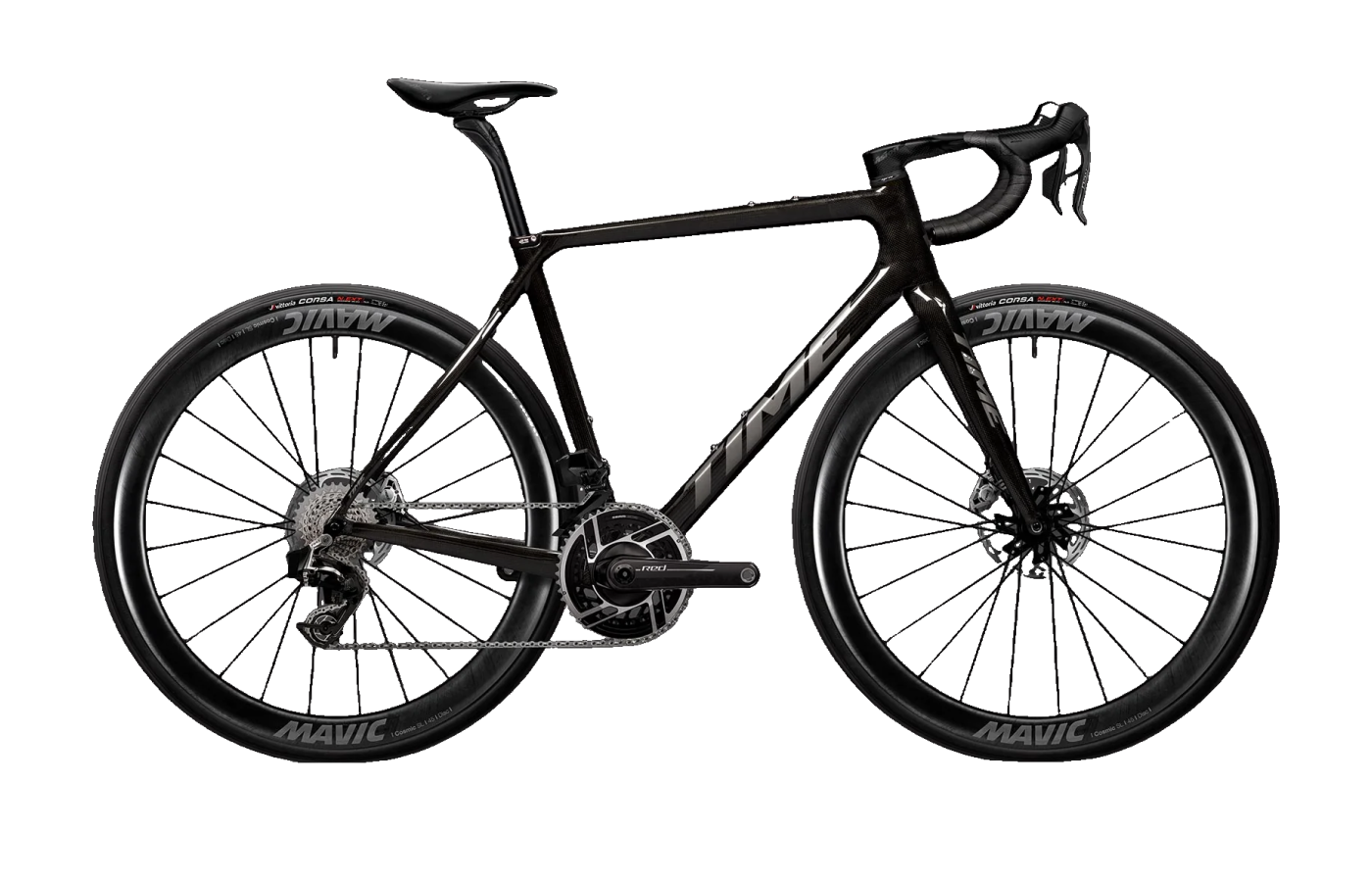
Time positions the Alpe d’Huez X as a multi-surface road bike, shifting away from the gravel-first focus of the earlier ADHX. Built around a redesigned chainstay system, the frame maintains standard road drivetrain compatibility while opening up clearance for high-volume road tires, with a sweet spot around 32 to 35mm. It utilizes Time’s signature Braided Carbon Structure and Resin Transfer Molding, sharing the premium carbon layup of the dedicated Alpe d’Huez climbing bike but tuning it for imperfect pavement.
Rather than a dedicated gravel rig, this generation is designed for riders who want the efficiency of a road race bike paired with the capability to handle rough tarmac and light dirt. Utility details like top-tube mount points and a clean one-by derailleur cover option reinforce its endurance-oriented, high-mileage intent.
Geometry & fit.
5 sizes published.
The geometry of the Alpe d’Huez X departs from traditional European climbing frames to support its endurance and multi-surface mandate. Time utilizes a longer wheelbase, extended front and rear centers, and a slightly slacker head angle. Combined with a lower bottom bracket, these dimensions create a highly stable platform that tracks predictably through high-speed, sweeping descents.
This longer footprint shifts the rider’s weight distribution and handling dynamics away from twitchy, low-speed agility and toward steady-state cruising. The fit is less aggressive than a pure race bike, promoting a posture that is comfortable for long alpine days rather than rotating the rider sharply forward over the bottom bracket. At the front end, the cockpit relies on a Deda DCR-compatible headset system. This allows riders to choose between semi-integrated routing for easier maintenance or a fully integrated setup for a cleaner aesthetic, depending on their preferred stem and handlebar combination.
Where the handlebar sits relative to the bottom bracket — the single most important fit pair.
01Fit geometry6 values
03Handling geometry8 values
Which size should I buy?
Slide your height to see the recommended size. GearWise's fit algorithm works from the published stack, reach, and ETT — the brand's own recommendation may differ.
→Calculated from GearWise's own stack / reach / ETT algorithm — the brand's size chart may recommend a different size, and a proper bike fit beats any calculator.
The lineup.
4 builds, ranging $8,169 – $10,139.
The build ladder for the Alpe d’Huez X is tightly focused on premium electronic groupsets, spanning from Shimano Ultegra Di2 and SRAM Force AXS up to Dura-Ace Di2 and SRAM Red AXS. Pricing ranges from roughly $8,100 to over $10,100, reflecting the boutique nature of Time’s European frame manufacturing rather than aggressive component value.
Across all four builds, the foundational equipment remains remarkably consistent. Every model is specified with 32mm Vittoria Corsa N.EXT tires, underscoring the frame’s optimization for high-volume road rubber. The Force and Ultegra builds roll on Vision SC45 carbon disc wheelsets and utilize FSA and Vision cockpit components. Moving up to the Red and Dura-Ace tiers introduces a choice of premium wheelsets from Mavic or Vision, alongside upgraded saddles and lighter carbon seatposts. The gearing across the board leans toward versatile road ratios, with the SRAM builds utilizing 48/35 chainrings paired with 10-33 cassettes, while the Shimano options feature 52/36 cranksets and wide-range cassettes to manage steep, sustained gradients.


From the press.
1 review from the cycling press.
Reviewers characterize the Alpe d’Huez X as a highly stable, endurance-leaning machine that prioritizes vibration damping over aggressive acceleration. On rough tarmac and pitted mountain descents, the frame excels at filtering out high-frequency chatter. Testers note that the bike delivers a "reassuringly smooth ride" (YouTube) that leaves riders feeling fresh after long days in the saddle. When navigating broken pavement or bunny-hopping debris, the chassis remains "perfectly composed" (YouTube), tracking predictably without the nervous energy of a dedicated lightweight climber.
The primary tradeoff for this stability is a muted response during explosive efforts. The bike acts more as a "friendly companion" (YouTube) that encourages a steady, seated cadence rather than goading the rider into high-heart-rate attacks. When standing up to sprint or muscle up a steep gradient, the handling can feel slightly "clumsy" (YouTube) compared to sharper, race-focused alternatives. Ultimately, the consensus points to a sophisticated, fatigue-reducing platform that rewards a consistent cruising attitude over out-of-the-saddle agility.