Ridley
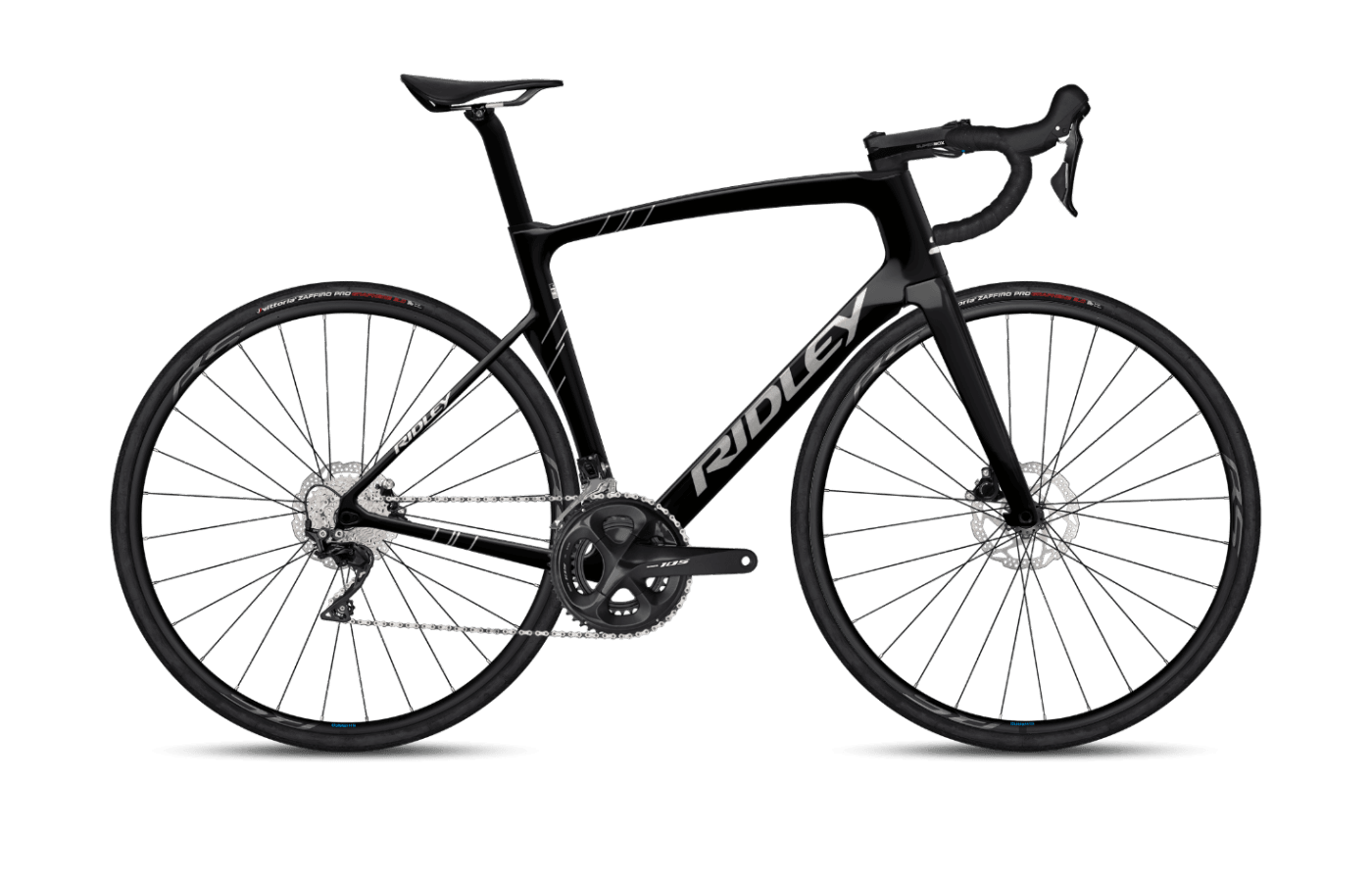
Noah DiscShimano 105 – 2x12
The 2025-on Ridley Noah 3.0 is a full reset of Ridley’s aero road platform rather than a light update to the previous Noah Disc. It is built around the current UCI tube-shape rules, particularly the 8:1 aspect-ratio allowance, and Ridley has used that freedom to move toward longer, narrower aerodynamic sections in key areas such as the fork and seatstays. That places the Noah 3.0 squarely in the modern aero-race category: a bike intended first for speed on fast road races, breakaways, and high-speed solo riding, but designed with current pro-level tire and setup trends in mind rather than older narrow-tire aero assumptions.
What distinguishes this generation is that it combines an aggressive race brief with noticeably broader practicality. Ridley says the geometry is more progressive, with a steeper seat angle, lower bottom bracket, and lower head tube aimed at supporting a more committed aero position. At the same time, the frame clears 34 mm actual tires, which is a significant capability increase for a dedicated aero road bike and makes the Noah 3.0 more viable for rough pavement and cobbled racing than many earlier aero platforms. UDH compatibility and the split positioning versus the Noah Fast 3.0 also matter: the Noah 3.0 keeps the same general geometry and intent, but offers more front-end configurability through either a conventional bar-and-stem setup or an integrated cockpit depending on build. In market terms, it sits as Ridley’s versatile aero race frame for riders who want top-end speed without being locked into a single proprietary cockpit concept.
Spec sheet.
Every component shipped with this build.
Geometry & fit.
6 sizes published.
The Noah 3.0’s geometry is clearly race-oriented, but the numbers show that Ridley has tuned it for modern high-speed stability rather than old-school twitchiness. In size M, the bike has a 565 mm stack and 393 mm reach, paired with a 73.5-degree head tube angle, 73-degree seat tube angle, 405 mm chainstays, a 987 mm wheelbase, and 66 mm of bottom-bracket drop. Those figures point to a low, performance-focused front end with relatively compact rear-center dimensions, while the moderate wheelbase and lower BB help keep the bike planted at speed. Larger sizes get slightly steeper front-end geometry and a 63 mm BB drop, while smaller sizes relax the head angle to 72 degrees in XS and 71.5 degrees in XXS to preserve predictable handling with smaller front wheels and shorter front centers.
The fit pattern also reflects Ridley’s stated push toward aggressive positioning. Stack stays fairly low across the range, from 493 mm in XXS to 616 mm in XL, while reach grows more conservatively from 375 mm to 409 mm. Seat tube angle steepens as sizes get smaller, from 72.5 degrees in L and XL to 74.5 degrees in XXS, which helps keep smaller riders centered over the pedals instead of too far behind the bottom bracket. Combined with 405-408 mm chainstays and wheelbases from 969 mm to 1017 mm, the result should be a bike that feels direct and efficient under power, but less nervous than older aero bikes thanks to the lower bottom bracket and geometry choices aimed at stability.
Where the handlebar sits relative to the bottom bracket — the single most important fit pair.
01Fit geometry6 values
03Handling geometry5 values
Which size should I buy?
Slide your height to see the recommended size. GearWise's fit algorithm works from the published stack, reach, and ETT — the brand's own recommendation may differ.
→Calculated from GearWise's own stack / reach / ETT algorithm — the brand's size chart may recommend a different size, and a proper bike fit beats any calculator.
The lineup.
7 builds.
Ridley offers the Noah Disc 3.0 across a broad spread of drivetrain configurations, from mechanical Shimano 105 2x11 and 105 2x12 builds up through electronic Shimano 105 Di2 2x12, Shimano Ultegra 2x11, and SRAM Rival AXS Road 2x12 with a 48/35 chainset. That range suggests a deliberate attempt to make the same aero platform available at multiple price and equipment levels rather than reserving it only for premium electronic builds. Riders prioritizing straightforward value are likely to gravitate toward the 105-equipped options, while the Di2 and AXS builds target buyers who want cleaner shifting under race use and a more current electronic setup.
The more unusual part of the lineup is the inclusion of Classified-equipped 1x12 builds, including Classified SRAM Rival AXS 1x12 Powershift and Classified Rival AXS 1x12. Those versions position the Noah 3.0 not just as a conventional aero road race bike, but as a platform open to alternative high-speed drivetrain concepts aimed at aerodynamic simplicity and racing efficiency. Without pricing or full wheel/component details, it is not possible to rank the builds precisely on value, but the spread itself is notable: Ridley is offering both mainstream 2x mechanical/electronic options and more experimental 1x Classified configurations on the same frame.