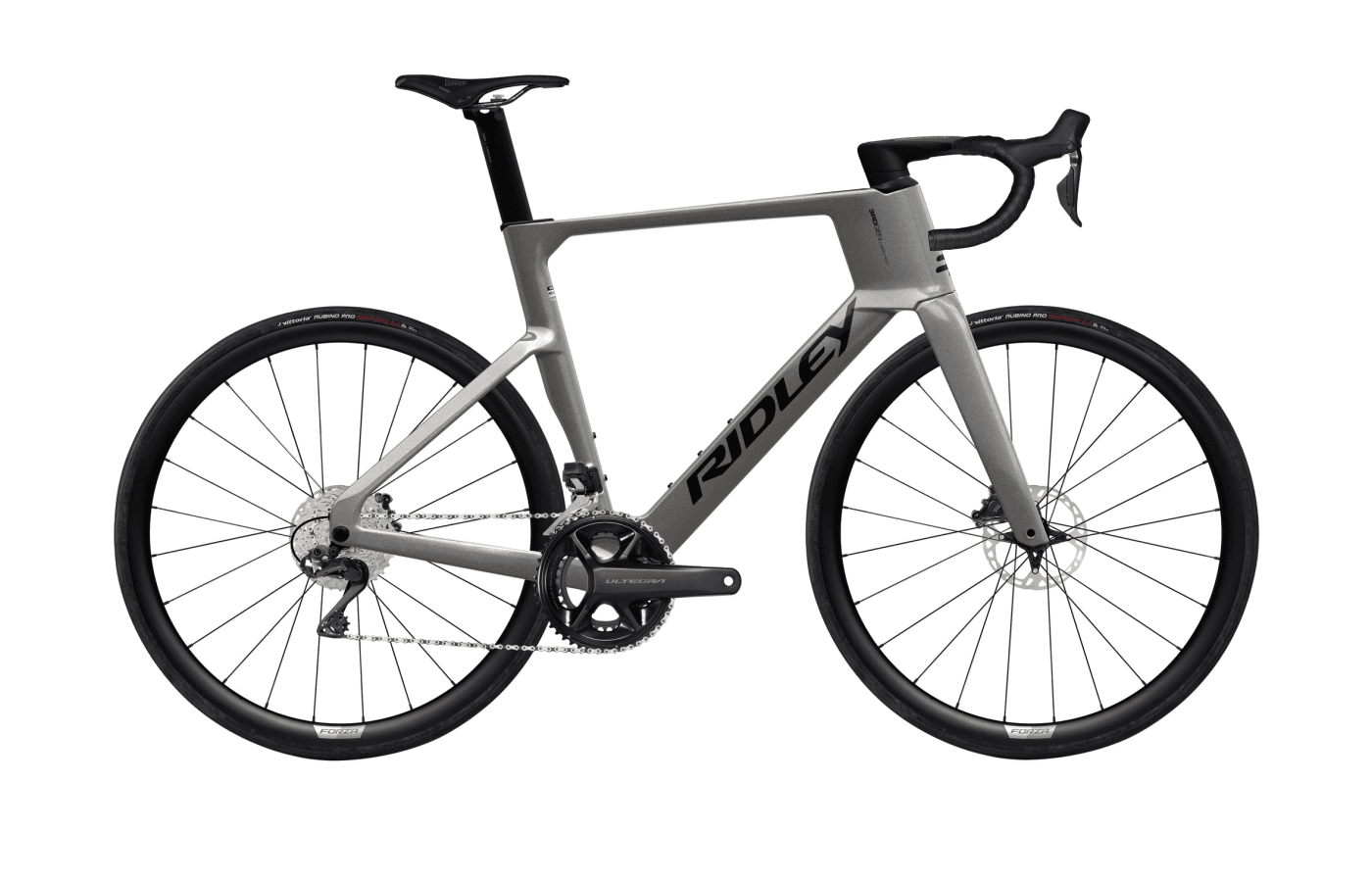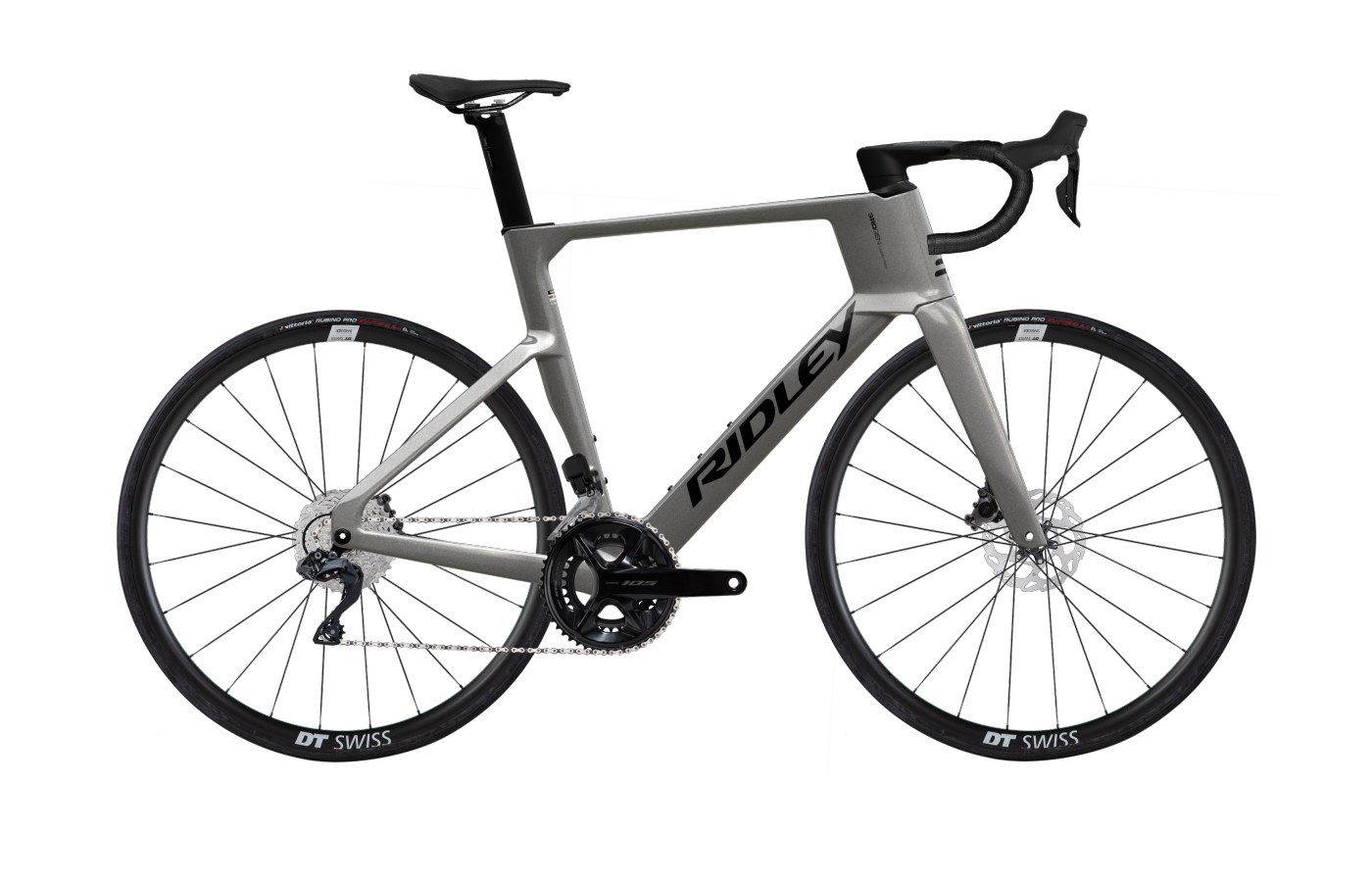
Ridley
Noah 3.0Shimano 105 - 2x12 -
The third-generation Ridley Noah is Ridley’s more accessible aero road race platform, positioned beneath the Noah Fast but intentionally retaining the same geometry and overall handling character. Rather than softening the concept, Ridley has kept the bike focused on outright speed: the frame is built around the latest UCI tube-shape rules, with notably elongated profiles at the fork and seatstays, and uses a lower-cost carbon lay-up to broaden access to the platform. The Noah 3.0 also differs from the Noah Fast in practical ways, allowing either a conventional stem-and-bar setup or an integrated cockpit, and preserving compatibility with mechanical shifting.
That makes this generation distinctive in the current aero-road market. It is still a race-first bike, with what Ridley describes as a progressive geometry built around a steeper seat angle, lower bottom bracket, and lower front end for aggressive positioning, but it avoids some of the proprietary constraints common in flagship aero bikes. At the same time, it reflects current performance-bike expectations with 34 mm tire clearance and a SRAM UDH rear derailleur hanger. The result is an aero road bike aimed at riders who want modern race-bike speed and fit without being forced into the most expensive or most integrated version of the concept.
Spec sheet.
Every component shipped with this build.
Geometry & fit.
4 sizes published.
The Noah 3.0’s geometry is clearly race-oriented. Across the size range, reach is relatively long for an aero road bike at 392 mm in XS, 403 mm in S, 412 mm in M, and 420 mm in L, while stack stays controlled at 532, 549, 570, and 594 mm respectively. Combined with the bike’s lower-front-end design brief, those numbers point to a stretched, aerodynamic riding position rather than an endurance-biased fit. The seat tube angle is also notably steep, ranging from 76.0 degrees in XS to 74.5 degrees in L, which helps keep riders centered and forward over the pedals in a race posture.
Handling numbers support that same intent. Chainstays are short at 407 mm across all sizes, and wheelbase remains compact at 995 mm in XS up to 1023 mm in L, both of which generally contribute to quick acceleration and responsive direction changes. Head tube angle varies from 72.0 degrees in XS to 73.5 degrees in M and L, a typical progression that calms front-end behavior on smaller sizes while preserving sharper steering on mid and large frames. A 70 mm BB drop on most sizes, with 72 mm on XS, lowers the center of gravity for a planted feel in high-speed cornering, which suits the bike’s aero-race brief.
Where the handlebar sits relative to the bottom bracket — the single most important fit pair.
01Fit geometry6 values
03Handling geometry5 values
Which size should I buy?
Slide your height to see the recommended size. GearWise's fit algorithm works from the published stack, reach, and ETT — the brand's own recommendation may differ.
→Calculated from GearWise's own stack / reach / ETT algorithm — the brand's size chart may recommend a different size, and a proper bike fit beats any calculator.
The lineup.
8 builds.
Ridley offers the Noah 3.0 in a wide spread of builds, from a Shimano 105 2x12 mechanical bike up through Shimano 105 Di2, Ultegra Di2, Dura-Ace Di2, SRAM Rival AXS, and SRAM Force AXS. That range is notable because it spans both electronic and mechanical drivetrains, something increasingly uncommon on aero road frames. It reinforces the Noah 3.0’s role as the more flexible alternative to the Noah Fast, especially for riders who want the same geometry and general platform without being locked into a top-tier electronic-only setup.
The lineup also includes more unusual configurations built around Classified and SRAM Rival AXS 1x12, including a Powershift option. Those builds broaden the Noah’s appeal beyond a conventional 2x aero race bike and give riders access to a cleaner, simpler drivetrain approach if that suits their riding. Without price data, the clearest value story is structural rather than numerical: the Noah 3.0 gives buyers access to Ridley’s current aero-race chassis concept across a much wider spec spectrum than many direct competitors.