Ridley
Ignite GTXSram Rival 1x11sp
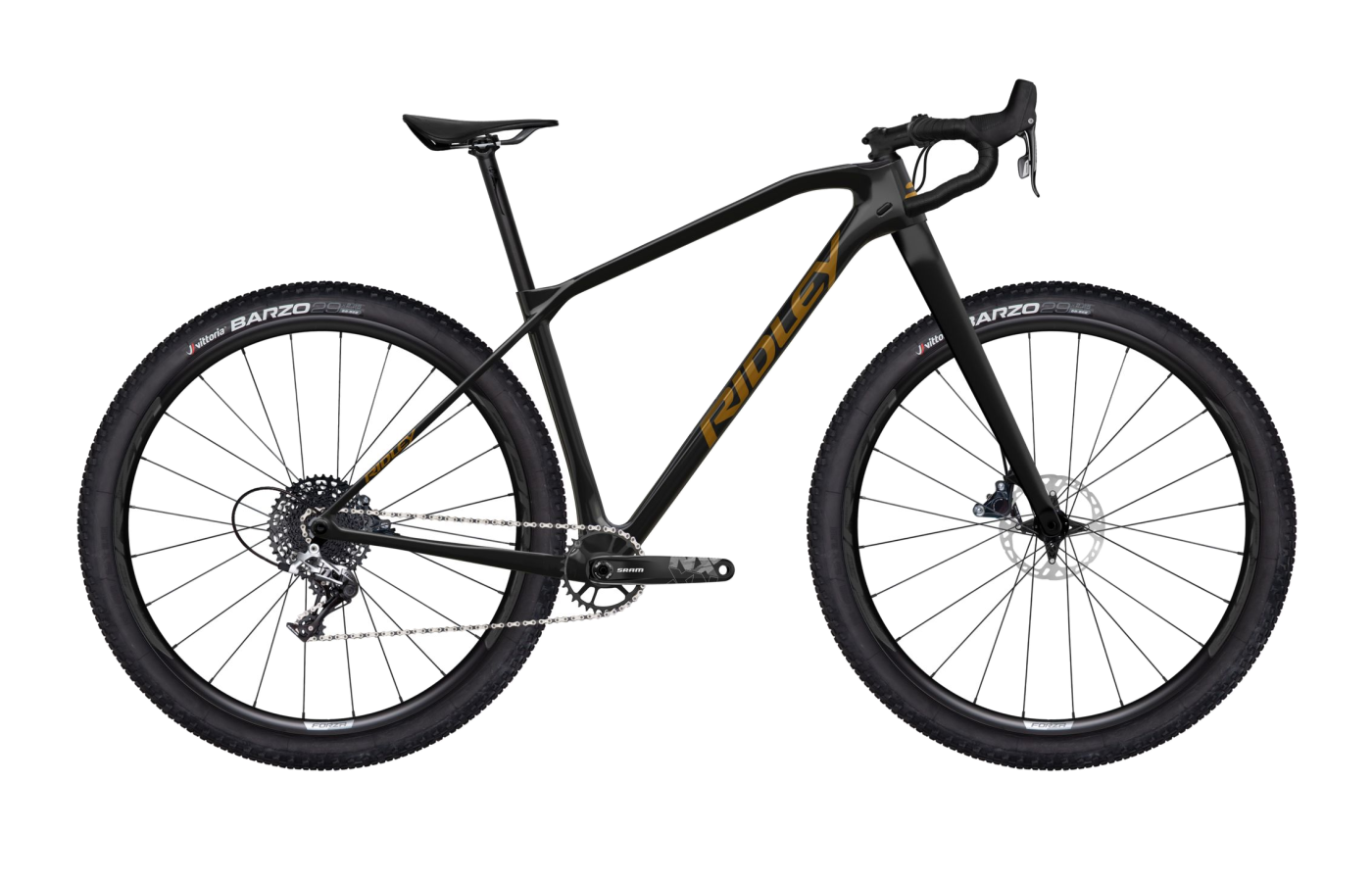
The Ridley Ignite GTX is not a conventional gravel bike with slightly bigger tires; it is a drop-bar off-road platform built directly from Ridley’s hardtail MTB thinking. Introduced for 2025 as an “alpine gravel bike,” it takes cues from the Ignite SLX mountain bike rather than from Ridley’s existing gravel range, with a 70-degree head angle, clearance for up to 29 x 2.3in tires, and the option of either a rigid carbon fork or a full 100mm MTB suspension fork. That combination places it in the growing “monster gravel” category: bikes intended for riders who want drop bars but regularly ride terrain that would overwhelm most gravel race bikes.
What makes this generation distinctive is how unapologetically MTB-based it is. The long front end, large-volume 29er tires, flex-stay rear triangle, and MTB fork-length compatibility all point to stability, traction, and impact management over rough ground rather than low weight or road-like speed. It is aimed at ultra-distance events, rough backcountry routes, and technical mixed-surface riding where control matters more than aerodynamic efficiency. In the market, it sits between aggressive gravel bikes and XC hardtails: more capable than the former on broken descents and singletrack, but still oriented around drop-bar hand positions and long-distance pacing.
Spec sheet.
Every component shipped with this build.
Geometry & fit.
4 sizes published.
The Ignite GTX’s geometry is notably more MTB-derived than most gravel bikes. Across the size range, the head tube angle is a slack 70 degrees, chainstays are a consistent 430mm, and wheelbase stretches from 1080mm in size S to 1152mm in XL. In size M, the bike pairs a 614mm stack with a 418mm reach; size L moves to 623mm stack and 440mm reach. Those numbers point to a tall front end and long overall chassis, which typically translate to a more upright fit, strong straight-line stability, and calmer steering on rough descents.
The 58mm BB drop is relatively modest for a gravel bike, effectively keeping the bottom bracket a bit higher off the ground than many lower-slung gravel race models. That should help with pedal clearance in rutted tracks and on singletrack, though it can slightly raise the rider’s center of gravity compared with road-biased gravel bikes. Combined with the 73.5-degree seat tube angle and long wheelbase, the result should be a fit and handling profile centered on control and confidence rather than quick, nervous responses. Riders looking for sharp road manners may find it overbuilt geometrically, but for rough gravel, technical doubletrack, and loaded off-road riding, the numbers support the bike’s intended use.
Where the handlebar sits relative to the bottom bracket — the single most important fit pair.
01Fit geometry5 values
03Handling geometry5 values
Which size should I buy?
Slide your height to see the recommended size. GearWise's fit algorithm works from the published stack, reach, and ETT — the brand's own recommendation may differ.
→Calculated from GearWise's own stack / reach / ETT algorithm — the brand's size chart may recommend a different size, and a proper bike fit beats any calculator.
The lineup.
4 builds.
The available range appears to center on four SRAM-based builds: Rival 1x11, Rival 1x11 with suspension fork, Apex 1x11 with suspension fork, and Apex 1x11 HDB. Even from that limited build list, the key distinction is clear: buyers can choose between more traditional rigid-fork execution and a more aggressive suspension-fork setup that leans fully into the bike’s monster-gravel brief. The Rival builds should appeal to riders wanting a higher-spec drivetrain, while the Apex options provide a more accessible entry into the platform.
Review coverage also indicates that suspension is a major differentiator in how the bike is experienced. Ridersbike specifically frames the 100mm fork as central to the Ignite GTX’s rough-terrain capability, making the suspension-equipped versions the more distinctive option in the lineup. At the same time, the YouTube test suggests even a lower-tier Apex-equipped bike remains fundamentally effective, with no major complaints about braking or shifting. In practical terms, the build range seems less about changing the bike’s identity and more about deciding how far toward technical-terrain capability, and how far up the component ladder, a rider wants to go.


From the press.
2 reviews from the cycling press.
Reviewers consistently describe the Ignite GTX as a genuine “monster gravel” bike rather than a stretched gravel bike with token off-road features. Ridersbike highlights the core formula clearly: mountain bike geometry, a 70-degree head angle, and a 100mm fork that make it notably more capable on rugged, high-speed descents than typical gravel bikes. The French YouTube review reaches a similar conclusion from on-trail experience, saying the bike feels very comfortable once adapted to and praising its stability, grip, and control when fitted with high-volume Schwalbe 2.5in tires. Across both reviews, the recurring strengths are composure on rough terrain, descending confidence, and a more relaxed, less fatiguing ride position for long-distance off-road use.
The same MTB influence also defines the bike’s limitations. The YouTube reviewer notes that the high, comfort-oriented position takes some adjustment and implies that the bike is best understood as a niche tool for riders who specifically want drop bars on very rough terrain. Ridersbike presents it as a bridge between categories, but also notes concerns around Ridley’s support and availability in the US, with reports of dead links and unresponsive customer service. So while reviewers are positive about the concept and ride quality, the bike is presented as a specialized, highly terrain-focused platform rather than a universal gravel option.