Storm
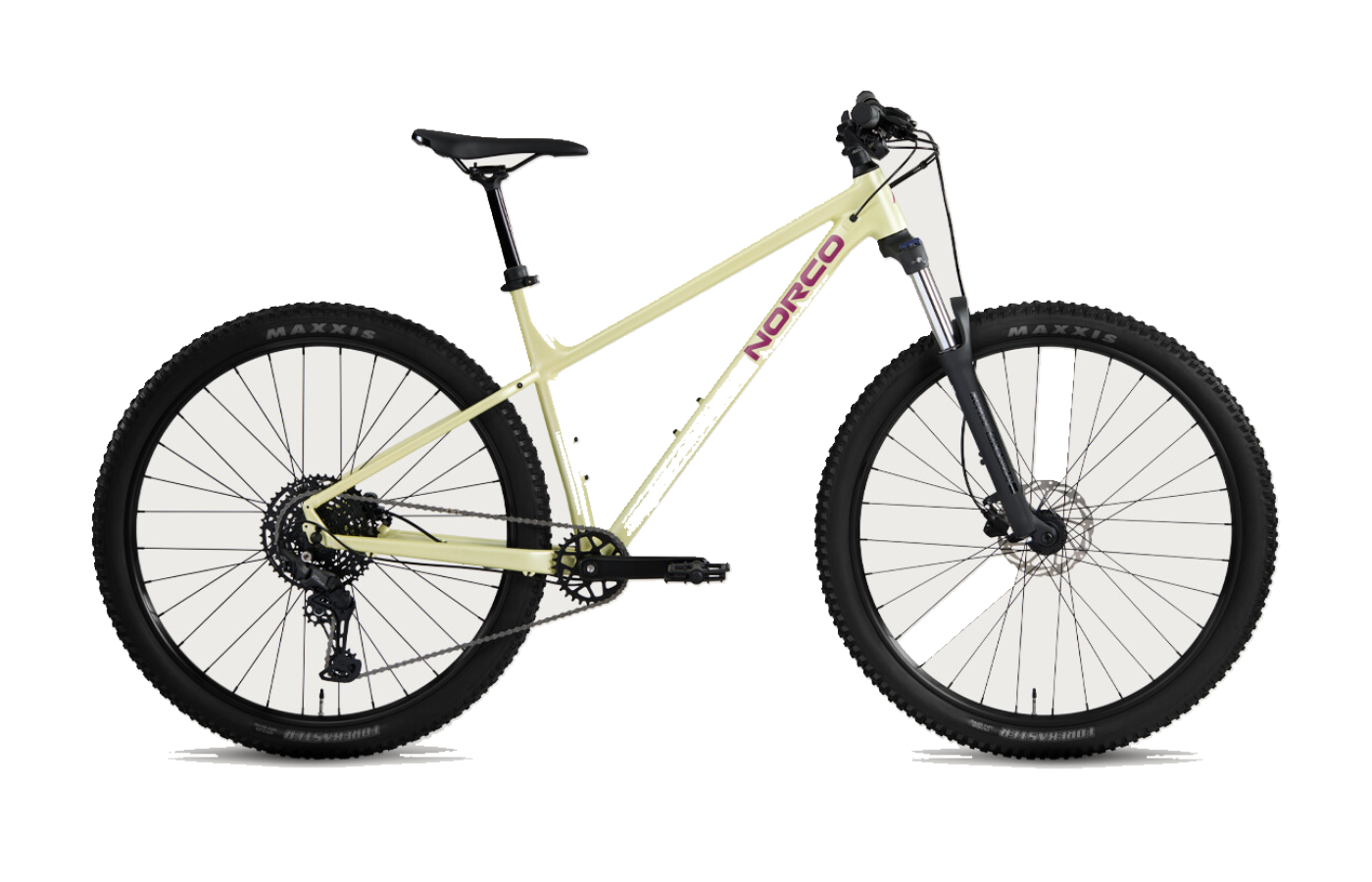
The 2025-present Norco Storm generation marks a clear shift away from older entry-level cross-country hardtail conventions and toward a more contemporary trail-oriented layout. Norco slackened the front end to a 67° head angle, steepened the seat angle to roughly 75°, shortened the stem to 50mm, and trimmed rear-center length to figures such as 440mm on the 29er sizes. Taken together, those changes point to a bike aimed at newer trail riders who want a hardtail that feels more stable on descents and more centered over the pedals on climbs, rather than a nervous, steep-fronted bike built mainly around path riding or basic XC use.
This generation is also notable for its frame details. Norco specifies a tapered headset standard, IS42/28.6 | IS52/40, and wider recommended tire widths of 2.35in to 2.6in, both of which reinforce the move toward more capable trail use. At the same time, the frame keeps a 9x135mm QR rear hub interface rather than moving to a thru-axle or Boost spacing, which places the Storm in a more budget-conscious part of the market. An unusual detail at this price level is that the Storm 100 and Storm 120 do not share the same frame, suggesting Norco treated this refresh as more than a simple parts update.
Geometry & fit.
2 sizes published.
The available geometry shows a hardtail with notably modern entry-level trail proportions. Across the size range, the head angle is a consistent 67°, which is substantially slacker than traditional budget hardtails and should give the Storm calmer steering and more confidence on steeper descents. The seat angle steepens from 74.5° on the 27.5in size to 75.5° on the largest 29er, helping keep the rider's weight centered for seated climbing. Reach grows from 410mm on the smallest size to 530mm on the largest, while stack runs from 608mm to 655mm, indicating a roomy front center and an upright enough cockpit for less experienced riders.
Rear-center numbers are short without being extreme: 430mm on the 27.5in size and 440mm on the 29er sizes. Combined with wheelbases from 1129mm to 1273mm, that should produce a bike that is stable and predictable rather than especially quick-turning. The 29er sizes also carry 52mm of BB drop and 108mm of trail, both figures that support planted handling. Overall, the fit and geometry suggest a hardtail intended to be easy to position on, secure at speed, and more capable on real trail terrain than older value-focused designs.
Where the handlebar sits relative to the bottom bracket — the single most important fit pair.
01Fit geometry6 values
03Handling geometry8 values
Which size should I buy?
Slide your height to see the recommended size. GearWise's fit algorithm works from the published stack, reach, and ETT — the brand's own recommendation may differ.
→Calculated from GearWise's own stack / reach / ETT algorithm — the brand's size chart may recommend a different size, and a proper bike fit beats any calculator.
The lineup.
1 build, ranging $949.
Only the Storm 120 build is listed in the provided data, so there is not enough information here for a meaningful comparison of complete-bike options, pricing, or component differences across the range. What can be said is that the model sits within a generation defined by updated frame standards such as a tapered headset and wider recommended tire fitment, while still using a 9x135mm QR rear end that signals a more cost-conscious specification approach.
Without additional build-level details such as drivetrain, fork, brakes, wheels, or MSRP, a fuller builds and specs overview would be speculative.
